
DIY Hydroponic Nutrient Solution: Mix Your Own at Home
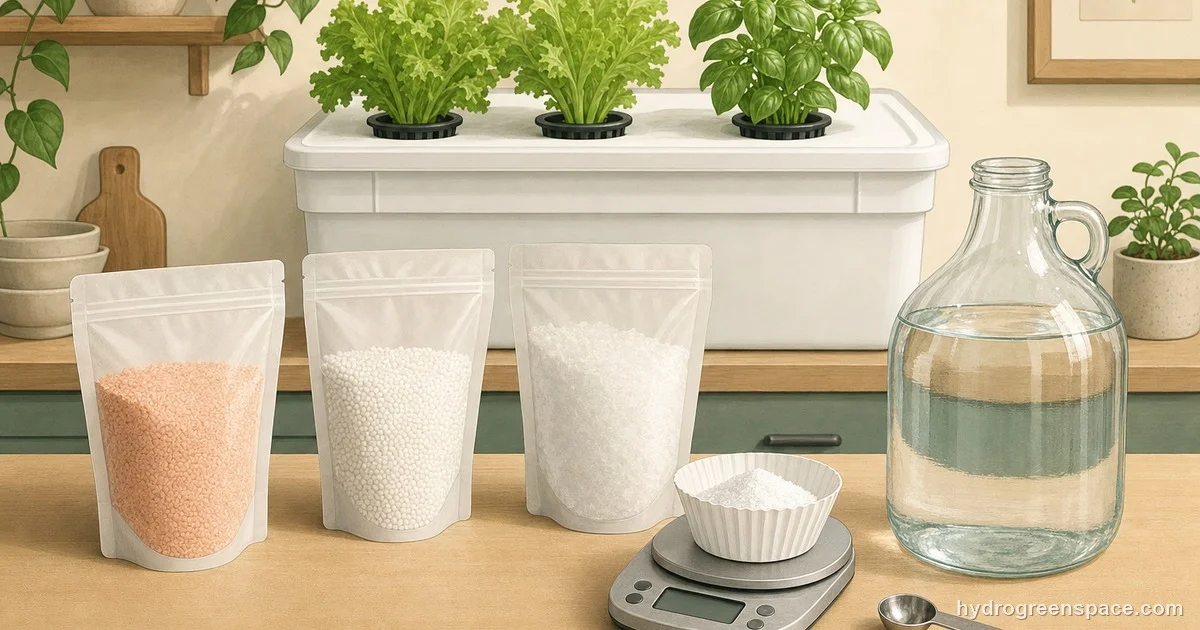
You want to feed a hydroponic system without paying for bottles of brand-name concentrate every month. Good news: a complete nutrient solution is three dry salts and a cheap kitchen scale.
Per gallon of water: 2.4 g of a 4-18-38 hydroponic base, 2.4 g of calcium nitrate and 1.5 g of Epsom salt. Dissolve each one separately, check the strength with an EC meter, then bring the pH to 5.5 to 6.0. That’s the whole recipe.
There’s one way to wreck it, and it happens before the solution ever reaches a plant: letting calcium nitrate meet the other two salts while they’re concentrated. Get the order right and the rest is weighing powder.
DIY nutrient solution at a glance
| What | Per gallon (3.8 L) | Per 5 gallons (19 L) |
|---|---|---|
| 4-18-38 hydroponic base | 2.4 g | 12 g |
| Calcium nitrate (15.5-0-0) | 2.4 g | 12 g |
| Epsom salt (magnesium sulfate) | 1.5 g | 7.4 g |
| Target pH | 5.5 to 6.0 | 5.5 to 6.0 |
| Target EC, lettuce | 1.2 to 1.8 mS/cm | 1.2 to 1.8 mS/cm |
| Target EC, tomatoes | 2.0 to 4.0 mS/cm | 2.0 to 4.0 mS/cm |
Amounts from the Masterblend 4-18-38 label (63 g, 63 g and 39 g per 100 liters), converted to US gallons. pH from Cornell’s hydroponic lettuce program, EC ranges from Oklahoma State University Extension.
Why three bags instead of one?
Because the most important ingredient can’t share a bag with the others.
Plants need a long list of elements from the water: nitrogen, phosphorus and potassium in bulk, calcium and magnesium in decent amounts, and a pinch of iron, manganese, zinc, boron, copper and molybdenum. A hydroponic base like 4-18-38 carries nearly all of it. Look at the guaranteed analysis on the label and you’ll find chelated iron, the trace metals and a little magnesium. What you won’t find is calcium.
That’s on purpose. Calcium reacts with phosphate and sulfate. Put them together in a strong concentrate and the calcium drops out as a white solid your plants can’t use. So the calcium comes in its own bag, as calcium nitrate, which also adds most of the nitrogen. Epsom salt tops up magnesium and sulfur. Commercial growers do the same thing: Penn State Extension describes greenhouses running a 4-18-38 tomato base supplemented with calcium nitrate and magnesium sulfate, with calcium kept in a different tank from phosphates and sulfates.
So does the three-salt recipe hold up? I ran the label rate through the math, using the calcium and magnesium content of each salt from Penn State’s recipe worksheet and the oxide conversions from their fertilizer label explainer, and set it beside the lettuce recipe Cornell’s research greenhouse has used for years:
| Element (ppm) | Three-salt label rate | Cornell lettuce recipe |
|---|---|---|
| Nitrogen | 123 | 150 |
| Phosphorus | 50 | 31 |
| Potassium | 199 | 210 |
| Calcium | 120 | 90 |
| Magnesium | 39 | 24 |
Close enough to grow well. The homemade mix runs a little lighter on nitrogen and a little richer in phosphorus, calcium and magnesium, and none of it is anywhere near a problem level. (My numbers leave out whatever is already in your tap water, which often adds calcium and magnesium of its own.)
How much of each salt per gallon?
Start with the label rate. It’s the most tested version of this recipe, and it’s where the table above comes from.
| Recipe | Base | Calcium nitrate | Epsom salt |
|---|---|---|---|
| 4-18-38 label rate, established plants | 2.4 g/gal | 2.4 g/gal | 1.5 g/gal |
| 4-18-38 label rate, transplants | 2.4 g/gal | 1.8 g/gal | 1.2 g/gal |
| Jack’s 3-2-1 (5-12-26 base) | 3.7 g/gal | 2.4 g/gal | 1.0 g/gal |
The transplant rate is the same label’s lighter mix for young plants. The last row comes from the Jack’s 3-2-1 schedule (369 g, 244 g and 100 g per 100 gallons) if that’s the base you bought. Different base, same idea: a phosphorus and potassium powder, calcium nitrate, Epsom salt.
Watch out: you’ll also see this recipe written as 2.4 g, 4.8 g and 1.2 g, a “2:4:1 ratio”. That doubles the calcium nitrate. The label rate is equal weights of base and calcium nitrate; doubling it pushes calcium to about 240 ppm, well past what lettuce recipes call for.
Weigh, don’t scoop. These are small amounts, and a teaspoon of fluffy powder and a teaspoon of dense crystals weigh very different things. A jewelry scale that reads to 0.1 g is all you need.
How to mix it, step by step
- Fill the reservoir with the full amount of water first. Dilution is what keeps calcium and phosphate apart, so the water goes in before any salt.
- Weigh the base and the Epsom salt for your volume, sprinkle them in and stir until the water is clear. They’re happy together.
- Dissolve the calcium nitrate on its own in a cup of water from the reservoir, then pour that cup back in and stir again. Never drop it into a jug that’s holding dissolved base.
- Wait a couple of minutes and read the EC. Too high: add water. Too low: add a little more of all three in the same proportions.
- Adjust the pH last, once the strength is where you want it.
Give each salt its own scoop, so no base powder ever ends up in the calcium nitrate bag.
Skip the scale every time: make A and B stock bottles
Weighing 1.5 g of magnesium sulfate every few days gets old. The fix is two concentrated stock bottles that you dose by volume, the same trick behind every “part A and part B” bottle on the shelf.
Make them from the label rate, scaled so each liter of stock feeds 100 liters (26 gallons) of reservoir:
- Stock A: 63 g of 4-18-38 and 39 g of Epsom salt, dissolved in 1 liter (about 1 quart) of water
- Stock B: 63 g of calcium nitrate, dissolved in its own 1 liter of water
To use them, add 10 mL of A and 10 mL of B per liter of water, which is about 38 mL (2.5 tablespoons) of each per gallon. Pour one in, stir, then the other.
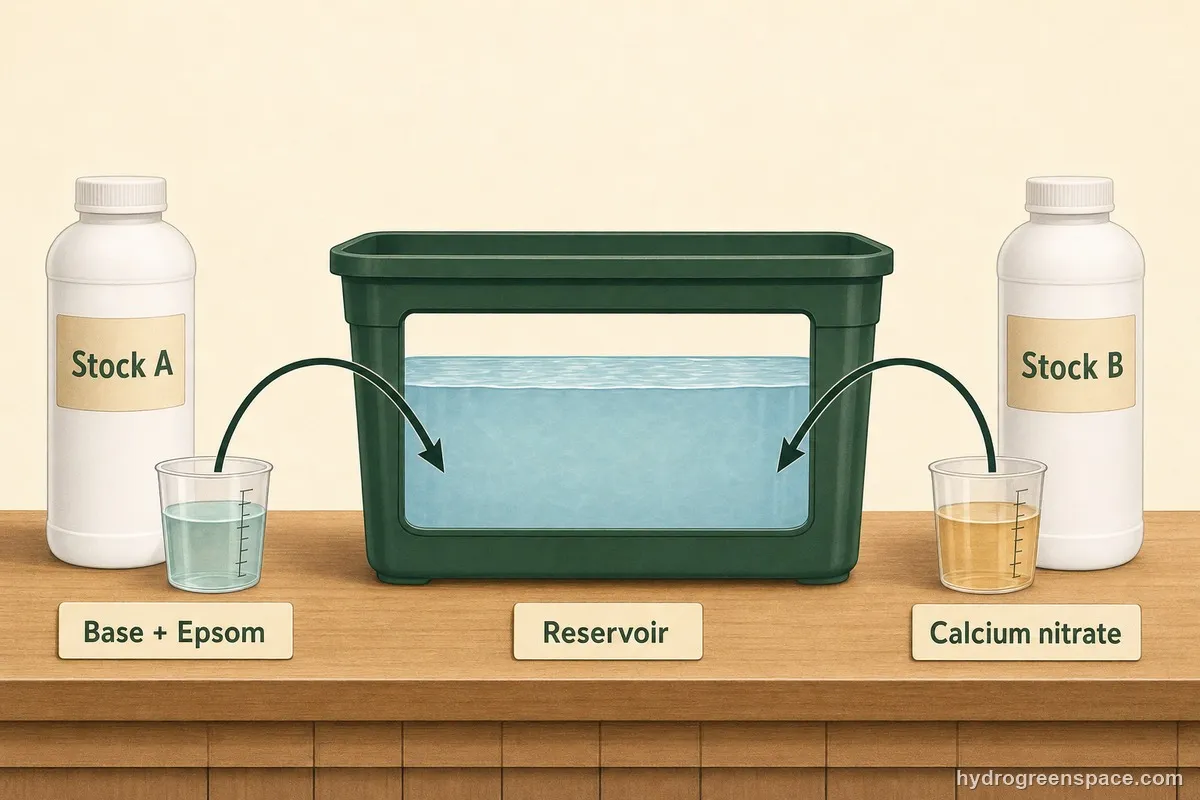
Why two bottles and not one? At this strength, calcium and phosphate would react. Dr. Bernard Kratky’s stock solution sheet for lettuce from the University of Hawaii puts it plainly: keep the stocks separate when concentrated “because they will react”, while in the dilute growing solution they don’t. He also gives each stock its own measuring cup and stirring rod, which is worth copying.
If you’re starting out: you can run without a meter at first. Kratky’s lettuce recipe (an 8-15-36 hydroponic base plus magnesium sulfate in stock A, calcium nitrate in stock B, each at 1 lb per gallon of stock) is dosed at 1 tablespoon of A and 1 tablespoon of B per gallon of water, which he sets to an EC of 1.5. That’s about 1.8 g of base, 1.8 g of calcium nitrate and 1.1 g of magnesium sulfate per gallon, a gentle lettuce-strength version of the same recipe.
Keep the bottles opaque, capped and labeled in big letters. A and B look identical once they’re dissolved.
How strong should the solution be for your crop?
The recipe gives you a starting strength. The EC meter tells you what you’ve got, because your tap water already carries some salts before you add anything.
| Crop | EC (mS/cm) |
|---|---|
| Basil | 1.0 to 1.6 |
| Lettuce | 1.2 to 1.8 |
| Cucumber | 1.7 to 2.0 |
| Spinach | 1.8 to 2.3 |
| Strawberry | 1.8 to 2.2 |
| Tomato | 2.0 to 4.0 |
EC ranges from Oklahoma State’s EC and pH guide.
For greens and herbs, the label rate or a little under is about right. For tomatoes and other fruiting plants, mix the same three salts at a higher dose, keeping the proportions, until the meter reads in their range. Change the amounts together, never just one salt, or the balance drifts. The EC chart by crop and growth stage has the numbers for more plants and for seedlings versus mature plants.
Think of EC as the salt meter on a soup: it tells you how strong the broth is, not what’s in it. That’s why the recipe matters and the meter alone isn’t enough.
Getting the pH right
Even a perfect recipe feeds badly at the wrong pH, because some nutrients stop dissolving or stop being taken up. Cornell keeps its lettuce solution at pH 5.5 to 6.0, and the extension guide behind the EC table says a hydroponic solution should sit between 5 and 6, usually 5.5.
The order matters: get the EC right first, then adjust pH. Adding nutrient shifts the pH, so doing it the other way round means doing it twice.
- pH too high: add pH down (phosphoric acid), citric acid or vinegar, a few drops at a time.
- pH too low: add pH up (potassium hydroxide or potassium carbonate), same way.
- Wait several minutes, stir, then test again. Readings taken straight after a squirt of adjuster bounce around and lead to overshooting.
If your pH climbs back up every day, your water is probably hard. Water with alkalinity above about 75 ppm keeps pushing the pH up, so check it daily, or mix with filtered or RO water. Check pH and EC at the same time each day, and you’ll spot a trend before the plants do.
Can you use Miracle-Gro or regular plant food instead?
Not on its own. Look at the label of the familiar blue all-purpose powder: Miracle-Gro Water Soluble All Purpose is 24-8-16 with trace metals, and no calcium or magnesium at all. And 20.5% of its 24% nitrogen is urea. A hydroponic base gets its nitrogen mostly as nitrate instead (3.5% of the 4% on the 4-18-38 label), and calcium nitrate adds more nitrate on top.
You could patch it with calcium nitrate and Epsom salt, but then you’re doing all the work of the three-salt recipe with a base that wasn’t designed for a reservoir. Buy a hydroponic base instead; a pound of it goes a long way, as the next section shows.
Is DIY cheaper than bottled nutrients?
Usually, because you’re not paying to ship water. At the label rate:
| One pound (454 g) of… | Makes about |
|---|---|
| 4-18-38 base | 190 gallons |
| Calcium nitrate | 190 gallons |
| Epsom salt | 300 gallons |
So a pound of each feeds 190 gallons of solution. Take what you paid per pound for the three bags, add them up, and divide by 190 for your cost per gallon. Then do the same for a bottled nutrient: divide the bottle price by how many gallons its label says it makes. That comparison, done with your own prices, is the honest one.
The trade-off is time. Bottles are pour-and-go; salts need a scale or a pair of stock bottles. Once the stock bottles exist, the difference is small: two measured pours instead of one.
What goes wrong with homemade nutrient solutions
The water turns cloudy or leaves white grit in the bottom right after mixing. Calcium met concentrated phosphate or sulfate, and some of it dropped out. That calcium is gone, so the solution is now short. Dump it and remix with the calcium nitrate dissolved separately.
Brown, crispy edges on the newest leaves. That’s calcium not reaching the growing tip; in lettuce it’s called tipburn. Penn State’s plant nutrition guide notes calcium symptoms start on new growth. Check you didn’t skip or underdose the calcium nitrate. If the recipe is right, it’s often fast growth under strong light in still air; Cornell’s lettuce growers prevent it with fans that blow down over the plants.
Yellowing between the veins on lower and middle leaves. Classic magnesium shortage. Check the magnesium sulfate went in. The same yellowing on the newest leaves points to iron instead. Check the pH first: it’s the quickest thing to rule out before you change the recipe. If you can’t tell which pattern you’re seeing, work through the yellow leaf patterns one at a time.
EC creeps up between changes even though you haven’t added anything. The plants are drinking water faster than they’re using salts, so the salts concentrate. Top up with plain water, not more nutrient.
The plants look fine but stall after a few weeks. Plants take up some elements faster than others, so the balance shifts even when the EC looks right. The same extension guide recommends replacing the whole solution every two weeks; the signs it’s time to change your nutrients tell you when to do it sooner.
Your next step
Order the three bags, a 0.1 g scale and an EC meter, and mix one gallon at the label rate before you commit a whole reservoir. Note the EC and pH you get from your own tap water, and you’ll know exactly how to scale it. When you’re ready to fill something bigger, the hydroponic nutrient calculator does the multiplying for any reservoir size, and the hydroponic nutrients hub helps if you’re still choosing between DIY salts and a bottled brand.