
Semi-Hydroponics for Orchids: LECA Setup That Works
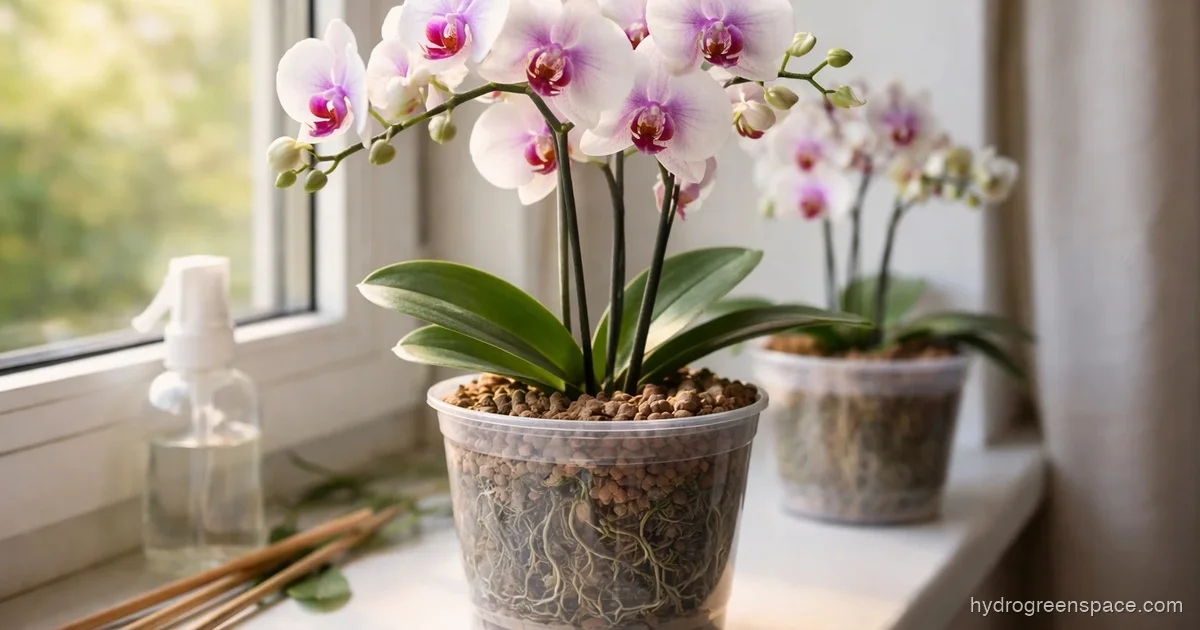
If you’ve ever watched a healthy orchid sit in LECA for two months, turning yellow, dropping roots, looking completely defeated, and wondered whether you made a terrible mistake, you didn’t. That’s the adaptation window. Semi-hydroponics for orchids works reliably once you understand what’s actually happening underground during those first few months.
LECA, or lightweight expanded clay aggregate, has a reputation in the orchid community as either a miracle medium or a root killer, depending almost entirely on whether the grower understood the transition process. The clay pellets wick moisture upward from a standing reservoir at the bottom of the pot, keeping roots constantly humid without staying wet. For epiphytic orchids that evolved clinging to tree bark in tropical canopies, that balance, moisture without saturation, is closer to nature than potting mix ever gets.
What Semi-Hydroponics Actually Does for Orchid Roots
Orchid roots are not like vegetable roots. They’re aerial structures with a layer of velamen, a spongy outer coating that absorbs moisture from humid air. In bark mix, roots that escape the pot and dangle in open air often look healthier than the ones buried inside. That tells you something about what these plants actually want.
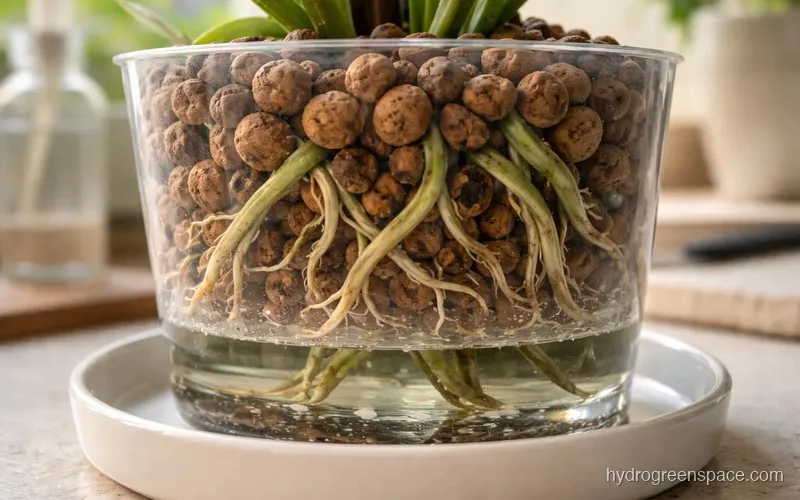
In a semi-hydro setup, the LECA pellets hold a thin film of moisture on every surface while air circulates freely between them. The roots don’t sit in water, but they’re never bone dry either. The passive wicking system does the work without pumps, timers, or any intervention from you once it’s dialed in. If you’ve read about the passive Kratky method, semi-hydro for orchids follows the same logic: a static nutrient reservoir, passive uptake, and minimal management.
The key difference is reservoir depth. In Kratky growing, you often start with a full reservoir and let it drop as roots consume it. With orchids in semi-hydro, you keep the water level intentionally low, typically no more than 1–2 cm of standing solution at the bottom of the pot. Roots above that zone get humidity from wicking; only the very bottom of the root mass touches the reservoir directly. Go higher than 2 cm and you’re essentially drowning the lower roots, which will rot and give you the death spiral growers blame on LECA.
The Transition Period: Why Your Orchid Looks Dead for Months
The adaptation window runs roughly 6 to 12 weeks, though some growers report up to 4 months before new root growth appears. During this time, the old bark-grown roots will mostly die back. That’s not a failure. Bark-grown roots have a different internal structure than roots grown in LECA from the start, and the plant often abandons them and grows a new set calibrated to the new environment.
What you should watch for:
- New root tips emerging from the crown or base of the plant (these are LECA-adapted roots and they’ll look white to silvery-green)
- The velamen staying plump for a few hours after watering (if it shrivels almost immediately, your humidity is too low or your reservoir ran dry)
- Leaves staying firm even if yellowing old leaves drop (leaf drop during transition can be normal; collapsing, wrinkled leaves are not)
What actually signals a problem:
- Crown rot, which shows as a soft, dark center where new leaves emerge
- All roots turning brown and mushy at the tips, including newly formed ones
- No new root activity after 12 weeks in a properly maintained setup
Common mistake: Growers panic during the adaptation window and either flood the reservoir to “help” the plant, or pull it out and go back to bark. Both extend the suffering. If crown and leaves are firm, leave it alone.
The transition is harder when you move a plant that’s in poor health to begin with. A bark-grown orchid with root rot, scale, or severe dehydration going into LECA is working on two problems at once. If possible, treat any existing issues before switching mediums.
Which Orchids Actually Thrive in Semi-Hydro
Phalaenopsis is the obvious starting point, and for good reason. Moth orchids tolerate consistent moisture, have no dry rest requirement, and adapt to LECA more forgivingly than most genera. Semi-hydro Phalaenopsis setups are genuinely low-maintenance once established, often only needing a weekly reservoir refill.
Genera that work well in standard semi-hydro setups:
- Phalaenopsis (moth orchids): the easiest conversion, tolerates the static reservoir well
- Paphiopedilum (slipper orchids): likes consistent moisture, transitions reliably
- Miltoniopsis (pansy orchids): prefers cool, moist roots; LECA suits them if temps are managed
- Dendrobium (nobile-type in growth season): workable with seasonal management
Genera that are problematic or require modified setups:
- Cattleya alliance (Cattleyas, Laelias, Brassavolas): these need a pronounced dry period between waterings to initiate blooming. A constant-reservoir setup interrupts that cycle. You can do semi-hydro with Cattleyas if you flush and dry the reservoir completely for several weeks in fall, but it takes deliberate management.
- Oncidium alliance: similar issue. Many Oncidiums come from seasonally dry habitats and need that stress to bloom reliably. Standard semi-hydro fights that biology.
- Cymbidium: mostly too large for the pot sizes where LECA excels, and they need cool nights to trigger blooming that indoor setups rarely provide anyway.
If you’re new to semi-hydro, start with a Phalaenopsis. Get one through the full transition cycle before trying anything in the Cattleya alliance.
Setting Up the Reservoir: The Number That Actually Matters
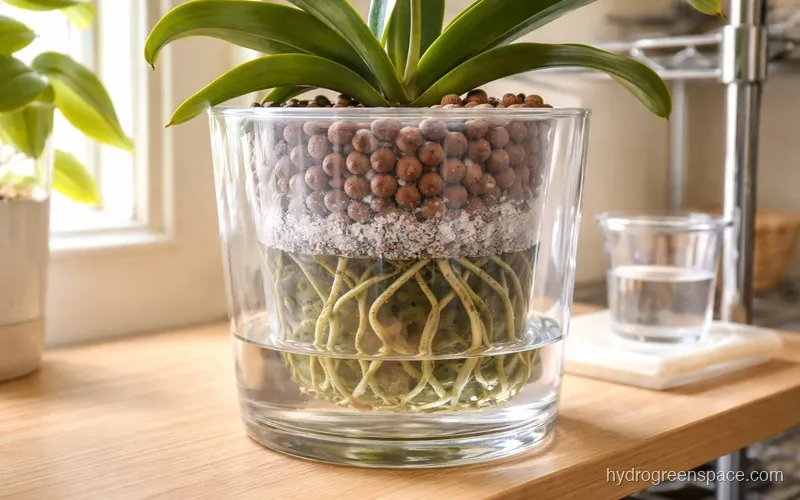
Use a clear pot inside a cachepot so you can see the water level without guessing. The outer pot holds the reservoir; the inner pot holds LECA and roots.
Fill the inner pot with LECA that’s been rinsed and soaked for at least 24 hours (dry LECA wicks poorly for the first week and can draw moisture away from roots rather than toward them). Settle your orchid in with roots distributed through the pellets, then pour your nutrient solution into the outer cachepot until the water line sits at 1–1.5 cm from the bottom of the inner pot.
Once the reservoir drops to empty, wait 24–48 hours before refilling. That brief dry period keeps anaerobic conditions from developing at the root tips. This is called flush-and-fill in the semi-hydro community and it’s the single habit that separates growers who succeed from growers who get root rot.
Every four to six weeks, do a full flush: pour clean water through the LECA until it runs clear out the bottom, then refill with fresh nutrient solution. This removes fertilizer salt buildup. LECA is porous and accumulates salts faster than bark does, and if you skip flushing you’ll see white mineral crust on the pellets and tip burn on new leaves. If you want to understand how fertilizer salts accumulate and how to manage them in any inorganic medium, other inorganic growing media options covers the underlying chemistry.
Fertilizing Orchids in LECA
Orchids in LECA need a dilute, balanced nutrient solution in every watering. This is different from bark-grown orchids where you fertilize occasionally on a separate schedule. Because LECA itself holds no nutrients, the plant depends entirely on what’s in the reservoir.
Use a fertilizer formulated for orchids or hydroponics, ideally with a balanced NPK around 20-20-20 or close, at quarter to half the recommended strength. Orchids are light feeders. If you’re unsure how to mix a nutrient solution correctly, how to mix a nutrient solution covers ratios and dilution in detail.
EC (electrical conductivity) target for orchids in semi-hydro: 0.8–1.2 mS/cm. That’s lower than you’d use for most vegetables. High EC burns orchid roots quickly, and LECA concentrates salts more than soil does.
Orchid-specific considerations:
- Use a fertilizer with calcium and magnesium included, or supplement separately (calcium deficiency shows as deformed new growth)
- Avoid urea-based nitrogen in a closed reservoir, as it breaks down into ammonia and can cause root toxicity over time
- In winter when growth slows, drop fertilizer strength to one-quarter
Troubleshooting the First Year
Roots are brown but not mushy: Normal for old bark-grown roots in transition. Check new root tips for health.
Leaves wrinkling or pleating: The reservoir ran dry or there’s no functional root system wicking yet. Pour clean water over the LECA to rehydrate the velamen directly while the root system catches up.
Green algae growing on LECA surface: Your outer pot is transparent and light is reaching the reservoir. Switch to an opaque cachepot or wrap it. Algae itself doesn’t harm orchids but it competes for oxygen at the root zone and signals you need to change the setup.
Orchid hasn’t bloomed since switching: Give it a full year. The plant spent months regrowing its root system. Once roots are established and the plant is cycling nutrients efficiently again, blooming resumes. If it still hasn’t bloomed after 12 months with a healthy root system, check your light levels first.
The Learning Curve Is Real but Short
Semi-hydroponics for orchids has a steeper setup curve than just dropping a Phalaenopsis in bark and forgetting it. But once a plant is through the adaptation window, the maintenance schedule becomes one of the simplest in indoor growing: refill the reservoir, flush monthly, and watch the roots. No soggy bark breaking down. No guessing about when to water. No repotting because the medium decomposed.
For growers who want to expand beyond orchids, the same LECA principles apply across a wide range of tropicals, and understanding how different hydroponic systems compare will give you context for how semi-hydro fits into the broader picture. The dedicated guide on orchid hydroponics goes deeper on advanced setups for mature collections, and when you’re ready to optimize your nutrient program specifically for LECA, the LECA nutrient management guide covers EC targets, flush schedules, and supplement stacks in detail.
Start with one Phalaenopsis. Get it through the transition. You’ll understand in four months why growers who do it once rarely go back to bark. Semi-hydroponics is one of several advanced hydroponic techniques that change how you think about root zone management across all your plants.