
Pollinating Hydroponic Strawberries: 3 Methods That Work
Strawberries are technically self-pollinating. That’s the first thing you read in any grow guide, and it’s true. Each flower carries both male stamens and female pistils, so no partner plant is required. But “self-pollinating” does not mean “pollination happens automatically.” That distinction is where most indoor growers get stuck, watching their plants flower beautifully and then produce nothing or tiny, misshapen fruit they can’t explain.
Outdoors, the wind and bees handle everything without you thinking about it. Inside your grow tent or closet, there’s no wind and there are no bees. If you don’t close that gap yourself, the pollen never moves from the stamen to the stigma, and the flower drops without setting fruit. Pollinating hydroponic strawberries is a simple, 5-minute-a-day task once you understand what’s happening, and it makes the difference between a productive crop and a frustrating one.
Why Indoor Strawberries Don’t Fruit Without Help
When a strawberry flower opens, its anthers (the tips of the stamens) release pollen. That pollen needs to land on the stigmas, which are the small, sticky receptors clustered in the center of the same flower. The whole thing is compact enough that a light vibration or a puff of air can do it.
Outdoors, bees are the main players. They vibrate flowers with their wingbeats as they collect nectar, shaking pollen loose and redistributing it. Wind adds additional movement. Indoors, your grow light doesn’t vibrate, your nutrient reservoir doesn’t create airflow, and there are no bees. Still air is the enemy of strawberry pollination.
This is worth understanding because it reframes the task. You’re not doing something complicated. You’re just replacing the environmental movement that the plant relies on but doesn’t have indoors. If you’re growing day-neutral varieties like Albion or Seascape, which bloom continuously, you’ll need to build this into your regular routine for the entire growing season.
Three Methods That Actually Work
A Small Paintbrush or Cotton Swab
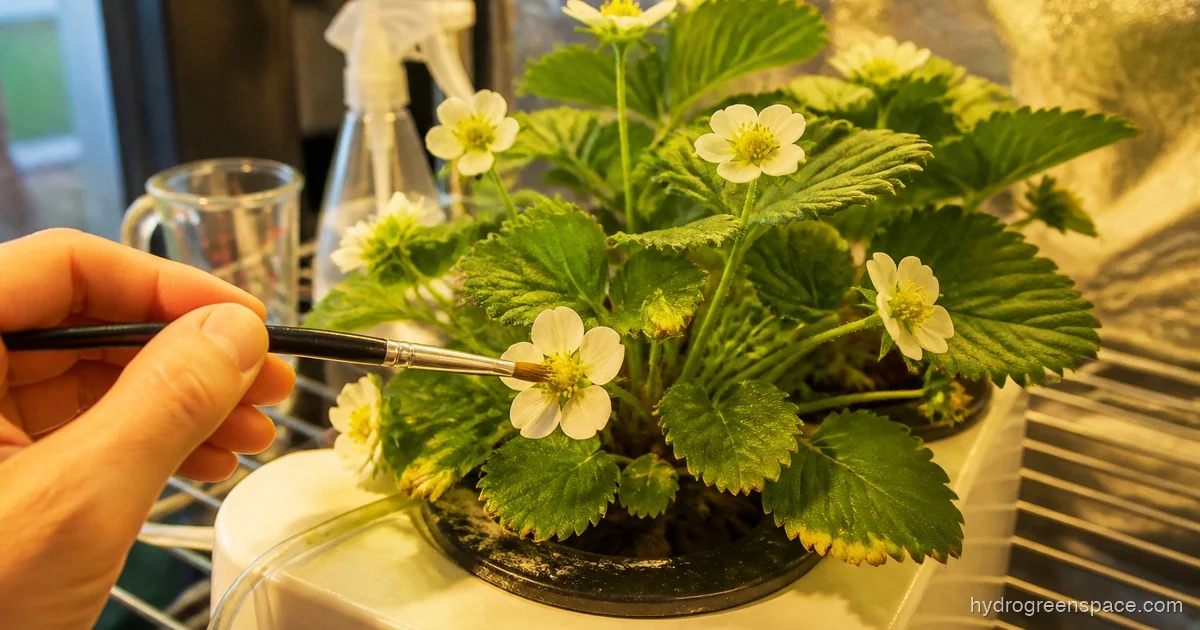
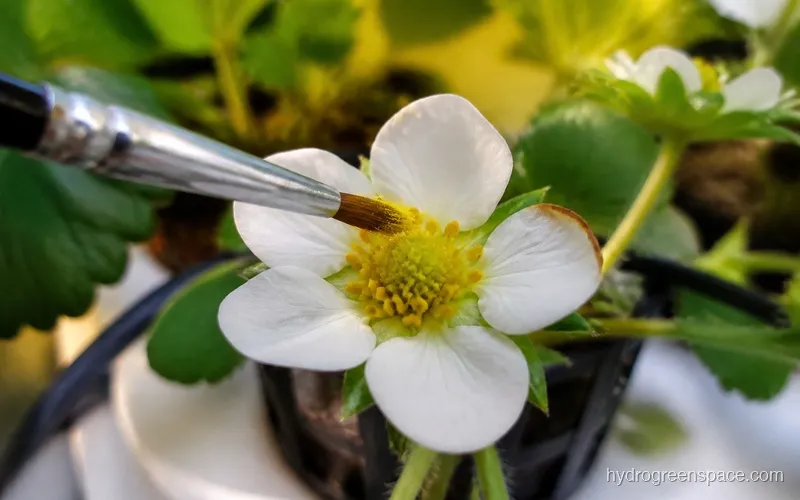
This is the most precise method and the one I’d recommend for beginners. Use a soft artist’s paintbrush (size 0 or 1) or a cotton swab. When a flower is fully open with visible yellow anthers, gently swirl the brush in the center of the flower, rotating to pick up pollen from the stamens and deposit it on the stigmas. Then move to the next flower and repeat.
You don’t need to clean the brush between flowers on the same plant or even between nearby plants of the same variety. Cross-pollinating flowers from different blooms on the same plant is fine and can improve fruit set.
One swirl per flower takes about two seconds. For a small setup with four to six plants, the whole job takes under five minutes.
An Electric Toothbrush
An electric toothbrush is the closest thing you can do to mimicking what a bee does. It vibrates at a frequency that dislodges pollen effectively without requiring any contact with the delicate stigmas. This is especially useful if you have a lot of plants or if your flowers are still partially open.
Turn it on, touch the back of the handle (not the bristles) to the stem directly below the flower, and hold it there for a second or two. The vibration travels up into the flower and shakes the pollen loose. You’ll sometimes see a fine yellow dust fall from the flower, which means it’s working.
The bristles themselves can damage small flowers, so keep them away from the bloom. The stem contact is all you need.
What I’d do: Keep a cheap battery-powered electric toothbrush in your grow space and use it every morning when you’re checking on your plants. It’s faster than a brush for large setups and the vibration is more effective than manual swirling for flowers that haven’t fully opened yet.
A Small Fan for Passive Pollination
A gentle oscillating fan positioned to create light airflow across your plants can handle some of the pollination load, especially during peak bloom when many flowers are open at once. It won’t replace active hand-pollination on its own (the airflow is rarely consistent or directed enough), but it helps, and the air circulation also reduces humidity around the canopy, which cuts down on botrytis risk.
Use a fan speed that makes the leaves flutter gently. Strong airflow stresses the plants and can dry out the stigmas, making them less receptive to pollen. Think “light breeze,” not “wind tunnel.”
If you’re running a fan anyway for temperature control, angle it so it passes across the plant canopy during flowering. That’s often enough to supplement whatever hand-pollination you’re doing. If you’re just getting started with your indoor setup, this guide to growing hydroponic strawberries at home covers fan placement and environmental setup in detail.
Timing and Frequency
Strawberry flowers are most receptive to pollination in the first two to three days after they fully open. You can tell a flower is ready when the petals are white and flat, the center is bright yellow, and you can see the distinct cluster of stigmas surrounded by the pollen-bearing anthers.
Pollinate once a day, in the morning if possible. This lines up with the flower’s natural pollen release cycle and gives the pollen time to germinate on the stigma during the warmer part of the light cycle. Skipping a day occasionally won’t ruin your crop, but irregular attention during peak bloom will reduce your yield.
With day-neutral varieties, you’ll have flowers at multiple stages simultaneously: newly opened, mid-cycle, and beginning to close. Focus on the ones that have been open one to two days. Very fresh blooms (just opened overnight) and older blooms (petals starting to curl or drop) are both less productive targets.
Once pollinated successfully, you’ll see the green receptacle at the base of the flower begin to swell within a week to ten days. That’s the fruit developing. If the flower drops off cleanly without that swelling, pollination didn’t take.
What a Failed Pollination Looks Like
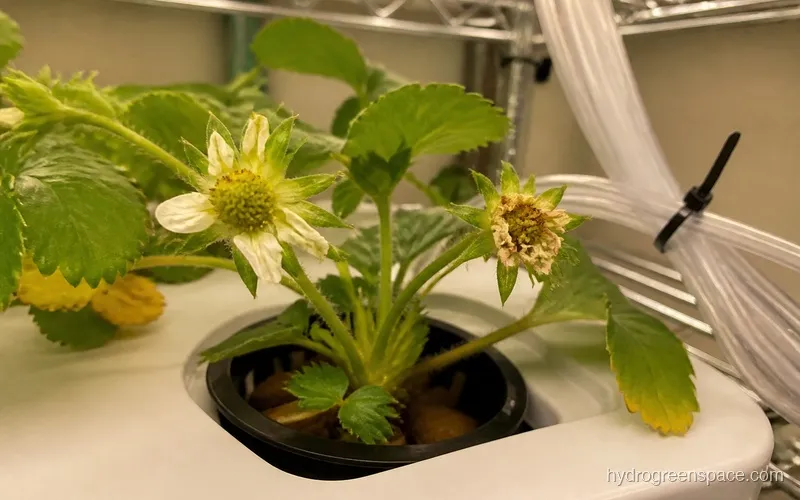
A strawberry that was poorly pollinated doesn’t just stay small. It grows into a deformed, uneven shape. The fruit develops from the receptacle, and each tiny seed (technically an achene) on the surface of the berry needs to receive pollen to stimulate the tissue around it to grow. If only part of the flower was pollinated, only that part of the berry develops fully. The result is a fruit that’s round and normal on one side and flat, pinched, or underdeveloped on the other, sometimes called a “cat-faced” or “button” berry.
You might also see:
- Berries that ripen very small but are otherwise normal in color and flavor (partial pollination)
- Hard, nubby patches on an otherwise normal berry (achenes that didn’t stimulate growth around them)
- Fruit that starts to form and then shrivels and drops before ripening (very poor pollination or flower drop)
If you’re seeing these symptoms, increase your hand-pollination frequency and check that your flowers are actually open when you’re working on them. Partially closed buds won’t respond no matter how good your technique is.
It’s also worth checking your variety. Some varieties bred for soil growing can be more finicky indoors. The varieties that perform best in hydroponic systems tend to be ones that already have high fruit-set rates. Choosing the right strawberry variety for your system makes every step easier, including pollination.
FAQ
Do hydroponic strawberries need to be pollinated? Yes. Strawberries are self-fertile, meaning one plant can produce fruit without another, but the pollen still needs to physically move from the stamens to the stigmas. Indoors, without wind or insects, that doesn’t happen unless you do it manually or run a fan.
Can you use a fan to pollinate hydroponic strawberries? A fan helps, but it’s not reliable enough on its own. Use it as a supplement to hand-pollination, not a replacement. The airflow is inconsistent, and the fan can’t guarantee coverage on every open flower.
What happens if strawberry flowers are not pollinated? The flower drops without setting fruit, or it develops into a deformed, misshapen berry. Partial pollination is often worse than no fruit. It’s the main cause of the cat-faced strawberries that indoor growers find confusing.
How often should you hand pollinate strawberries? Once per day, during the first two to three days after each flower opens. Morning is ideal but any time during the light cycle works.
Is an electric toothbrush good for pollinating strawberries? Yes. It’s one of the most effective methods. Touch the handle (not the bristle head) to the flower stem and let the vibration do the work. It mimics the frequency of a bee’s wingbeats and dislodges pollen efficiently.
Do strawberries self-pollinate? They’re self-fertile, which means a single plant can produce fruit. But the pollen transfer still needs to happen. Indoors, that’s your job.
Once you dial in a daily pollination habit, it becomes as automatic as checking your nutrient levels. The plants will tell you quickly when it’s working. That satisfying little swell at the base of a fertilized flower showing up within a week is one of the better signals you can get from an indoor garden. From there, the next variable that determines your actual yield is the nutrient solution. Getting your hydroponic strawberry nutrient solution dialed in is what turns consistent pollination into consistently heavy harvests. If you’re still working through the full setup, the complete hydroponic strawberries guide covers every stage from choosing a system to managing your first harvest.