
Hydroponic Strawberries: Complete Growing Guide
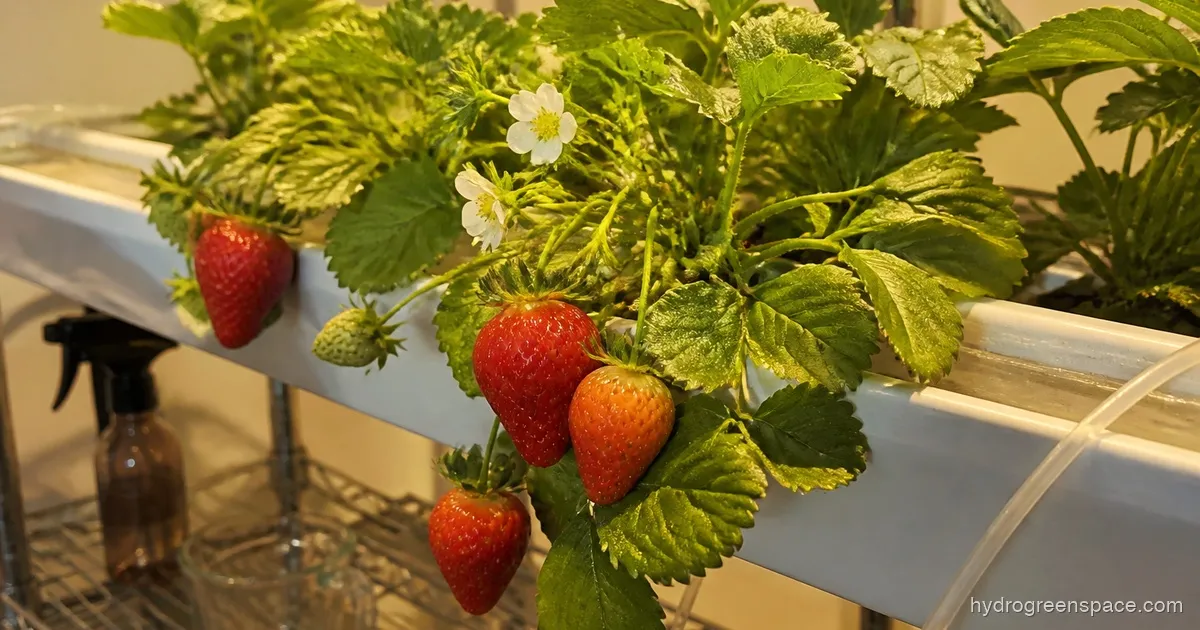
Strawberries are the crop that converts skeptics. Someone who thought hydroponics was just a hobby for lettuce-obsessed apartment dwellers will grow their first batch of hydroponic strawberries and suddenly understand what the fuss is about. The berries taste like strawberries from a garden: sweet, fragrant, picked ripe, and they keep coming month after month without a seasonal clock telling them to stop.
That’s the appeal. But hydroponic strawberries have more moving parts than most crops. Variety selection, system type, nutrient timing, hand pollination, runner management, pH drift: get any one of these significantly wrong and you’ll spend months tending plants that fruit once, fruit sour, or don’t fruit at all.
This guide covers every piece of the puzzle. Each section gives you the core idea and links to the full deep-dive so you can go as far as you need to on any topic. Whether you’re planning your first setup or troubleshooting an existing one, start here and follow the threads that matter to your situation.
How to Grow Hydroponic Strawberries at Home
The overall grow process has more steps than most crops, but none of them are difficult on their own. You’re managing pH and EC in a specific range, keeping roots moist without waterlogging them, and providing enough light and warmth to trigger continuous fruiting. The biggest trap for new growers is skipping the variety selection and crown preparation steps at the beginning, because both affect everything downstream. Get variety right first and the rest of the process becomes a lot more predictable.
For the full guide, see How to Grow Hydroponic Strawberries at Home.
Best Strawberry Varieties for Hydroponics
The variety question is more consequential for strawberries than for almost any other crop. Pick the wrong type and no amount of dialing in your nutrient solution will produce a plant that fruits year-round. Pick the wrong day-neutral variety and you might get inconsistent runners, low yields, or fruit that’s smaller than expected for your system.
The three main types are June-bearing (seasonal, avoid), everbearing (limited off-season production, marginal for hydroponics), and day-neutral (continuous production, the right choice). Within day-neutral, varieties like Albion, Seascape, and Portola are well-suited to controlled indoor environments. Albion is the most forgiving for beginners. Portola runs hotter and produces more runners. Seascape is reliable but slightly less flavored than Albion in hydroponic conditions.
For the full guide, see Best Strawberry Varieties for Hydroponics.
Best Hydroponic System for Strawberries
This decision matters more for strawberries than for most crops. Strawberries want roots that are consistently moist but never sitting in stagnant water. That narrow band rules out a few systems and elevates others. A bad system choice doesn’t just limit your yield; it can cause root problems that take weeks to show up and longer to recover from.
NFT (Nutrient Film Technique) is the most reliable all-around choice. Roots sit in a shallow stream of nutrient solution that flows continuously, which keeps moisture levels steady without waterlogging. DWC works but requires an air pump running continuously and more attention to oxygenation. Ebb and flow can work well if cycles are dialed in correctly. Vertical tower systems are popular for aesthetics and space efficiency but often create uneven moisture distribution between the top and bottom pockets.
Can you grow strawberries hydroponically indoors? Yes, and most growers who do it seriously use NFT or DWC systems under grow lights. NFT in a 4-foot channel under a 600W equivalent LED is a setup that scales from one plant to twenty without changing the approach.
For the full guide, see Best Hydroponic System for Strawberries.
How to Start Bare Root Strawberries in Hydroponics
Most serious growers start from bare root crowns rather than seeds or established transplants. Bare roots are cheaper, they’re what commercial growers use, and they arrive dormant, which actually makes the transition into a hydroponic system easier to manage. But they need correct preparation before planting or the first two weeks can go badly.
The three most common mistakes are skipping the pre-soak, placing the crown too deep, and using media that retains too much moisture. The crown (the junction between the root mass and the leaves) needs to stay at the surface, not buried. Burying it causes crown rot, which often doesn’t show up until several weeks in when the plant collapses. Roots should hang freely into the nutrient solution, not be packed into wet media.
For the full guide, see How to Start Bare Root Strawberries in Hydroponics.
Hydroponic Strawberry Nutrient Solution: EC, pH and NPK
Nutrient management is where the largest gap between beginner and experienced growers shows up. It’s also the primary driver of fruit quality. Sour strawberries, bland strawberries, cracked fruit, and tiny berries all trace back to what’s happening in the reservoir, and they’re all fixable once you know what to look for.
For strawberries, pH should stay between 5.8 and 6.2. EC targets shift by growth stage: 1.2–1.4 mS/cm during establishment, stepping up to 1.6–2.0 mS/cm during active fruiting. Going above 2.2 mS/cm is where you start seeing tip burn and reduced fruit size. Potassium is the key macro during flowering and fruiting; increase it as plants move into heavy production. Calcium and magnesium matter more for strawberries than for many other crops because they affect cell wall strength, which directly impacts whether fruit cracks during a growth flush.
What nutrient solution is best for strawberries? A balanced three-part formula adjusted by stage works well for most growers. The MasterBlend 4-18-38 approach (combined with calcium nitrate and Epsom salt) is a cost-effective DIY option that gives you precise control over every macro and micro element.
Why are hydroponic strawberries sour? The most common cause is high nitrogen relative to potassium during fruiting. Nitrogen pushes vegetative growth. Potassium and phosphorus push flower and fruit development and support sugar accumulation. If your plants are lush and green but your fruit is sour, your N:K ratio is out of balance.
For the full guide, see Hydroponic Strawberry Nutrient Solution: EC, pH and NPK.
Pollinating Hydroponic Strawberries
This is the step that surprises most new indoor growers. You can have a healthy plant loaded with flowers and still get no fruit if you skip pollination. Outdoors, wind and bees handle this passively. Indoors, nothing moves pollen between the stamens and pistil unless you make it happen.
Three methods work reliably: a small electric toothbrush pressed lightly against the back of open flowers (vibration mimics bee movement), a fine artist’s paintbrush moved gently across the center of each flower, or a small fan running on low to create air movement across the canopy. The toothbrush method is the fastest if you have a lot of plants. The fan approach is the most passive but least reliable on its own.
Timing matters. Strawberry flowers are most receptive in the first 2–3 days after opening. A flower that goes unpollinated drops off without setting fruit, which is both a visual indicator that something’s wrong and a missed harvest opportunity. Pollinate every other day during peak flowering and you’ll cover most open flowers in time.
What does failed pollination look like? The flower drops without a berry forming, or you get a misshapen berry (catfaced, with gaps or lobes) that results from partial pollination. Well-pollinated fruit is symmetrical and fully formed.
For the full guide, see Pollinating Hydroponic Strawberries: 3 Methods That Work.
How Long Do Hydroponic Strawberries Take to Fruit?
The honest answer is 60–90 days from transplant to first harvest, but that range is nearly meaningless without context. Bare root crowns that are properly prepared and transplanted into an optimized system trend toward the shorter end. Crowns that went through a hard dormancy, plants started in suboptimal conditions, or systems running low light or cool temperatures will push toward 90 days or beyond.
The growth stages break down roughly like this: 1–2 weeks of root establishment where almost nothing visible happens above the surface, followed by 2–3 weeks of active vegetative growth, then flower initiation. From first open flower to ripe fruit is typically 4–6 weeks. So the clock starts over with each new flowering flush, and once a plant is established and fruiting, it can continue cycling for 12–18 months before productivity drops off enough to warrant replacement.
Starting method changes everything here. Runners (which are already growing actively when you separate them) establish much faster than bare root crowns coming out of dormancy. If you’re starting from seed, add another 3–4 months before the plant is ready to fruit consistently.
For the full guide, see How Long Do Hydroponic Strawberries Take to Fruit?.
Hydroponic Strawberry Yield Per Plant
A neglected plant in a mediocre system might give you 80 grams over a season. An optimized plant in the same system can produce 400–500 grams. That’s not an exaggeration and it’s not a marketing number from a seed catalog. It reflects what changes when you get light, nutrients, pollination, and runner management all working together.
How much do hydroponic strawberries yield per plant? In practical home setups, 200–350 grams per plant per season is a realistic target once you’ve dialed in your system. Light hours are probably the biggest single lever. Strawberries need 12–16 hours of light daily for consistent flowering. Below 12 hours and you’ll see vegetative growth without fruit set. Nutrients and pollination frequency are the other main variables, and both are covered in their own sections below.
For the full guide, see Hydroponic Strawberry Yield Per Plant: What to Expect.
Strawberry Runners in Hydroponics: Root or Remove?
Every established strawberry plant will eventually throw runners (long horizontal stems that produce small plantlets at their tips). What you do with them shapes your entire grow season. Runners left attached pull energy from the mother plant, which often means fewer flowers and smaller fruit. But runners are also free plants.
Rooting runners hydroponically is straightforward: guide the runner tip into a small net pot with damp media and keep it moist until roots establish. Once you see the plantlet growing actively on its own (usually 2–3 weeks), cut the runner from the mother plant. During peak fruiting season, the standard advice is to remove runners and focus the plant’s energy on fruit. After the main harvest cycle winds down, it makes sense to root a few runners to refresh your plant stock.
For the full guide, see Strawberry Runners in Hydroponics: Root or Remove?.
Hydroponic Strawberry Diseases: Causes and Fixes
Hydroponics eliminates many of the soil-borne pathogens that plague field strawberries. What it doesn’t eliminate, and in some ways makes worse, is the shared water environment. One infected plant can spread Pythium or Fusarium through the reservoir to every other plant in the system within 24–48 hours. That’s a speed and scale of spread that soil doesn’t allow.
Root rot (Pythium) is the most common and most serious disease in hydroponic strawberry systems. It presents as brown, slimy roots and wilting that doesn’t respond to watering. Prevention is more important than treatment: maintain dissolved oxygen above 6 mg/L, keep reservoir temperature below 68°F (20°C), and avoid light leaks that encourage algae growth. Gray mold (Botrytis) shows up on fruit and leaves, especially in humid environments with poor air circulation. Powdery mildew is a foliage problem that’s less urgent but reduces photosynthesis if left unchecked.
For the full guide, see Hydroponic Strawberry Diseases: Causes and Fixes.
Are Hydroponic Strawberries Safe to Eat?
The concern is understandable but misplaced. Plants absorb mineral ions, not organic compounds. Whether those ions came from decomposed compost or a bottle of hydroponic nutrients makes no biological difference to the plant. The result in the fruit is the same.
Where hydroponics actually has an advantage over conventional field production is pesticide exposure. Controlled indoor environments face far fewer pest pressures than outdoor fields. Most home hydroponic growers never use pesticides at all. That’s not something you can say about the average grocery store strawberry, which is consistently one of the most pesticide-residue-heavy fruits in commercial production.
Are hydroponic strawberries organic? No, not under current USDA standards. Organic certification requires soil-based growing, so hydroponic production doesn’t qualify regardless of what inputs you use. Pesticide-free, yes. Organic, no. If that distinction matters to you, it’s worth understanding what the label actually means before making purchasing or growing decisions.
Do you need to wash hydroponic strawberries? Yes, as a basic hygiene step. They’re not treated the same way commercial fruit is, so the urgent need for washing (to remove pesticide residue) doesn’t apply. But rinsing before eating is still sensible.
For the full guide, see Are Hydroponic Strawberries Safe to Eat?.
If you’re just getting started, the best first move is picking your system and your variety before doing anything else. Those two decisions constrain almost everything that follows: how you manage water, how many plants fit in your space, and how long before your first harvest. Get them right and the rest of the process is a series of adjustments, not a restart.
Start with Best Hydroponic System for Strawberries if you haven’t chosen a setup, or with Best Strawberry Varieties for Hydroponics if you have a system but need to nail down what to grow in it. Both guides give you enough specifics to make a real decision, not just a list of options.