
Romaine Lettuce Hydroponics: Head Formation Guide
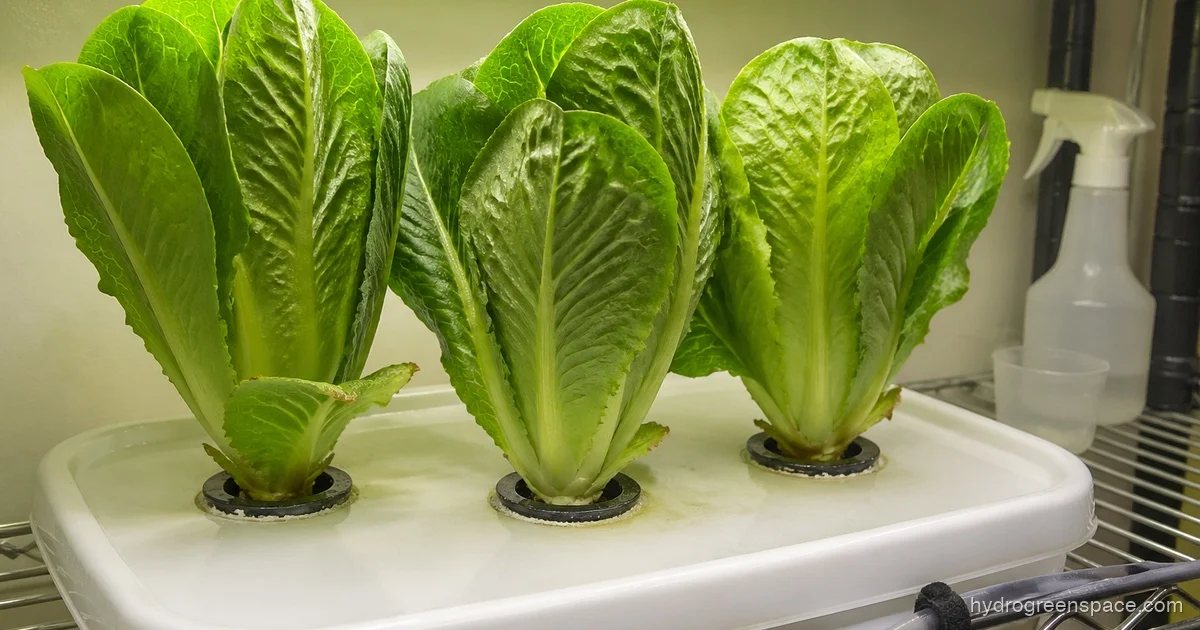
Romaine is one of the most rewarding lettuces you can grow hydroponically, and also one of the easiest to grow badly. Most growers get a tangle of floppy green leaves instead of a tight, upright head, then assume hydroponics just isn’t suited for romaine. It is. You just need to know what romaine actually needs, which is different from butterhead or looseleaf.
This guide covers system selection, the numbers that matter (pH, EC, temperature), and the two problems that kill most romaine grows before you get to harvest.
The Best Hydroponic System for Romaine Lettuce
Romaine does well in several systems, but the right choice depends on your setup and how hands-on you want to be.
Kratky Method
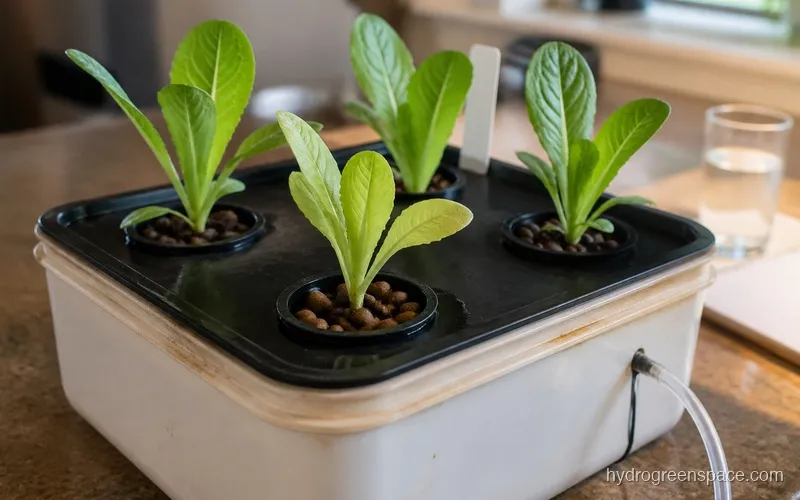
The Kratky method is the easiest entry point for growing romaine lettuce hydroponically. You fill a reservoir, set your seedling in a net pot, and the plant drinks down the solution while an air gap forms above the roots. No pump, no timer, no moving parts.
Romaine works in Kratky, but with a caveat: it grows taller and heavier than butterhead, so your container needs to be deep enough (at least 6 inches) to support the root mass. A wide-mouth mason jar works for a single plant, but a 5-gallon bucket gives you more room and a better air gap as the solution drops. If you want to understand the mechanics before you build anything, how the Kratky method works covers the air gap dynamics in detail.
What I’d do: Start with Kratky if this is your first hydroponic grow. One bucket, one plant, and you’ll learn everything you need to know about romaine’s water and nutrient demands before scaling up.
Deep Water Culture (DWC)
DWC keeps roots submerged in aerated nutrient solution around the clock. The constant oxygen supply from the air stone accelerates growth compared to Kratky, and you can run multiple plants in one reservoir with a multi-site lid. Romaine in DWC tends to produce fuller heads because the roots never experience the dry-down period that Kratky plants do.
The tradeoff is that DWC requires an air pump and some basic maintenance (checking the reservoir every few days, topping off water, adjusting pH). It’s still a simple system, but it’s not quite as set-and-forget as Kratky.
NFT (Nutrient Film Technique)
NFT runs a thin film of nutrient solution continuously over roots in a sloped channel. It’s the system commercial lettuce farms use because it scales easily and keeps roots highly oxygenated. For home growers, NFT is worth it if you’re growing 10+ plants at once (a 4-foot channel can hold 8 to 12 romaine heads with proper spacing).
The downside is that NFT has no buffer. If your pump fails for a few hours in warm weather, roots dry out and your crop is at risk. For a single grower with a day job, DWC or Kratky is more forgiving. The NFT system setup guide goes deeper if you’re considering this route.
pH, EC, and Temperature: The Numbers Romaine Actually Needs
Romaine isn’t fussy, but it does have a narrower tolerance for temperature than most growers expect.
pH: Keep your nutrient solution between 5.8 and 6.2. Romaine starts showing calcium and iron lockout above 6.5, which makes tipburn worse (more on that below). If you’re not sure how to adjust, adjusting pH in hydroponics walks through the process.
EC: Keep nutrient solution between 0.8 and 1.6 mS/cm. Stage-by-stage targets are covered in the nutrients section below. Higher EC doesn’t make romaine grow faster. It just stresses the plant.
Solution temperature: Keep nutrient solution between 65°F and 72°F. Above 75°F, root zone oxygen drops, root rot risk climbs, and your romaine will bolt before it forms a head. This is the single most overlooked variable in indoor romaine grows.
Air temperature: 65°F to 75°F is the target. Above 80°F, romaine bolts. The plant interprets heat as a signal to go to seed, and once that process starts, the head never tightens.
Why Your Romaine Won’t Form a Head (And How to Fix It)
This is the question that shows up constantly in hydroponic forums: “My romaine just grows a string of leaves. It never forms a head.” There are two causes, and they’re both fixable.
Not Enough Light
Romaine head formation is directly tied to light quantity. The plant needs enough photosynthetic energy to push leaves inward and build the dense, upright structure you expect. If you’re running a weak grow light, or your light is too far from the canopy, the plant will produce leaves but won’t compact into a head.
You need at least 25-30 DLI (daily light integral) for good romaine head formation. In practical terms, that means a decent LED grow light running 16 hours a day at the right distance. Check how far your grow light should be from plants, because it matters more for head formation than most growers realize.
Spacing
Romaine is taller than butterhead and needs more lateral room to form properly. If you’re growing in a multi-site system, space plants at least 8 to 10 inches apart (center to center). Crowded plants reach for light instead of forming a tight head, and you end up with elongated, floppy leaves.
Tipburn: The #1 Problem in Hydroponic Romaine
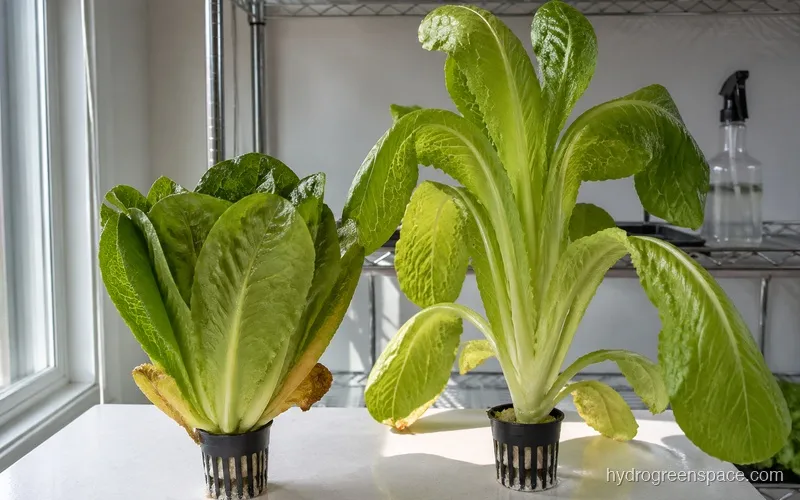
Tipburn is that brown, papery edge you see on the inner leaves of romaine. It looks like a nutrient deficiency, but it isn’t (not exactly). It’s a calcium transport failure, and understanding the difference changes how you fix it.
Calcium moves through a plant via transpiration. The plant pulls water up through its roots and out through tiny pores (stomata) in its leaves, and calcium rides along for the trip. In low-light, low-airflow environments, inner leaves transpire very little, and that’s where tipburn shows up first.
Your nutrient solution can have plenty of calcium and you’ll still get tipburn if the plant can’t move that calcium to the inner leaves.
How to prevent tipburn:
- Increase airflow directly over the plant canopy. A small oscillating fan running during the light period makes a significant difference. Moving air stimulates transpiration in the inner leaves.
- Don’t push EC too high. High salt concentration reduces water uptake and makes calcium transport worse.
- Keep pH in range (5.8 to 6.2). High pH locks out calcium at the root level, compounding the problem.
- Avoid letting solution temperature creep up. Warm water holds less oxygen and stresses roots.
Warning: Tipburn is not reversible. Affected leaves won’t recover. The goal is preventing it from spreading by fixing the airflow and environment immediately. If tipburn is on outer leaves, check your nutrient solution. If it’s on inner leaves only, airflow is almost certainly the issue.
How Long Does Romaine Take to Grow Hydroponically?
Romaine runs 45 to 70 days from seed to harvest in a hydroponic system, which is slower than butterhead (30 to 45 days) and significantly slower than looseleaf varieties (25 to 35 days). The extra time is the price of the head. If you’re comparing notes with someone growing butterhead and wondering why your romaine isn’t ready yet, that’s normal.
Seed to transplant takes about 7 to 14 days. After transplanting into your system, most romaine varieties are harvestable around 35 to 55 days later, depending on light, temperature, and the variety you’re growing. ‘Parris Island Cos’ and ‘Jericho’ are two varieties that perform consistently in home hydroponic setups.
You can harvest by cutting the whole head at the base, or harvest outer leaves and let the plant keep growing. Outer-leaf harvesting works fine, but romaine grown for its head is best harvested all at once (the inner leaves are the sweetest part, and they don’t develop properly if you keep removing the outer leaves). For timing guidance that applies across lettuce types, knowing when your romaine is ready to harvest covers the signs to look for.
Nutrients for Hydroponic Romaine
Romaine is not a heavy feeder, but it does have specific needs at different growth stages.
Nitrogen drives the leafy growth in the vegetative phase, where a balanced formula with slightly elevated N does its job. As the plant matures and starts forming a head, you can back off nitrogen slightly and make sure calcium and magnesium are present. Calcium, as covered above, is critical for preventing tipburn. Magnesium supports chlorophyll production and becomes important under high-intensity grow lights.
A general lettuce formula works well for romaine. Keep EC at 0.8 to 1.0 during the seedling stage, step up to 1.2 to 1.4 during vegetative growth, and hold at 1.4 to 1.6 as the head forms. Don’t push higher than 1.6. Romaine under salt stress will bolt faster than any other lettuce you’ll grow. The complete guide to hydroponic nutrients breaks down what each element does if you want to go deeper on the chemistry.
For growing medium in your net pots, rockwool cubes are the standard starting point for lettuce seedlings. They hold moisture well, provide good root support, and transition cleanly into any hydroponic system. Using rockwool in hydroponics has the prep steps, and skipping the pre-soak is one of the most common beginner mistakes.
Once you get your first tight romaine head out of a DWC or Kratky setup, you’ll understand why commercial growers rely on hydroponics for it. The texture and flavor of a head grown in a controlled nutrient solution (harvested an hour before dinner) is genuinely different from anything you’ll find at a grocery store. For everything else involved in growing lettuce hydroponically, the complete hydroponic lettuce guide covers every variety and system in one place. If you want to branch out after your first successful grow, iceberg lettuce in hydroponics uses many of the same system principles with its own set of quirks worth knowing.