
Hydroponic Lettuce: Systems, Nutrients & Common Fixes
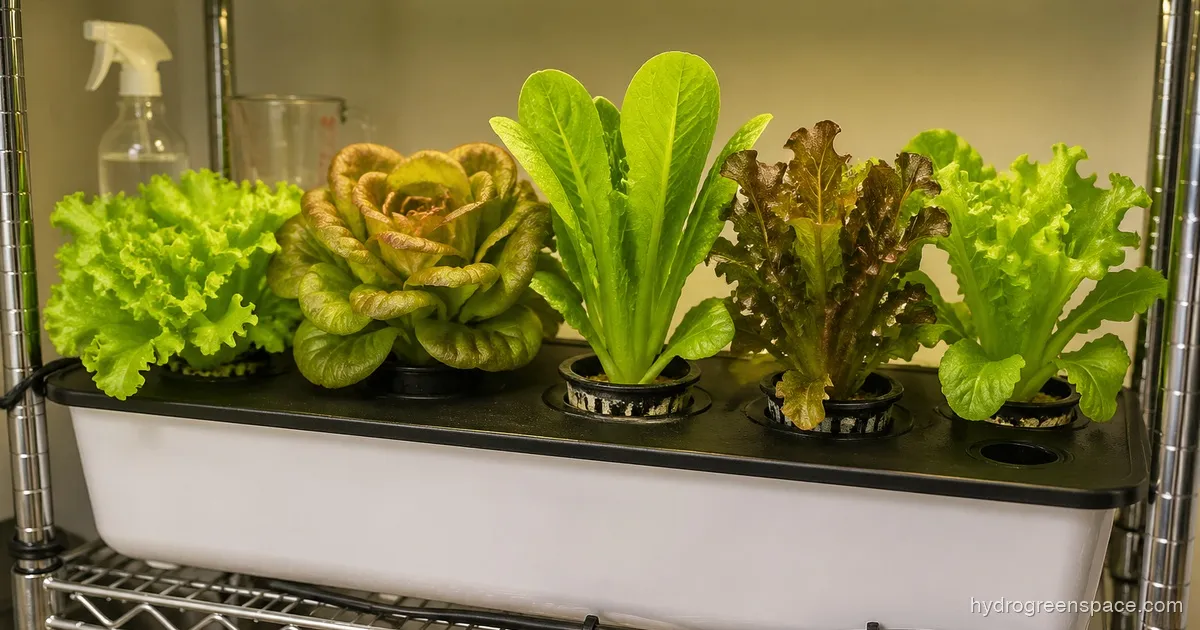
Lettuce is the gateway crop for home hydroponics. It’s fast, forgiving, and the results come quickly enough that your first harvest will probably convince you to expand your system before the month is out. But “lettuce is easy” gets repeated so often that it starts to feel like a guarantee, and it isn’t. The difference between a grower who pulls beautiful heads every three weeks and one who keeps watching their crop bolt or develop tip burn usually comes down to a few specific decisions: which system they chose, which variety they planted, and whether they understood what the numbers on their pH and EC meter actually mean.
This guide covers all of it. You’ll find honest comparisons of every major hydroponic system for lettuce, the exact nutrient and pH targets to dial in, a breakdown of what goes wrong and why, and direct links into every deep-dive guide in this cluster. If you’re starting from scratch, this is your map. If you’ve been growing for a while and something isn’t working, start here and follow the thread into whatever section applies.
Growing lettuce hydroponically at home is genuinely one of the most satisfying things you can do with a small indoor space. You just need to know what you’re doing.
What Is the Best Hydroponic System for Growing Lettuce?
No single system wins for every grower, but for lettuce specifically, three setups dominate: Deep Water Culture (DWC), Nutrient Film Technique (NFT), and the Kratky method. Each has a distinct character.
DWC suspends plant roots directly in aerated, nutrient-rich water. It’s the most scalable home system for lettuce, produces consistently fast growth, and is very hard to mess up once your air pump is running. A standard 5-gallon bucket DWC can grow a single head of butterhead lettuce in 30 to 40 days from transplant.
NFT runs a thin film of nutrient solution continuously over the root zone through angled channels. Commercial lettuce farms use NFT because it’s efficient and space-smart. For home growers, it requires a pump and plumbing that adds complexity. Channels can also clog or dry out if the pump fails, which means NFT punishes inattention harder than DWC does. That said, if you want a tidy, scalable system mounted on a wall or shelf, NFT is worth the learning curve.
The Kratky method is passive DWC: no air pump, no electricity, no moving parts. You fill a reservoir, let the plant drink down the water level (creating an air gap for the roots), and harvest. It’s the lowest-cost entry point in hydroponics and works beautifully for loose-leaf lettuce. The tradeoff is that Kratky doesn’t scale well and is less forgiving with head lettuce varieties that need consistent oxygenation.
Raft systems (also called floating raft culture) sit somewhere between Kratky and powered DWC. Plants float on foam boards above a still reservoir, often with light aeration. Community gardens and classrooms love raft culture because it’s visual, cheap, and easy to manage in batches. It’s also a legitimate option for home growers who want to produce large quantities of loose-leaf without complex plumbing.
pH and EC for Hydroponic Lettuce: The Numbers That Matter
Lettuce is one of the less demanding crops when it comes to nutrient solution management, but that doesn’t mean you can ignore it.
pH: Keep your solution between 5.5 and 6.5, with 6.0 as your sweet spot. Below 5.5 and you’ll start locking out calcium and magnesium. Above 6.5 and iron becomes unavailable. Both deficiencies show up as yellowing, and both are easy to misdiagnose if you’re not testing regularly. Check pH every two to three days on an active system.
EC (Electrical Conductivity): Lettuce wants a light nutrient load. For seedlings and young transplants, target 0.8 to 1.2 mS/cm. As plants mature, you can push to 1.6 to 2.0 mS/cm. Go higher and you’ll stress the plant unnecessarily. Lettuce does not need the heavy feeding that tomatoes or peppers do, and overfeeding is a more common mistake than underfeeding.
Solution temperature: Keep it between 65°F and 72°F (18°C to 22°C). Warmer water holds less dissolved oxygen and becomes a breeding ground for root rot pathogens like Pythium. If your reservoir is sitting in a warm room, insulating it or adding a small aquarium chiller makes a measurable difference.
Common mistake: Testing pH without also checking EC. You can have a perfect pH reading and still be under- or over-feeding. Use both meters, every time you mix a fresh reservoir.
What Nutrients Does Lettuce Need in Hydroponics?
Lettuce is a leafy green, which means it runs primarily on nitrogen. Nitrogen drives the dense leaf production you’re after. But nitrogen alone doesn’t complete the picture.
A complete hydroponic nutrient formulation for lettuce includes nitrogen, phosphorus, potassium, calcium, magnesium, sulfur, and a full suite of micronutrients (iron, manganese, zinc, copper, boron, molybdenum). The ratio matters as much as the total concentration. For lettuce, a higher nitrogen-to-potassium ratio supports vegetative growth. Once you see the plant maturing or you’re pushing toward head formation, a slight potassium bump can help with leaf compactness and flavor.
Pre-mixed lettuce-specific nutrient solutions are formulated with these ratios already adjusted, which is why they’re the right starting point for most home growers. A premixed 2-part or 3-part system takes the guesswork out of mixing. As you gain experience, you’ll start adjusting ratios based on what you observe in the plants rather than following instructions to the letter.
Calcium and magnesium deficiencies are the most common nutrient problems in lettuce, especially in soft-water areas where tap water doesn’t supply enough baseline calcium. If you’re growing with RO (reverse osmosis) water, you’ll almost certainly need to supplement Cal-Mag separately from your base nutrients.
Why Is My Hydroponic Lettuce Bitter, Bolting, or Growing Strings of Leaves?
These are the three most common disappointments in hydroponic lettuce, and they share a common root cause more often than not.
Bitterness and bolting happen when lettuce experiences heat or light stress. Lettuce is a cool-season crop. When air temperatures exceed 75°F to 80°F consistently, or when day length runs beyond 16 hours, the plant interprets this as the end of its growing season and shifts resources toward flowering. The leaves become bitter as that transition begins. The fix is almost always environmental: cooler temperatures, shorter photoperiod, and better airflow.
Tip burn is a different animal. Those brown, papery edges on the inner leaves are caused by calcium deficiency at the leaf margin, not in your reservoir. Even with adequate calcium in solution, lettuce growing in warm temperatures or low-airflow environments can’t pull calcium into its rapidly expanding inner leaves fast enough. Better air circulation over the canopy is the primary fix, not more Cal-Mag.
Strings of leaves instead of a head happen for three reasons. First, variety: some cultivars sold as “head lettuce” are actually loose-leaf or semi-heading types that will never form a tight head indoors. Second, spacing: head lettuce needs room to fold its growth inward (butterhead needs 8 inches between plants; iceberg needs 10 to 12 inches). Third, temperature: head formation in all lettuce types is triggered by slightly cooler conditions. A warm grow room keeps the plant in vegetative mode indefinitely.
Succession planting is your best tool against bolting at scale. Stagger plantings by two to three weeks so you always have plants at different stages, and you’ll never be racing to harvest everything before it turns bitter.
For the full guide to harvest timing, including the exact visual signals that tell you your lettuce is at peak flavor and the early warning signs of bolt, see When to Harvest Hydroponic Lettuce.
Cut-and-Come-Again Harvesting vs. Full Head Harvest
Loose-leaf lettuce varieties can be harvested repeatedly from the same plant. You remove the outer leaves, let the center keep growing, and come back for another cut seven to ten days later. Done right, a single plant can produce multiple harvests over several weeks before it finally bolts or exhausts itself.
Head lettuce doesn’t work the same way. You can take outer leaves while the head forms, but once you harvest the head itself, that plant is finished. Succession planting matters even more with head varieties because each plant builds toward one defined harvest event.
The cut-and-come-again approach pairs naturally with Kratky and small DWC setups where you have a fixed number of net pots. A system that’s always at different stages gives you a steady supply of fresh leaves without constantly restocking seedlings.
For a complete breakdown of both methods, including what to do when regrowth slows and when to pull the plant entirely, see How to Regrow Hydroponic Lettuce.
How to Store Hydroponic Lettuce (and Make It Last)
Hydroponic lettuce wilts faster than store-bought for a simple reason: it hasn’t been treated with postharvest coatings and hasn’t spent weeks in cold-chain storage that toughens it up. Fresh-grown hydroponic lettuce is biologically active right up until you cut it.
Cut lettuce lasts 7 to 10 days in the refrigerator when stored correctly: wrapped loosely in a damp paper towel, inside a partially sealed bag that maintains humidity without trapping moisture. Loose-leaf varieties deteriorate faster than whole heads. Don’t wash before storing.
The method that gets you the longest window is leaving roots attached. Living lettuce stored root-on in a container with a small amount of plain water in the bottom can last two to four weeks. Some growers treat it like fresh-cut flowers on the counter. It works, and it’s the closest you’ll get to grocery-store shelf life without a commercial cold room.
For detailed storage tracks by harvest type (cut head, loose leaves, and root-on living lettuce), see How to Store Hydroponic Lettuce and How Long Does Hydroponic Lettuce Last.
Is Hydroponic Lettuce Healthy? And Do You Need to Wash It?
Yes, hydroponic lettuce is healthy. Multiple studies have shown that hydroponically grown lettuce has comparable or higher concentrations of vitamins A, C, and K compared to soil-grown lettuce. The key variable is your nutrient solution: a well-formulated hydroponic mix gives the plant everything it needs, and that translates directly to what ends up on your plate.
The freshness advantage is real. Grocery store lettuce was typically harvested days or weeks before it reaches you, and nutrient content degrades after harvest. Lettuce you pull from a home system goes from root to plate in minutes.
As for washing: yes, you still need to rinse your hydroponic lettuce. Home-grown hydroponic produce is cleaner than field-grown lettuce, but it’s not sterile. Airborne dust, mold spores, and handling contamination are present in any indoor growing environment. Rinse under cool running water before eating, regardless of how the lettuce was grown.
For more detail on nutrition research, pesticide considerations, and food safety, see Is Hydroponic Lettuce Healthy and Do You Need to Wash Hydroponic Lettuce.
Best Lettuce Varieties for Hydroponics
Variety selection is where many beginners make their first costly mistake. Buying a generic “lettuce” seed mix without knowing whether that cultivar is suited for indoor hydroponic conditions, your specific system type, or your grow room temperature can set you up for six weeks of underwhelming results.
Loose-leaf varieties (Black Seeded Simpson, Oak Leaf, Salanova) are the easiest starting point for any system. They’re fast, tolerate variation in temperature and light, and don’t require head formation. Butterhead varieties (Boston, Buttercrunch, Bibb) are the beginner gold standard for head lettuce: compact, fast to mature, and highly productive in DWC and Kratky systems alike.
Romaine is rewarding but needs more precise management for that tight, upright head. Iceberg is the most demanding of the group, takes the longest (55 to 90 days), and requires the coolest temperatures. Both are achievable with experience, but neither is the right first variety.
For a full comparison of lettuce varieties by system type, growth timeline, and difficulty, see Best Lettuce Varieties for Hydroponics by System and Best Lettuce for Beginner Hydroponics.
Variety-Specific Growing Guides
Once you’ve got the fundamentals working, each lettuce type has its own nuances around timing, spacing, and common problems.
Butter Lettuce Hydroponics
Butter lettuce is often the first head lettuce a home grower successfully produces, and for good reason. It’s compact, it matures in 30 to 45 days, and it forms a soft, loose head that doesn’t require the cold conditions that iceberg demands. The two problems that trip up first-time butter lettuce growers are tip burn from low airflow and premature bolting from warm grow rooms. Neither is hard to fix once you understand the cause.
For a complete butter lettuce growing guide, including variety selection, EC targets, and what happens after your first harvest, see Butter Lettuce Hydroponics.
Romaine Lettuce Hydroponics
Romaine grows exceptionally well hydroponically when the conditions are right, and it’s one of the most satisfying lettuce types to produce at home because the head is so visibly different from what you get at a grocery store. The challenge is getting that upright, tight head. Romaine needs adequate spacing, consistent airflow through the canopy, and a photoperiod that doesn’t trigger early bolting. Growers who pack plants too tightly or run lights too long end up with loose, floppy rosettes.
Tipburn is the number one problem in hydroponic romaine, even more prevalent than in butterhead. The cause and fix are the same as described above: increase airflow over the canopy before adjusting calcium in the reservoir.
For the full guide to romaine system selection, head formation troubleshooting, and specific EC and pH targets, see Romaine Lettuce Hydroponics.
Iceberg Lettuce Hydroponics
Iceberg consistently surprises growers who’ve already succeeded with butterhead or loose-leaf. The plant grows vigorously in hydroponics with no problem. But without precise temperature management (ideally below 70°F during head formation), correct spacing, and enough time, you won’t get a head. You’ll get a large, leafy rosette. Head formation in iceberg requires cooler conditions than most home grow rooms naturally provide. If your space runs warm, iceberg is going to fight you.
For a realistic iceberg growing guide that covers the timeline honestly and explains what it actually takes to form a solid head, see Iceberg Lettuce Hydroponics.
Starting Your First Hydroponic Lettuce System
If you’re here because you’re still deciding where to start, the answer is: pick a simple system, pick a forgiving variety, and grow one successful crop before you scale up.
A single 5-gallon DWC bucket with an air pump, a net pot lid, some rockwool cubes, and a bottle of vegetable nutrients costs less than $50 to set up. A Kratky mason jar with a net pot lid costs less than $10 and needs no electricity at all. Either one will grow you a head of butterhead lettuce in five to six weeks. That first harvest, pulled from water with no soil and no dirt, from a system you built yourself, is usually what turns a curiosity into a habit.
When you’re ready to go deeper on any part of this, start with the best lettuce varieties for your system to nail your variety selection, then work through the harvest and storage guides as your first plants approach maturity. Everything else you’ll learn by doing.