The Best Indoor Hydroponic System for Vegetables (Matched to What You're Actually Growing)
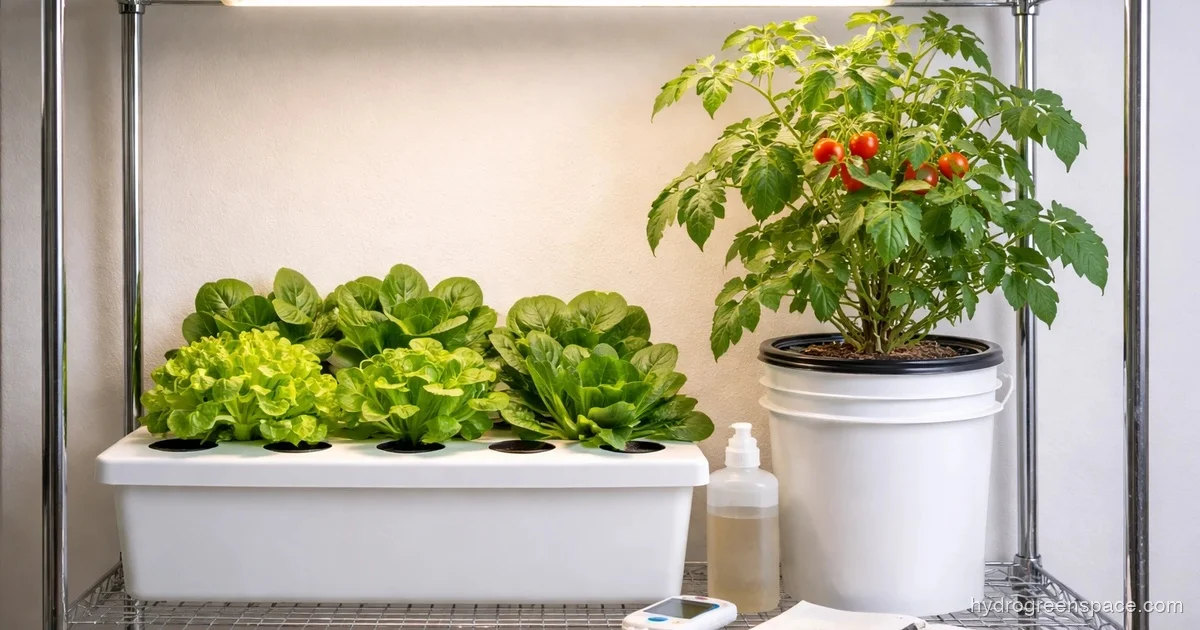
Most “best hydroponic system” guides pick a winner and call it done. The problem is that the best indoor hydroponic system for vegetables depends almost entirely on what you want to grow, and a countertop kit that’s perfect for lettuce will fail you the moment you try to grow a tomato plant in it.
I’ve seen this happen to dozens of beginners: they buy a popular 12-pod herb garden, get excited, and then wonder why their pepper plants are stunted at six inches while still in the seedling phase. The system wasn’t broken. It just wasn’t built for that crop.
I’ll tell you the right system for each vegetable category, why it works, and what to avoid. If you’re still deciding what to grow, start with different types of hydroponic systems to understand the mechanics before committing to hardware.
Why the “Best” System Depends on What You’re Growing
The short answer to “what type of hydroponic system is best for vegetables?” is: it depends on whether you’re growing leafy crops or fruiting ones.
Leafy greens (lettuce, spinach, kale, chard) have shallow root systems, low nutrient demands, and a short grow cycle of four to six weeks. They thrive in low-maintenance systems with minimal water volume.
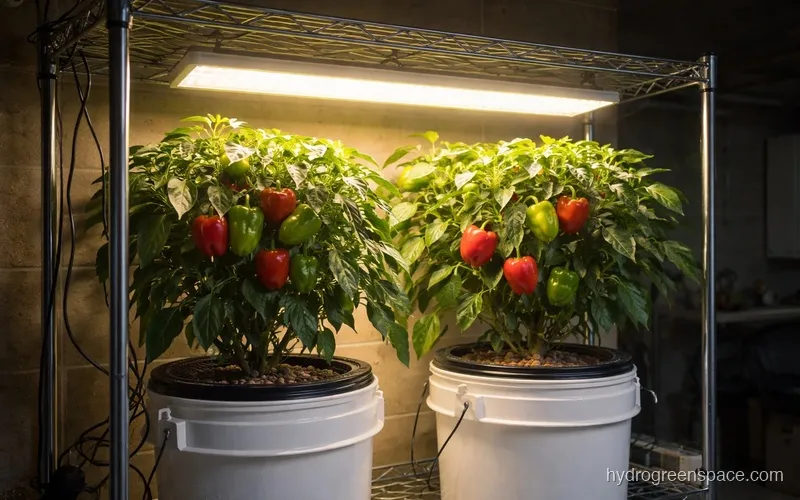
Fruiting vegetables (tomatoes, peppers, cucumbers, eggplant) are the opposite. They need deep root zones, high nutrient concentrations, strong lighting, and a lot more patience. A countertop herb kit simply does not have the water reservoir capacity or structural support these plants require.
Herbs fall somewhere in between, depending on whether they’re compact varieties (basil, cilantro) or woody perennials (rosemary, thyme).
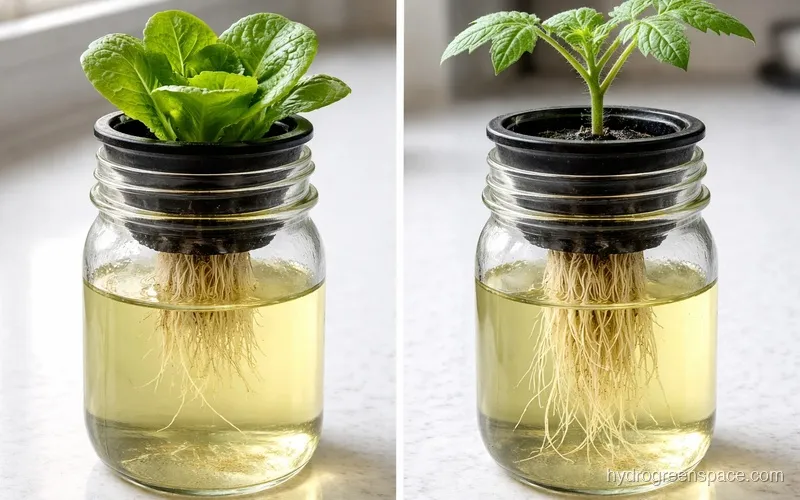
Once you’ve matched the system to the crop, the secondary filters are space (countertop vs. shelf vs. grow tent), noise tolerance for apartments, and how much weekly maintenance you’re willing to do.
Quick-Pick Comparison
| System | Best For | Type | Budget |
|---|---|---|---|
| AeroGarden Bounty | Leafy greens & herbs | Aeroponic | $$ |
| Lettuce Grow Farmstand | High-volume leafy greens | Vertical tower | $$$ |
| GH WaterFarm | Fruiting veg (1 plant) | DWC | $$ |
| Viagrow 4-Bucket DWC | Fruiting veg (multi-plant) | DWC | $$$ |
| iDOO 7-Pod | Herbs on a budget | Aeroponic | $ |
| AeroGarden Farm 24 | Herbs at scale | Aeroponic | $$$$ |
Best Hydroponic Systems for Leafy Greens
Leafy greens are the ideal starting crop for indoor hydroponics. Fast turnaround, forgiving on nutrients, and almost every system type works well with them. The question is really about space and scale.
AeroGarden Bounty (Best All-in-One Countertop Pick)
The AeroGarden Bounty is a 9-pod aeroponic system with a built-in grow light on an adjustable arm. It’s genuinely well-engineered for leafy greens and herbs, and the light spectrum is dialed in for vegetative growth.
What I like about it: the reservoir is two liters, which is fine for lettuce and spinach, and the automated reminder system for water and nutrients makes it nearly zero-effort to run. Yield per grow cycle with lettuce is respectable for the size.
What it won’t do: support anything that grows above 24 inches, hold more than nine pods, or justify its price if you’re seriously scaling up. This is a countertop quality-of-life purchase, not a production system.
AeroGarden Bounty
9-pod aeroponic system with built-in adjustable grow light. Nearly zero-effort to run with automated water and nutrient reminders.
Best for: Lettuce, spinach, basil, cilantro, chard
Check price on AmazonTip: The AeroGarden Bounty is frequently discounted during Amazon’s sale events. The Harvest (6-pod version) is half the price but produces noticeably less yield per cycle. The jump from 6 to 9 pods is worth it.
Lettuce Grow Farmstand (Best for High-Volume Leafy Greens)
The Lettuce Grow Farmstand is a vertical tower system with plant pods arranged around a central reservoir column. You start with 12 pods and can stack up to 36. It’s designed for outdoor use but works indoors near a sunny window or under supplemental lighting.
The limitation here is lighting: the Farmstand doesn’t include grow lights, and to get consistent yields indoors year-round, you’ll need to add their LED halos or a third-party fixture. That adds to the cost.
For leafy greens at scale, though, this is one of the cleanest indoor hydroponic vegetable garden systems available. The pump is whisper-quiet, which matters in apartments.
Lettuce Grow Farmstand
Vertical tower system starting at 12 pods, expandable to 36. Whisper-quiet pump, good choice for apartments growing leafy greens at scale.
Best for: Lettuce, kale, arugula, Swiss chard, herbs
Check price on AmazonGrow lights not included; budget for LED halos or a third-party fixture for year-round indoor use.
Best Hydroponic Systems for Fruiting Vegetables
Tomatoes, peppers, and cucumbers are where most beginners either spend too little and regret it, or buy the wrong system entirely. These plants need a deep-water culture (DWC) or recirculating drip system with a real water reservoir (five gallons minimum per plant), and high-output lighting is non-negotiable.
If you’re planning to grow tomatoes and peppers indoors, read the section on growing tomatoes hydroponically before you buy anything. The system choice is only part of the equation.
General Hydroponics WaterFarm Complete (Best DWC for Beginners Growing Fruiting Veg)
The WaterFarm is a single-bucket DWC kit with a drip ring and air pump. At around eight gallons, it gives one large plant the root volume it needs. The drip ring keeps roots oxygenated at the top while the air stone handles the reservoir.
Setup takes about 30 minutes. Maintenance is a weekly nutrient solution check, pH adjustment, and reservoir top-off. Expect to spend 20 to 30 minutes per week on a single unit.
One honest note: a single WaterFarm grows one plant. If you want to run tomatoes and peppers alongside each other, you’ll need multiple units or the multi-bucket Farm systems.
General Hydroponics WaterFarm Complete
Single-bucket DWC kit with drip ring and air pump. Eight-gallon reservoir gives one large fruiting plant the root volume it needs.
Best for: Tomatoes, peppers, cucumbers (one plant per unit)
Check price on Amazon→Check price on Mars Hydro TS1000Full-spectrum 150W LED, what I'd pair with a single or dual WaterFarm setup.What I’d do: If I were setting up a serious indoor fruiting system for the first time, I’d run two WaterFarms side by side under a 200W LED (something like the Mars Hydro TS 1000). That gives you one tomato and one pepper plant with enough light to actually produce fruit.
Viagrow Complete DWC Hydroponic System (Best Modular Kit for Expansion)
The Viagrow kit is a four-bucket recirculating DWC setup connected to a five-gallon reservoir. All four plants share the same nutrient solution, which simplifies feeding but means you need to grow plants with similar nutrient needs in the same run.
The modular design is the big win here. You can expand to eight or more buckets without replacing the whole system, which is what home growers who want to scale actually need. Start with four, add more when you’re comfortable.
Viagrow 4-Bucket Recirculating DWC
Four-bucket recirculating DWC connected to a shared reservoir. Modular, expandable to 8+ buckets without replacing the whole system.
Best for: Tomatoes, peppers, cucumbers, eggplant (multi-plant)
Check price on Amazon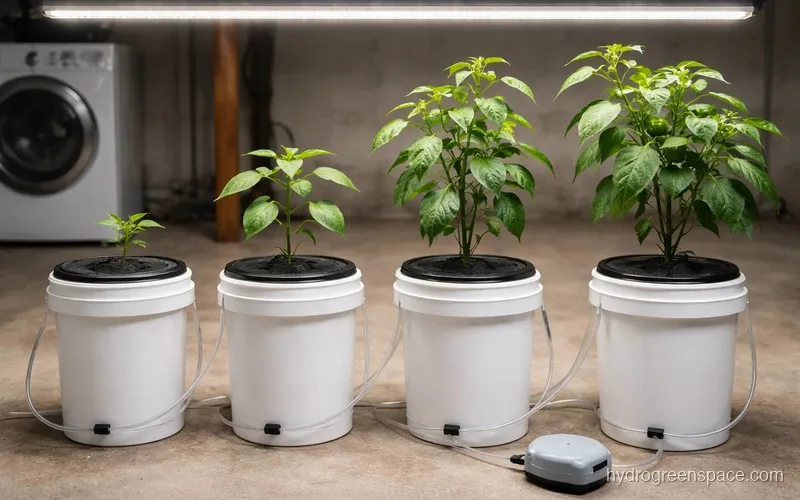
Warning: DWC is unforgiving on temperature. If your nutrient solution goes above 72°F (22°C), root rot becomes a real risk. In a basement setup this usually isn’t an issue (see setting up a basement hydroponics space for temperature management), but in a warm apartment, a small aquarium chiller is worth the investment.
Drip Systems for Apartments and Larger Setups
If noise is a concern, a drip system (also called a top-feed system) runs a pump on a timer rather than continuously. That means the pump cycles on for 15 minutes every hour instead of running non-stop, which cuts noise significantly.
The Active Aqua Grow Flow system and the Greentree Hydroponics Drip System are both solid entry-level options for apartment growers who want to run fruiting vegetables without the constant hum of an air pump.
→Check price on Active Aqua Grow Flow12-site drip system, timer-based pump runs quietly on cycles instead of continuously.Best Hydroponic Systems for Herbs
Herbs are the most beginner-friendly crop for indoor hydroponics. The compact annuals (basil, cilantro, dill) are covered well by small countertop systems. Woody perennials (rosemary, thyme, oregano) need more root space and a system with a larger reservoir than most entry-level kits provide.
iDOO 7-Pod Hydroponic Garden (Best Budget Herb System)
For compact herbs, the iDOO is hard to beat on price. It’s a simple aeroponics-style countertop system with seven pods, built-in LED, and a quiet pump. No complicated setup, no pH meter required at the start (though I’d recommend getting one eventually).
The reservoir is small, which means more frequent top-offs, but for herbs on a kitchen counter the maintenance is manageable.
iDOO 7-Pod Hydroponic Garden
Budget countertop herb system with built-in LED and quiet pump. No complicated setup, good first system for kitchen herbs.
Best for: Basil, cilantro, mint, parsley, dill
Check price on AmazonNo pH meter required to start, but pick one up once you're comfortable; it makes a noticeable difference in yield.
Common mistake: Planting mint near other herbs in a shared-pod system. Mint is aggressive and will outcompete everything else in the pod arrangement within two weeks. Give mint its own dedicated system or keep it isolated.
AeroGarden Farm (Best for Serious Herb Production)
The AeroGarden Farm 24 is a two-tiered 24-pod system with independent grow light arms. It’s significantly more expensive, but if you want to grow herbs at scale (or mix herbs with leafy greens), the larger reservoir and taller grow space make it worth considering.
This is where the best hydroponic grow kits conversation starts to overlap with herb production: systems like the Farm 24 are capable of both.
AeroGarden Farm 24Plus
Two-tiered 24-pod system with independent grow light arms. Larger reservoir and taller grow space than countertop units, built for mixed herb and leafy green production.
Best for: High-volume herbs, mixed leafy greens and herbs
Check price on AmazonWhat About Grow Lights?
If you’re growing near a window with direct sun for 6+ hours a day, some leafy greens and herbs can get by without supplemental lighting. Fruiting vegetables will not produce well without a dedicated grow light, full stop.
The spectrum matters: vegetative growth (leafy greens, herbs) needs more blue light (5000-6500K). Flowering and fruiting crops (tomatoes, peppers) need more red spectrum (2700-3000K). Most modern full-spectrum LED grow lights balance both, but check before buying. For a deeper look at this, LED grow lights for hydroponics covers spectrum, PPFD, and fixture sizing in detail.
Can You Grow All Vegetables in a Hydroponic System Indoors?
Technically, yes. Practically, some vegetables aren’t worth the effort in a home setup. Root vegetables (carrots, beets, potatoes) require specially designed deep media beds, and the yield per square foot rarely justifies the space. Corn is possible but borderline absurd indoors.
The vegetables that actually make sense hydroponically: lettuce, spinach, kale, Swiss chard, basil, cilantro, tomatoes, peppers, cucumbers, green beans, peas, and strawberries. If you want a full breakdown, the hydroponic vegetables guide covers which crops are worth your time and which aren’t.
The fastest crops to harvest are leafy greens: a lettuce head can go from seed to harvest in 30 days under optimal conditions. Basil is close behind. Tomatoes and peppers take 60 to 90 days and require hand-pollination indoors since there are no pollinators.
How Much Does an Indoor Hydroponic Vegetable System Cost?
Here’s a realistic budget breakdown:
| Setup Type | System Cost | Lighting | Nutrients (first run) | Total |
|---|---|---|---|---|
| Countertop herb/leafy kit | $80-$150 | Included | $15-$25 | $95-$175 |
| Mid-range leafy system | $150-$300 | Included or $50-$100 | $20-$40 | $170-$440 |
| Single-plant DWC (fruiting) | $60-$120 | $80-$150 | $30-$50 | $170-$320 |
| 4-bucket DWC (fruiting) | $150-$300 | $150-$300 | $40-$60 | $340-$660 |
Nutrients are an ongoing cost. If you want to reduce that long-term, making your own hydroponic nutrients from compost is one option worth exploring for leafy crops, though I’d recommend starting with a commercial A+B formula until you’re comfortable with the system.
→Check price on GH Flora Series 3-Part KitThe nutrient kit I start every new grower on, works for leafy greens and fruiting veg across all growth stages.The nutrient piece matters more than most beginners expect. If you want the full picture on what to feed your plants, the best nutrients for hydroponic vegetables guide covers NPK ratios, micronutrient deficiencies, and brand comparisons.
How to Choose: A Quick Decision Filter
If you’re still not sure where to start, run through this:
- What are you growing? Leafy greens or herbs → start with a countertop all-in-one. Fruiting vegetables → DWC or drip system, minimum 5-gallon reservoir per plant.
- How much space? Countertop (under 2 sq ft) → AeroGarden Bounty or iDOO. Shelf or dedicated grow space (4-10 sq ft) → Lettuce Grow Farmstand or multi-bucket DWC.
- Apartment or house? Noise sensitivity → look at systems with timer-based pumps or the quietest aeroponic units.
- How much time per week? Under 30 minutes → stick to all-in-one kits with automated alerts. Happy to tinker → modular DWC gives you more control and scalability.
If you’re brand new to all of this, the best hydroponic system for beginners pillar covers the foundation before you invest in a full vegetable setup. And if space is tight, the best hydroponic systems for apartments rundown focuses specifically on compact, low-noise options.
Pick the system that matches what you want to grow first. Get one crop dialed in. Then expand. The growers who stick with hydroponics long-term are the ones who started with one system, learned it well, and grew from there.