Best Hydroponic Grow Kit for Indoor Gardening (2026)
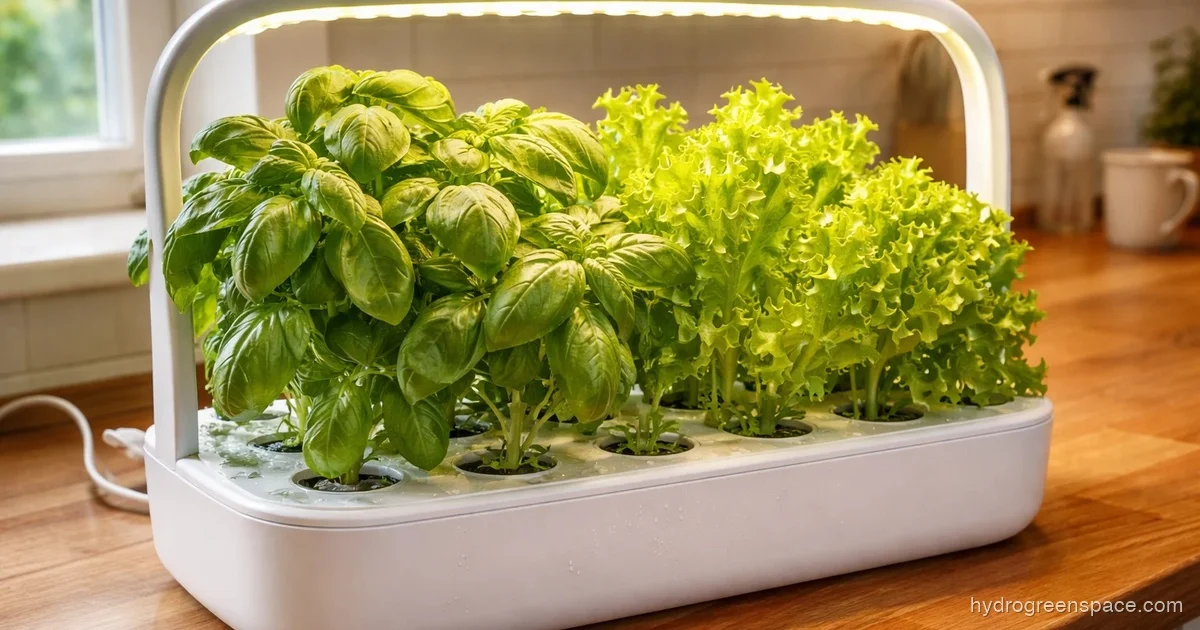
The best hydroponic grow kit for indoor gardening is not a single product. It depends on what you want to grow, how much counter space you have, and whether you want to spend $80 or $300. Before getting to any specific kit, this guide covers what actually separates a good kit from a mediocre one. Then the picks are organized by use case, so you can go straight to the one that fits your situation.
If you’re starting from zero and want to understand how a hydroponic system works before spending any money, that’s worth a few minutes of reading. If you’re ready to buy, keep going.
Quick-Pick Comparison
| Kit | Best For | Type | Budget |
|---|---|---|---|
| AeroGarden Harvest | Absolute beginners, herbs | Aeroponic pod | $$ |
| iDOO 12-Pod | Herbs & leafy greens, more capacity | Aeroponic pod | $ |
| Click & Grow Smart Garden 3 | Tiny spaces, zero-maintenance | Smart garden | $ |
| Gardyn Home Kit 3.0 | Serious growers scaling up | Aeroponic tower | $$$$ |
What to Look for Before You Buy Any Kit
Here’s what actually matters.
Pod Count and Family Size
Pod count is the first number you’ll see on any countertop hydroponic garden kit, and it’s easy to underestimate how much it matters. A 6-pod unit will keep one person in fresh herbs. A 12-pod system can realistically produce salad greens for two people a few times a week. A 24-pod tower is a different category entirely — it’s for someone who wants to replace a meaningful chunk of their grocery bill.
The mistake I see constantly: someone buys a 6-pod kit hoping to grow their own lettuce, harvests a small bowl every two weeks, gets frustrated with the yield, and writes off the whole thing. The system worked fine. The pod count just didn’t match the expectation.
Built-In LED Grow Light vs. No Light
A kit that includes a built-in LED grow light is not the same product as one that doesn’t, and the price difference is real. If you’re putting a kit near a south-facing window that gets 6 or more hours of direct sun, you might get away without supplemental lighting for herbs. For leafy greens and anything that isn’t herbs, you need the light.
Most countertop kits in the $80-$200 range come with integrated grow lights. If a kit at that price doesn’t include lighting, look closely at what you’re actually getting.
System Type: Pod Gardens vs. DWC vs. Aeroponic Towers
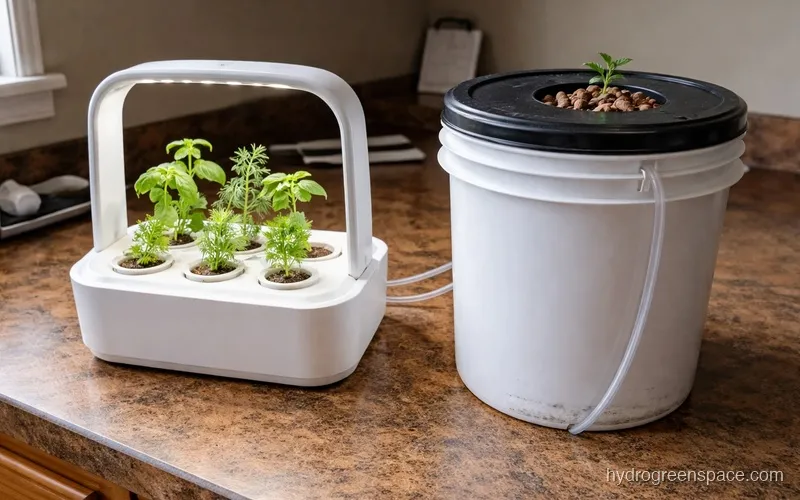
Countertop pod systems (AeroGarden, Click & Grow, iDOO) are self-contained units with pre-seeded or empty grow pods, a reservoir, a pump, and a light overhead. They’re the easiest entry point — fill the reservoir, add nutrients, plug in the light. Almost no learning curve.
Deep water culture (DWC) kits are a step up. You get a bucket or reservoir, net pots, an air pump, and tubing. No pod system, no fancy enclosure. You’re responsible for seeds, growing medium, and nutrients separately. If you want to understand the different types of hydroponic systems before committing to one, DWC is the most educational to start with because you can see exactly what’s happening with the roots. A simple 5-gallon bucket system falls into this category.
Aeroponic tower systems (Gardyn, Tower Garden) spray mist at the roots instead of submerging them. They’re more efficient with water and nutrient solution, grow more plants in vertical space, but cost significantly more and have more components that can fail.
What I’d do: If you’re buying your first kit and want a reliable, low-maintenance start, go with a countertop pod system with an integrated grow light. Skip the aeroponic tower until you’ve got one growing season under your belt.
Budget Tiers That Actually Matter
- Under $100: You’re looking at small pod systems (6-12 pods), basic DWC bucket kits, or starter-level countertop gardens with mediocre lights. Good for testing whether you’ll stick with the hobby.
- $100-$200: The sweet spot for most beginners. This range gets you a solid pod system with a decent light spectrum, or a quality DWC kit with everything included.
- $200-$300+: You’re crossing into smart systems with app connectivity, larger pod counts, or aeroponic towers. Worth it if you know you’ll use it. Overkill for a first purchase.
The Best Hydroponic Grow Kits by Use Case
Best for Absolute Beginners: AeroGarden Harvest
The AeroGarden Harvest (6 pods) is the kit I recommend to anyone who wants to start growing without spending a weekend on setup or troubleshooting. It comes with everything: the unit, a 20-watt LED grow light on an adjustable arm, the pump, pods, nutrient solution, and seed kit. Fill it, add nutrients, set the light timer. That’s genuinely the full setup.
The light is on a simple digital timer with preset growing modes. The reservoir holds about a liter and a half, and it reminds you with indicator lights when to add water and nutrients. For herbs, this is a complete, functional system.
The honest limitation: 6 pods is not a lot of production. You’ll grow enough basil to use in cooking, not enough to preserve or give away. If you want more throughput, the AeroGarden Bounty (9 pods) or Harvest Elite (also 6 pods, with Wi-Fi) are direct upgrades.
AeroGarden Harvest
6-pod aeroponic system with a 20W LED grow light, built-in pump, and automatic reminders. Fill, add nutrients, and go.
Best for: First-time growers, herb gardens, limited counter space
Check price on AmazonBest for Herbs and Leafy Greens: iDOO 12-Pod System
The iDOO 12-pod system hits a price point (usually $80-$120) that’s hard to argue with for what you get. The full-spectrum LED panel is adequate for herbs and lettuces, the reservoir is larger than most entry-level systems, and the height is adjustable so you can accommodate plants that bolt.
It’s not as polished as AeroGarden. The pump can be slightly audible, and the build quality is noticeably lighter. But for the price, it’s one of the best indoor hydroponic garden kits for someone who wants more growing capacity without crossing the $150 threshold.
iDOO 12-Pod Hydroponic System
Full-spectrum LED panel, adjustable height, larger reservoir than entry-level units. More growing capacity without the AeroGarden price.
Best for: Herbs and lettuces, budget-conscious buyers, households needing 12 pods
Check price on AmazonBest Compact Kit: Click & Grow Smart Garden 3
If counter space is your real constraint, the Click & Grow Smart Garden 3 is the most honest product in this category. It’s small, the plant pods are proprietary and pre-loaded with substrate and nutrients (you add water and the system feeds itself), and there’s no nutrient measuring involved at all.
This is closer to a “smart garden” than a true hydroponic grow kit in the traditional sense. The nutrient solution is embedded in the pod substrate rather than dissolved in water. That distinction matters if you want to eventually move to full hydroponics, but if you want fresh herbs on your windowsill with absolutely zero management, it’s hard to beat.
Common mistake: Expecting Click & Grow pod gardens to produce the same yield as a true hydroponic system. The pods are smaller and the growing medium is different. Manage expectations: you’re getting a live herb plant that lasts weeks, not a high-production system.
Pairs well with the best hydroponic system for apartments if you want to graduate to a larger setup later.
Click & Grow Smart Garden 3
Three-pod self-feeding smart garden. Nutrients embedded in the substrate, zero measuring required. Compact enough for any windowsill.
Best for: Tiny kitchens, windowsills, gift buyers, zero-maintenance herb growing
Check price on Amazon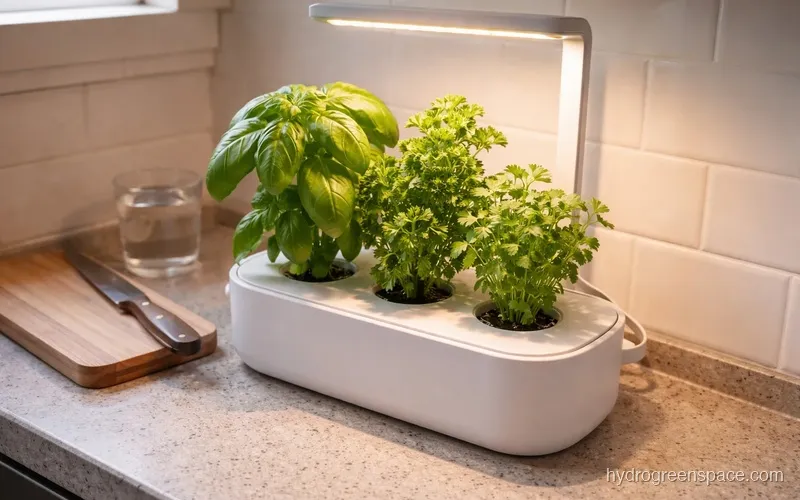
Best Under $100: URUQ or Ahopegarden 12-Pod Systems
Several Chinese-manufactured pod systems have entered the market at the $60-$90 range and they’re genuinely decent for the price. URUQ and Ahopegarden are the two I’d feel comfortable recommending in this tier.
What you’re giving up vs. AeroGarden: build quality, customer support, and brand reputation. What you’re getting: more pods for less money, adequate grow lights for herbs and lettuces, and a reservoir large enough to go a week without checking.
If your goal is to test whether you’ll actually use a hydroponic kit before investing more, this is the right place to start. The best hydroponic system under $100 has more depth on this category if budget is your main filter.
Best for: First-time buyers who want to test the hobby before committing to a higher-end system, college dorms, office spaces.
→Check price on Apera PH20 pH MeterWorth adding to any budget pod system to catch nutrient solution drift early.Tip: With budget pod systems, spend an extra $10 on a quality pH test kit. These systems work, but the cheaper nutrient solutions included in starter kits can drift pH in ways that stall growth. A quick pH check every few days catches problems early.
Best Smart System: Gardyn Home Kit 3.0
The Gardyn Home Kit 3.0 is a different category entirely. It’s a 30-pod vertical aeroponic tower with an app, a camera, and AI-assisted plant monitoring. At $695 for the full kit, it’s not a beginner buy, but it’s the most capable home system I’ve seen for someone who wants to genuinely replace grocery store produce.
The app monitors your plants between visits, the aeroponic misting system is more efficient with water and nutrients than pod-based systems, and the 30-pod capacity is enough to produce real meal volume from leafy greens. It also looks intentional in a kitchen or living space, which matters when you’re dealing with a piece of equipment that lives at eye level.
The honest tradeoff: it’s expensive, it has more components to maintain, and the proprietary pods lock you into their ecosystem for seed purchases.
Gardyn Home Kit 3.0
30-pod vertical aeroponic tower with app, camera, and AI-assisted plant monitoring. The highest-production home system available.
Best for: Committed growers scaling up, households of 3-4 people, app-connected monitoring
Check price on AmazonProprietary pods required for seed purchases; factor that into the long-term cost.
Best for Growing Vegetables: Look Beyond Pod Systems
If your goal is to grow actual vegetables (tomatoes, peppers, cucumbers), countertop pod kits are generally the wrong tool. Most pod systems aren’t designed for plants with heavy root systems or significant vertical height.
For vegetables, you want a DWC kit or a larger system with dedicated grow space. The best hydroponic systems for vegetables goes deep on this, but the short version is: look for a system with at least a 5-gallon reservoir per plant, a quality air pump, and separate grow lighting with enough wattage for fruiting plants (at minimum 200-300 actual watts for a small space).
The list of vegetables that grow well in hydroponics is worth a read before you decide what to plant, because some vegetables (cherry tomatoes, kale, chard) adapt very well to hydroponic kits while others need more root space than any countertop system can provide.
What Comes in a Hydroponic Kit (and What Doesn’t)
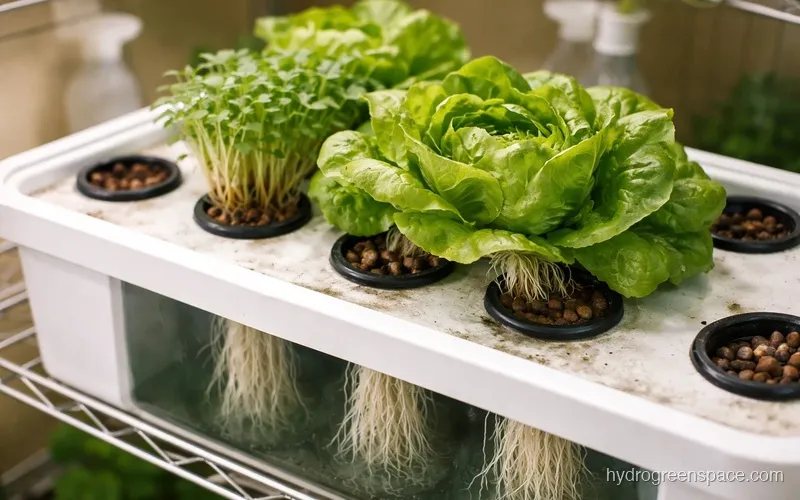
Most beginner kits include: the growing unit, a pump, a light (if it’s a countertop system), growing pods or net pots, a starter nutrient solution, and a seed kit or seed pods.
Most kits do not include: pH testing supplies, replacement nutrient solution beyond the starter pack, extra seed pods, or a thermometer for your reservoir. The germination dome, if needed, is usually not included in pod-style systems (they’re typically designed for direct pod insertion).
If you’re working from a true DWC or aeroponic kit rather than a pod system, you’ll need to buy growing medium, pH solution, and seeds separately. A full hydroponic equipment checklist covers everything you’ll want to have on hand before your first grow.
A Note on Setup Time
Pod systems: 10-15 minutes to unbox and start. DWC kits: 30-60 minutes including pump setup and initial fill. Aeroponic towers: 1-2 hours, especially if you’re connecting an app and calibrating a sensor.
This isn’t a reason to avoid the more complex systems if you’re ready for them. But if you’re buying a kit as a gift or for someone who wants minimal friction, setup time is a real differentiator.
How to Choose if You’re Still Not Sure
Here’s the decision made simple:
- You want herbs with no hassle and have $100-$150: AeroGarden Harvest or Bounty
- You want more pods without spending much: iDOO 12-pod or a budget tier brand
- Your space is genuinely tiny: Click & Grow Smart Garden 3
- You want to grow vegetables: skip the pod systems entirely, go DWC
- You want to invest in a real high-production system: Gardyn Home Kit 3.0
- You’re not sure what you even need yet: read the best hydroponic systems for beginners before buying anything
The kit is just the starting point. Once you’ve grown one cycle with whatever system you choose, you’ll know exactly what you want next, and it’ll be a much easier decision.