Best Hydroponic System for Beginners (2026 Guide)
The most common beginner hydroponic mistake isn’t buying the wrong nutrients or skipping a pH meter. It’s picking a system that’s too complex for where you are right now. Someone who starts with a recirculating NFT system when they’ve never grown anything hydroponically is going to have a bad time, and not because NFT is bad. It’s because the learning curve for the system itself competes with the learning curve for growing. Keep it simple on round one.
This guide covers everything a first-time grower needs to choose the right starting system: which system types actually work for beginners, how to match a system to your space and budget, which products deliver on their promises, and when it’s worth spending more. Every section links to a deeper article so you can go as far as you want without losing the thread.
What Is the Easiest Hydroponic System for a Beginner?
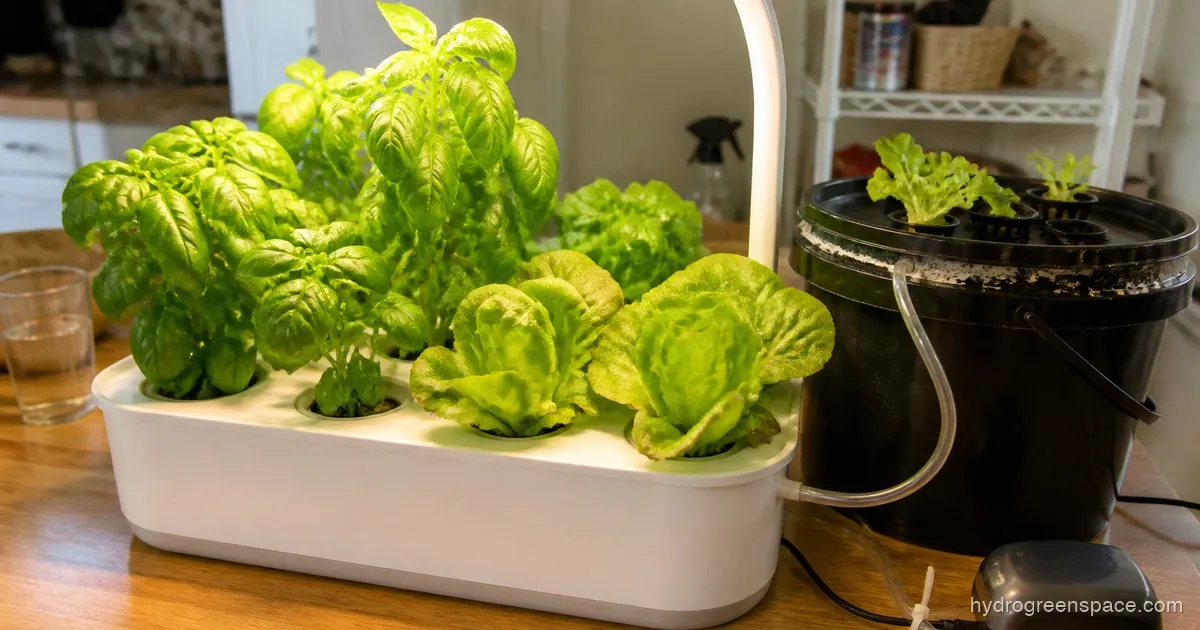
If you have to pick one system to start with, pick Deep Water Culture (DWC). You grow plants in a bucket or reservoir, their roots hang in a nutrient solution, and an air pump keeps the water oxygenated. That’s it. There are only a few things that can go wrong, and almost all of them are visible and fixable before they kill your crop.
The Kratky method is even simpler if you want to go hands-off. No pump, no electricity, no moving parts. You fill a jar or reservoir with nutrient solution, set your plant in it, and let it grow. The gap between the water surface and the net pot naturally creates an air pocket that roots use for oxygen. It works remarkably well for lettuce and herbs. The tradeoff is that it doesn’t scale easily, and anything that uses a lot of water (like basil) needs more frequent topping off than the method implies.
Countertop all-in-ones like the AeroGarden take the simplest possible approach: plug it in, add pods, add nutrients when the light blinks. The light, pump, and timer are all built in. These systems are genuinely beginner-friendly, but they come with real constraints on pod count and what you can actually grow. They’re a great way to learn the fundamentals without needing to understand any of the mechanics underneath.
What you want to avoid early on: NFT (Nutrient Film Technique) and aeroponics. NFT pumps a thin film of nutrient solution over roots continuously; if the pump fails for even a few hours, your plants die. Aeroponics mists roots in a chamber and requires precise timing, clean nozzles, and consistent pressure. Both systems work well in the hands of experienced growers. Neither is where you want to start.
Best Hydroponic Grow Kits for Indoor Gardening
If you want something that ships to your door mostly ready to go, a dedicated grow kit is the fastest path to your first harvest. The challenge is that “kit” means different things depending on the price and the brand. Some kits include grow lights, nutrients, a timer, and grow media. Others include the reservoir and pods and assume you’ll figure out the rest.
The most important question to ask before buying any kit: what is NOT included? A $60 kit that requires you to buy a $40 LED, a pH meter, and nutrients is actually a $140 kit. A $120 kit that includes everything functional out of the box is the better deal even though the price tag looks higher. A good kit declares its contents clearly; a misleading kit makes you find out through trial and error.
Kits fall into two broad categories. Countertop herb gardens (AeroGarden, CRZDeal, LYKO, Sarina) are self-contained and designed for herbs and small greens. Larger modular kits give you more control and growing space but require more setup. For the full breakdown of what separates a good kit from a mediocre one, organized by use case, see Best Hydroponic Grow Kit for Indoor Gardening.
Best Indoor Hydroponic Systems for Vegetables
Growing vegetables hydroponically indoors is a completely different challenge than growing herbs on your countertop. Leafy greens like lettuce, kale, and spinach are low-light, fast-growing, and forgiving. Fruiting vegetables like tomatoes, cucumbers, and peppers need more light, more root space, and longer grow cycles.
A countertop AeroGarden or 12-pod herb garden is not going to grow a tomato plant to maturity. The pod size limits root development, and the built-in lights aren’t powerful enough to drive fruit production. If you want vegetables beyond greens, you need a system with a larger reservoir, more head height for plant growth, and either a serious grow light or a window that gets 6-plus hours of direct sun.
The short answer on system type: DWC or ebb-and-flow for fruiting vegetables, NFT or Kratky for leafy greens, and either works for herbs. The longer answer matches each vegetable category to the system and setup that will actually produce results. For that full breakdown, see Best Indoor Hydroponic System for Vegetables.
AeroGarden Sprout: The Most Purchased Beginner System
The AeroGarden Sprout is probably the system most beginners buy first. It’s on Amazon, it’s under $100, and it works. What it doesn’t tell you up front is that it only holds 3 pods, the included seed pods run out in about six weeks, and after that you’re either buying AeroGarden-branded refills at a premium or figuring out how to use your own seeds with blank pods.
Is it worth buying? For someone who genuinely just wants to grow a few fresh herbs on the counter and doesn’t want to think about nutrients or timers, yes. For someone who expects a full herb garden that produces continuously with minimal input, the Sprout will feel small and expensive to maintain. The Harvest (6 pods) is the better buy for most people if you’re going to spend money in this product line at all.
For a full breakdown of germination, light performance, ongoing costs, and how it compares to the Harvest, see AeroGarden Sprout Review.
CRZDeal Indoor Hydroponic Garden: Budget vs. Name Brand
The CRZDeal system shows up as an alternative to the AeroGarden in almost every budget comparison, and for good reason: it costs $30 to $50 less and holds more pods. But the comparison is more nuanced than price alone. AeroGarden’s light is noticeably stronger, and their support is better. CRZDeal’s grow sponges have a documented mold risk if you’re not careful about humidity and airflow during germination.
If you’re choosing between these two systems, the question is really about priorities. The AeroGarden costs more but delivers a more polished experience and more reliable results. CRZDeal delivers more pods per dollar but requires a bit more attention to setup and humidity. Neither is the wrong choice; they suit different buyers. For the full comparison and honest assessment of what CRZDeal gets right and where it falls short, see CRZDeal Indoor Hydroponic Garden Review.
LYKO Hydroponics Growing System: Budget Herb Garden Worth Watching
The LYKO system keeps appearing in “best budget herb garden” roundups, and it earns those mentions with a clean design and solid light output for the price. The thing that doesn’t show up in those lists is the durability question: LYKO uses a water pump and tubing system that’s less robust than what you’d find in a more established brand, and some long-term users have reported pump issues after several months of continuous use.
If you’re buying this as a starter system to grow one or two herb cycles and learn how hydroponics works before upgrading, it’s a reasonable choice. If you’re looking for something that will run for 2-plus years without issues, it’s a riskier bet. For who should buy it and who should look elsewhere, see LYKO Hydroponics Growing System Review.
Growee Hydroponics: Automated pH for Home Growers
pH management is the thing that trips up most beginners after their first successful crop. You nail germination, the plants take off, and then around week 4 things start looking off: yellowing, slow growth, wilting that doesn’t make sense given you’re watering correctly. The culprit is usually pH drift. Nutrient solution pH needs to stay between 5.5 and 6.5 for most plants, and without regular testing and adjustment it drifts constantly.
Growee is an automated controller that manages pH (and optionally nutrients) for you. It attaches to any existing reservoir, uses a probe to monitor pH in real time, and doses pH-up or pH-down solution automatically to keep you in range. It’s not cheap, and it doesn’t replace understanding why pH matters. But for growers who have already run a few cycles and want to take daily maintenance off their plate, it’s genuinely useful. For the honest assessment of whether the accuracy, app experience, and cost add up for a home grower, see Growee Hydroponics Review.
Hydropickers Hydroponic Grow Box: No Electricity Required
The Hydropickers grow box is a Kratky-style passive system sold at Home Depot and Tractor Supply: no pump, no electricity, no timer. You fill it with nutrient solution, plant your seeds in the net pots, and the system takes care of itself as water is consumed. That simplicity is the whole appeal.
The honest limits: this works well for lettuce, herbs, and leafy greens. It does not work well for tomatoes, peppers, or any plant with substantial root mass or high water demand. The reservoir is sized for smaller crops, and the Kratky method provides no recirculation; when the water is gone, you add more and maintain the air gap. It’s genuinely beginner-friendly for the plants it’s suited for. For a full comparison against DIY Kratky and what you’ll need to add, see Hydropickers Hydroponic Grow Box Review.
MUFGA Hydroponics: A Mid-Range System Worth Setting Up Correctly
The MUFGA system is a recirculating DWC-style kit that sits in the $60 to $100 range and delivers a lot of growing capacity for the price. It’s not the easiest system to set up. The instructions that ship with it are thin and miss a few details that matter, like the pod sticker you shouldn’t throw away during unboxing and the difference between topping off water and actually cycling the reservoir.
Once it’s running correctly, MUFGA grows lettuce, herbs, and greens reliably. The mistake most beginners make is placing it near a window as a substitute for a grow light; the plants stretch toward the light source and never develop compact, healthy growth. For the full setup guide (including what the instructions miss), what grows well, and who should buy it, see MUFGA Hydroponics Instructions and Setup Guide.
Sarina Hydroponic Smart Garden: 12 Pods and an App
The Sarina Smart Garden is a 12-pod LED-lit countertop system with app connectivity, designed to feel like a premium product in the AeroGarden tier without the AeroGarden price. On paper it checks every box. In practice, buyer complaints across platforms are consistent enough to take seriously: app connectivity issues, inconsistent pod germination, and customer support that’s difficult to reach.
That said, it grows well when it works, and 12 pods is a meaningful upgrade over a 3-pod or 6-pod system if you want variety. The comparison that matters most is Sarina vs. AeroGarden Sprout: two very different pod counts, different price points, and different reliability records. For who the Sarina is actually right for and where to be cautious, see Sarina Hydroponic Smart Garden Review.
Best Hydroponic Systems by Budget
How much does a beginner hydroponic system cost? The real answer depends on what you want to grow, but here’s a useful frame for setting expectations.
Under $100: You’re in countertop herb garden territory (AeroGarden Sprout, CRZDeal, LYKO, Hydropickers) or a basic DWC bucket setup you build yourself. Expect to grow herbs and leafy greens. Lights are usually included with countertop systems; DIY DWC requires a separate light unless you have a strong window. These systems are reviewed in depth in Best Hydroponic System Under $100.
$100 to $200: This is where grow capacity expands meaningfully. You can get a 12-pod system with a stronger light, or a mid-range modular kit that can handle larger plants. Spend $100 on a hydroponic system and you’ll grow herbs; spend $200 and you can grow vegetables. The difference mostly comes down to light output and reservoir size. See Best Hydroponic System Under $200.
$200 to $500: This range stops feeling like a kitchen appliance and starts feeling like actual growing infrastructure. You’re looking at real DWC setups, better automation, and systems that can handle tomatoes, cucumbers, or peppers across multiple grow cycles. See Best Hydroponic System Under $500.
Best Complete Hydroponic Starter Kits
The kits that earn the “complete” label genuinely include light, nutrients, grow media, and some form of pH guidance. The ones that don’t are still worth considering at the right price point; you just need to know exactly what you’re buying. For the breakdown by price tier and exactly what’s included (and what isn’t) in each category, see Best Complete Hydroponic Starter Kit for Beginners.
Best Hydroponic Systems for Apartments
Growing in an apartment creates four constraints that don’t apply when you have a basement or garage: footprint, noise, humidity, and water containment. A countertop herb garden handles all four easily. A larger DWC or multi-bucket system requires more thought: reservoir changes involve moving water, pumps produce low-level noise that matters in a quiet space, and any humidity added to a small apartment affects your whole living environment.
Apartment growers also deal with the landlord question. Most small countertop systems are genuinely non-invasive and indistinguishable from a kitchen appliance. Larger setups with reservoirs and grow tents start to raise questions about water damage liability that are worth thinking through before you invest in equipment. For system recommendations organized by space type and the full apartment-specific breakdown, see Best Hydroponic System for Apartments.
Pick a System and Start
The biggest thing slowing beginners down isn’t the system. It’s starting with seeds that take too long or plants that need more light than they have. If you want fast results while you’re learning, start with lettuce or basil. Both germinate quickly, grow fast, and forgive the small errors you’ll make while you’re getting the hang of nutrient management and pH.
What I’d do: For round one, run a DWC bucket with lettuce. It takes about four weeks from seed to first harvest, costs less than $50 in supplies, and teaches you everything: pH management, nutrient mixing, root health, light schedules. Once you finish that first crop, you’ll know exactly which direction you want to go next.
Pick the section above that matches your situation, read the deeper article for the system you’re considering, and get something in water. The best hydroponic system for beginners is always the one you actually start with.