Growing Media for Hydroponics: Complete Guide
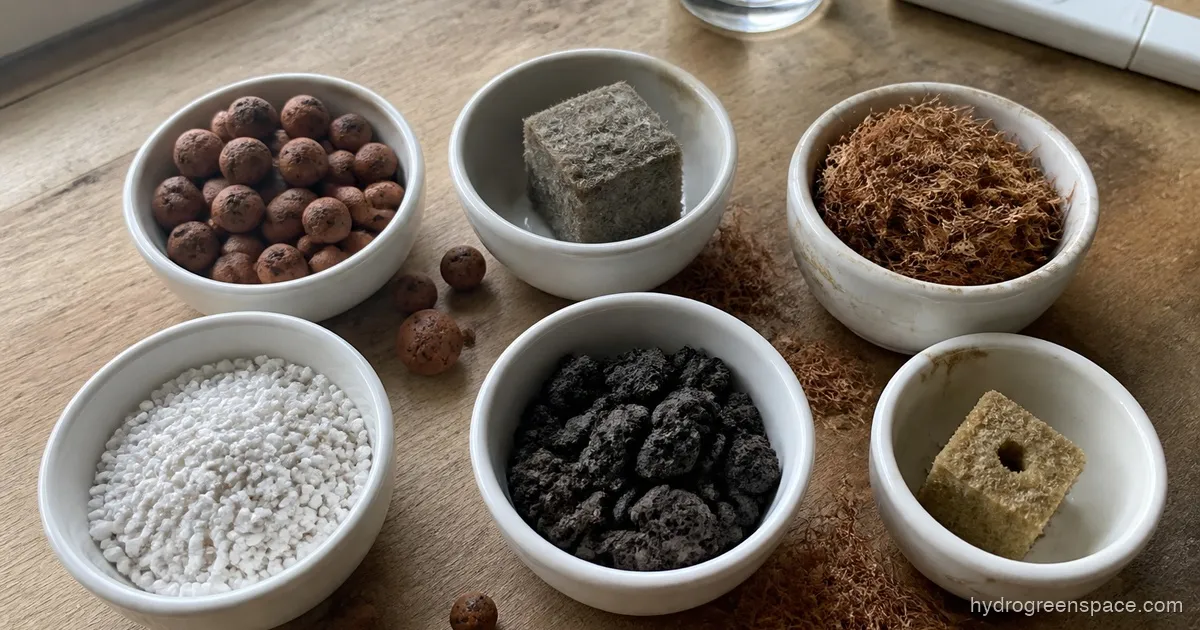
The growing medium you choose shapes almost every outcome in your hydroponic system. Get it right and your roots stay oxygenated, your pH stays stable, and your plants move through the growth stages with almost no intervention. Get it wrong and you’ll be chasing root rot, fighting pH swings, and wondering why your nutrient solution isn’t working.
Most beginners pick a substrate based on whatever their first tutorial used. That’s how growers end up with rockwool in a DWC bucket (a waste of money) or coco coir in an NFT channel (a maintenance headache). The medium has to match the system, and the system has to match the grower’s schedule, budget, and experience level.
This guide covers every major hydroponic growing medium used by home growers: how each one works, what systems it fits, what you’ll pay over time, and when to switch to something better. Each section gives you the key points you need to make a decision, then links to the full deep-dive article if you want to go further.
How Growing Media Actually Work in Hydroponics
Not every hydroponic system even needs a growing medium. True DWC (deep water culture) suspends roots directly in oxygenated nutrient solution. But most systems, including ebb and flow, drip, Dutch bucket, NFT, and media beds, use a substrate to anchor the plant, manage moisture near the root zone, and keep conditions stable between feeding cycles.
A good soilless growing medium does three things: it supports the plant physically so it doesn’t tip over, it holds just enough moisture to bridge the gap between waterings without staying waterlogged, and it keeps the root zone open so oxygen can get in. Aeration matters more than most beginners expect. Roots don’t just need water and nutrients; they need oxygen. A medium that stays too wet will suffocate your roots just as effectively as no water at all.
Two other properties matter for every substrate: whether it affects pH and whether it holds nutrients. A truly inert growing medium like clay pebbles or rockwool has no chemical interaction with your nutrient solution. Others, like coco coir, are biologically active and can bind calcium and magnesium if you don’t prepare them correctly. Understanding these basics before you pick a medium will save you weeks of troubleshooting later.
For the full guide, see Growing Medium for Hydroponics: Which One Works
Rocks for Hydroponics: Which Types Actually Work
Using rocks as a growing medium is one of the oldest approaches in hydroponics, and it still holds up in the right context. The key word is “which rocks,” because not all stones are equally useful, and some can actively harm your crop.
Clay pebbles (also called LECA) are the most widely used rock-type medium for a reason: they’re lightweight, pH-neutral, drain and re-wet easily, and hold their shape through hundreds of grow cycles. Lava rock is a legitimate alternative with excellent aeration, though the irregular surface can trap debris and make cleaning harder. Pea gravel and river rocks can work in basic setups, but they’re heavy, have no real water retention, and their pH profile varies by source.
One question that comes up constantly: can you use rocks from your backyard? The honest answer is usually no. Yard rocks often contain calcium carbonate (which raises pH), debris, pests, and pathogens that will outlast any surface rinse. Unless you can verify the mineral composition and sterilize them properly, buy a medium designed for hydroponics.
For the full guide, see Rocks for Hydroponics: Which Types Actually Work
How to Use Rockwool in Hydroponics
Rockwool is the industry standard for a reason. It’s made from spun basalt rock and slag, which gives it an almost ideal structure for hydroponics: excellent water retention, good air pockets, and a stable form that supports roots from seedling through harvest. Commercial greenhouses around the world run entire tomato and pepper operations on nothing but rockwool slabs.
The single most common mistake with rockwool is skipping the pH pre-soak. Rockwool comes out of manufacturing with a naturally alkaline pH, often above 7.5. Plant seeds or seedlings into unsoaked rockwool and you’re starting them in a medium that locks out nutrients from day one. A 24-hour soak in pH 5.5 water corrects this. It takes five minutes of prep work and prevents a week of problems.
Rockwool is not reusable in any meaningful way: it breaks down, holds old root matter, and is difficult to sterilize between crops. That’s the main argument for switching to alternatives, especially if you’re doing multiple grows per year. It also has a safety note: the fibers can irritate skin and lungs during handling, so gloves and a dust mask are worth using when cutting or working with dry cubes.
Common mistake: Using insulation rockwool as a growing medium. Horticultural rockwool and building insulation look similar but are not the same product. Insulation rockwool is treated with chemicals that will kill your plants. Only use horticultural-grade rockwool sold for growing.
For the full guide, see How to Use Rockwool in Hydroponics (Step-by-Step)
Perlite vs Vermiculite: Two Media That Are Not Interchangeable
Perlite and vermiculite are both white, lightweight granular materials sold in the same garden center aisle. They look similar enough that beginners often treat them as interchangeable. They are not, and using the wrong one in the wrong context will hurt your results.
Perlite is made from volcanic glass that’s been superheated until it pops. The result is a highly porous, lightweight particle that drains fast and holds almost no water on its own. That makes it excellent for aeration in media-based systems and a natural companion to coco coir, as adding 30% perlite to coco coir dramatically improves drainage and root oxygenation.
Vermiculite is a different mineral (a type of mica) that expands into accordion-shaped particles when heated. Unlike perlite, it holds significant moisture and has a mild cation exchange capacity, meaning it can hold onto nutrients. That makes it useful for seed starting and propagation, but risky in recirculating systems where the buffering effect can throw off your nutrient balance.
What I’d do: Use perlite for most growing applications and keep vermiculite to seed starting trays and germination. If you’re in a recirculating system, leave vermiculite out of the mix entirely.
For the full guide, see Perlite vs Vermiculite: The Hydroponic Grower’s Guide
Clay Pebbles vs LECA: Not Actually Two Different Products
If you’ve ever seen clay pebbles and LECA listed as separate options in a growing media comparison and wondered which one to buy, there’s nothing to compare. LECA stands for Lightweight Expanded Clay Aggregate. Clay pebbles, expanded clay pellets, and the brand name Hydroton are all the same material sold under different names.
What matters is the quality. Good clay pebbles have a consistent size (usually 8-16mm), a hard outer shell, and a porous interior that holds some moisture while draining freely. Cheap versions can crumble, have inconsistent sizing, and may have a high pH without proper rinsing. Before your first use, rinse them thoroughly and soak overnight in pH-adjusted water to clear dust and neutralize any alkalinity.
Clay pebbles work in almost every hydroponic system: ebb and flow, drip, Dutch bucket, and media beds. They’re not ideal for NFT (not enough surface area between channels) and rarely used in pure DWC. Their biggest advantage over rockwool or coco coir is reusability, with proper cleaning and sterilization between grows, a good batch of clay pebbles can last for years.
LECA has recently become popular in the houseplant community for semi-hydroponics: growing ornamental plants with roots sitting partially in water, partially in clay pebbles. The principles are the same, just applied to tropical houseplants instead of edibles.
For the full guide, see Clay Pebbles vs LECA: Are They the Same Thing?
Coco Coir for Hydroponics: The Setup Steps That Actually Matter
Coco coir has become one of the most popular growing media for home hydroponic growers over the past decade, and there are good reasons for it. It’s made from the fibrous husk of coconut shells, which means it’s a renewable byproduct rather than a mined or manufactured resource. It holds moisture well without becoming waterlogged, supports strong root development, and is widely available and reasonably priced.
The catch is the buffering step. Raw coco coir is high in sodium (from processing) and has a strong affinity for calcium and magnesium ions. If you add a calcium-magnesium-containing nutrient solution to unbuffered coco, the coir will grab those ions before your plants can access them. The result looks like a calcium or magnesium deficiency even when your nutrient solution tests correctly. Buffering means pre-soaking the coco in a calcium-magnesium solution so those binding sites are already filled before your plants are introduced.
Coco coir comes in three forms: loose fiber (highest water retention, lower aeration), chips (more air pockets, faster drainage), and compressed bricks that expand when wet. For most hydroponic applications, a 70/30 mix of loose coco and perlite gives the best balance of moisture retention and oxygen delivery.
Tip: Coco coir is not technically soil and not technically hydroponic growing media in the traditional sense. It’s a hybrid that works best with nutrients formulated specifically for coco, as standard hydroponic nutrients and soil nutrients both miss some of what coco-grown plants need.
For the full guide, see Coco Coir for Hydroponics: Setup, Buffering and Nutrients
Rockwool Alternatives: When You’re Ready to Switch
A lot of growers discover rockwool through beginner tutorials and stick with it for years simply because it’s familiar. That’s not always a bad choice, because rockwool performs well in the right hands. But if you’re doing multiple crops per year, conscious of disposal costs, or working with systems where rockwool isn’t the best fit, there are genuinely better options.
The most commonly used alternatives are clay pebbles, coco coir, perlite, rapid rooter plugs, and oasis cubes. Each fills a different role. Clay pebbles are the best long-term choice if reusability matters most. Coco coir is the top pick if you want the closest experience to growing in soil. Rapid rooter plugs (made from composted bark) are arguably the best seed-starting medium available, as they hold moisture like rockwool, pH-buffer better out of the box, and are fully biodegradable.
The question of what to use instead of rockwool doesn’t have one right answer. It depends on the stage of growth (seed starting vs grow-out), the system type, and whether you want to reuse the medium between crops. Most experienced growers end up using two or three media across different parts of their operation: rapid rooters or oasis cubes for propagation, clay pebbles or coco coir for grow-out.
For the full guide, see Rockwool Alternatives: 5 Better Hydroponic Media
Best Hydroponic Growing Medium: Side-by-Side Comparison
When growers ask “what’s the best growing medium for hydroponics,” they’re usually asking the wrong question. There’s no single best medium; there’s a best medium for each system type, skill level, and budget. A beginner setting up their first ebb and flow system should not be using the same substrate as someone running a commercial NFT rack.
Here’s how the major options stack up across the factors that matter most for home growers:
| Medium | Best For | Reusable | pH Neutral | Water Retention | Aeration |
|---|---|---|---|---|---|
| Clay pebbles | Ebb and flow, drip, Dutch bucket | Yes (years) | Yes | Low | High |
| Rockwool | Seed starting, NFT, drip | No | Yes | High | Medium |
| Coco coir | Drip, Dutch bucket, media beds | Partially | Near-neutral | High | Medium (with perlite) |
| Perlite | Mixed media, propagation | Partially | Yes | Low | Very high |
| Lava rock | Aquaponics, media beds | Yes | Yes | Low-medium | High |
| Rapid rooter plugs | Seed starting, clones | No | Yes | High | Medium |
Can you mix growing media? In most cases, yes. Coco coir and perlite is one of the most common blends in home growing. Clay pebbles can be layered in a media bed with a smaller particle substrate underneath to retain some moisture near the root zone. What you want to avoid is mixing materials with very different water retention profiles in a recirculating system, as it creates uneven wet and dry zones that are difficult to manage.
For beginners who just want a starting point: clay pebbles for ebb and flow or drip systems, rapid rooter plugs for seed starting, and coco coir with perlite for anything resembling a soil-based setup. That combination covers most home systems without requiring you to learn the nuances of every substrate at once.
For the full guide, see Best Hydroponic Growing Medium: Full Comparison
The right growing medium isn’t complicated once you understand what each one actually does. Start with your system type, match the medium to how that system manages moisture and drainage, and choose reusable media if you’re planning to grow continuously. If you’re still deciding on a system, the growing medium for hydroponic systems guide walks through the compatibility questions in detail. Pick one, run a full crop with it, and you’ll understand it better than any comparison article can teach you.