
Rockwool Alternatives: 5 Better Hydroponic Media
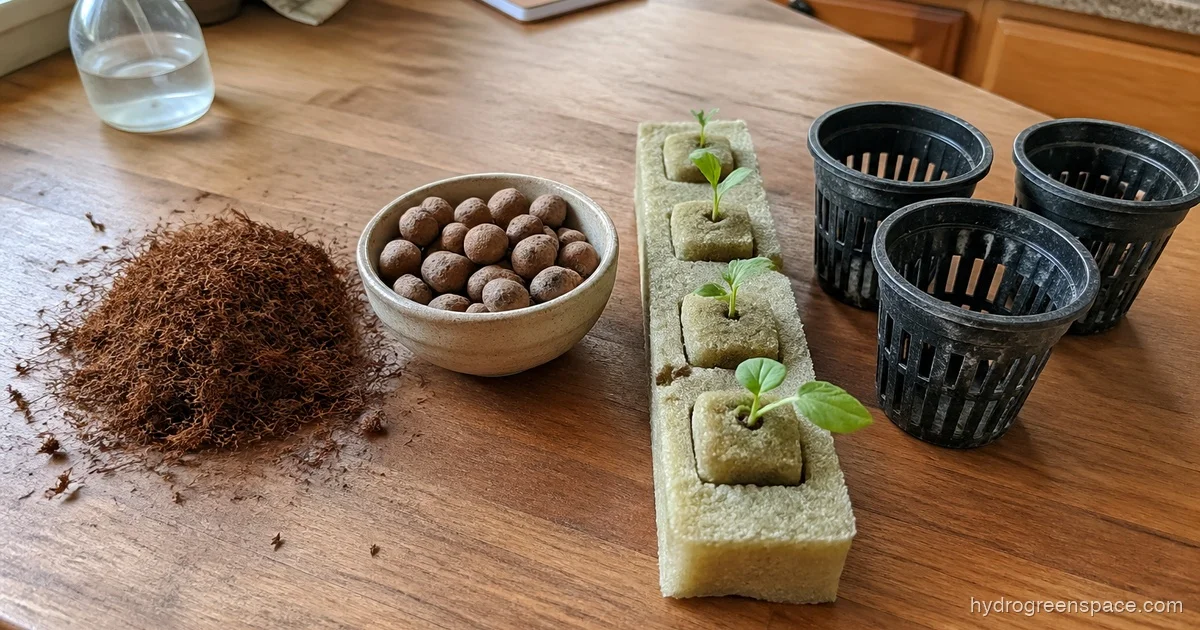
Rockwool works until it doesn’t. You try to adjust the pH, flush it, reuse it, and suddenly you’re fighting problems that have nothing to do with nutrients or light. A lot of growers stick with it simply because that’s what every beginner tutorial recommends, not because it’s the best option for their setup. There are genuinely better fits depending on what system you’re running, and once you try a few of them, going back to rockwool feels like a default choice rather than a deliberate one.
This guide covers the five most practical rockwool alternatives, matched to the systems where each one actually performs. If you’re just starting out or thinking about switching, the quick-reference table below will get you to the right pick fast.
Why Growers Switch Away from Rockwool
Rockwool (also sold as stonewool or mineral wool) is made from spun volcanic rock fibers. It’s widely used because it’s sterile, has decent water retention, and holds its shape well in net pots. But it has real drawbacks worth understanding before you commit to it.
First, pH management. Fresh rockwool sits at a pH of 7.5–8.0 out of the bag, which means you have to pre-soak it in pH 5.5 water for at least 24 hours before use. Skip that step and your seedlings will struggle even if your nutrient solution is dialed in perfectly. If you want to learn how to use rockwool in hydroponics, that prep process is non-negotiable, but it’s also one more thing that can go wrong.
Second, it’s not reusable in any practical sense. Rockwool fibers break down after one cycle, and sterilizing used cubes thoroughly enough to trust them again is more effort than most home growers want. Third, there are legitimate environmental concerns. Rockwool doesn’t biodegrade, and the fine fibers are a respiratory hazard if you cut or handle it dry without a mask.
None of this makes rockwool a bad product. It’s just not the only option, and for many setups it’s not even the best one.
Quick-Reference: The 5 Best Alternatives at a Glance
| Medium | Best for | Reusable? | pH neutral? | Relative cost |
|---|---|---|---|---|
| Coco coir | DWC, deep water, general use | No (1–2 cycles) | Near-neutral (buffer needed) | Low |
| Expanded clay / LECA | DWC, Kratky, media beds | Yes (with sterilization) | Yes | Medium |
| Perlite / vermiculite | NFT, top-drip, passive | Partial | Yes | Low |
| Oasis cubes / foam plugs | Seed starting, cloning | No | Yes | Medium–High |
| Rice hulls | Media beds, amendments | No | Yes | Very low |
The 5 Best Rockwool Substitutes in Depth
Coco Coir: The Most Versatile Switch
Coco coir for hydroponics is the most popular rockwool alternative for a reason: it’s easy to source, cheap, and familiar to anyone who has grown in soil. Coco is made from the fibrous husk of coconut shells, and it behaves more like a soil amendment than a true inert medium, which is both its strength and its one catch.
The strength: coco holds moisture well while still allowing enough oxygen to reach roots. The air-to-water ratio is forgiving, which makes it a good fit for beginners. The catch: coco naturally binds calcium and magnesium, so you need to run a slightly higher CalMag dose than you would with an inert medium. Skip that and you’ll see interveinal chlorosis on younger leaves around week 3.
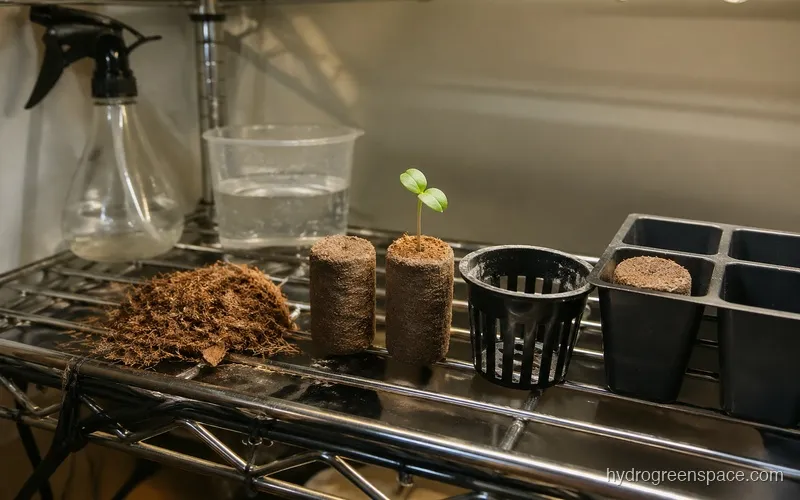
Coco comes in three forms, loose coir, coir blended with perlite (usually 60/40), and coir discs or plugs for seed starting. The 60/40 blend is what most hydroponic growers use for fill media in DWC or drip systems.
What I’d do: If you’re switching from rockwool for the first time, start with a buffered, pre-rinsed coco like Canna Coco or Botanicare CocoGro. Unbuffered generic coco needs to be flushed multiple times before use, and the savings aren’t worth the extra work.
Expanded Clay Pellets (LECA): Best for Reuse
If you want a medium you can actually sterilize and reuse across multiple grows, expanded clay is the answer. You can read more about clay pebbles and LECA to understand the differences between brands, but the short version: they’re all pH-neutral, inert, and porous enough to support roots in almost any system.
Expanded clay holds its shape indefinitely. Rinse it with a 1% hydrogen peroxide solution between grows, let it dry, and it’s ready again. For home growers doing multiple cycles per year, the medium-higher upfront cost pays for itself fast.
The main limitation is that clay pellets don’t retain much water, which means they’re not ideal for passive systems where the roots need to stay moist between watering cycles. In active recirculating systems (DWC, RDWC, Dutch bucket) they shine.
Perlite and Vermiculite: Cheap and Effective
Both perlite and vermiculite are volcanic minerals, but they behave differently. Perlite is lightweight, highly porous, and drains fast, which makes it excellent for NFT channels where you want roots exposed to a thin nutrient film with plenty of oxygen. Vermiculite holds much more moisture and is better suited as an amendment to improve water retention in other media.
The comparison of perlite vs vermiculite in hydroponics goes deeper on the specifics, but as a practical summary: use perlite as a standalone in NFT or top-drip systems, and use vermiculite blended into coco (around 10–20%) if you want to boost moisture retention without sacrificing airflow.
Perlite is also one of the cheapest growing media you’ll find. A 4-cubic-foot bag covers a lot of net pots and costs less than a bag of rockwool cubes.
Warning: Perlite is extremely dusty. Always wet it before handling and consider wearing a dust mask. The particles are fine enough to irritate lungs if you’re opening a bag indoors without ventilation.
Oasis Cubes and Foam Plugs: Purpose-Built for Starting
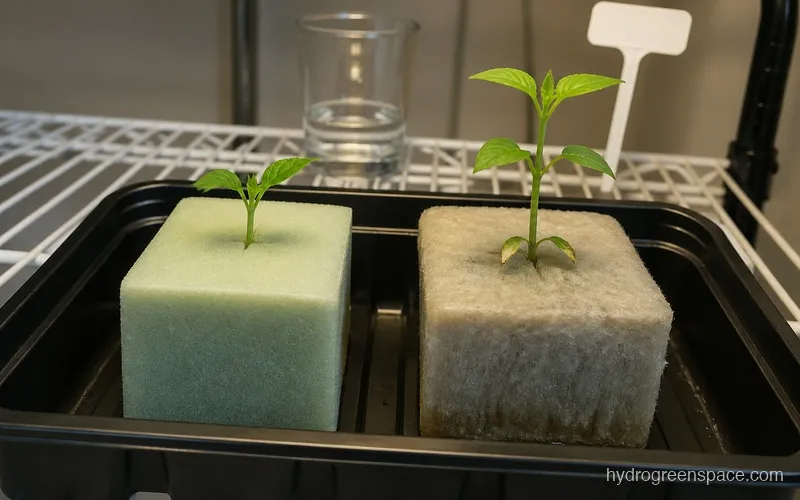
Oasis cubes (sometimes called Oasis Horticubes) and similar foam-based plugs are the closest functional replacement for rockwool starter cubes. They’re pre-formed, maintain a consistent moisture level, and transplant cleanly into net pots without falling apart.
The pH is already buffered, so unlike rockwool you don’t need to pre-soak them for 24 hours. Wet them with pH-adjusted water (around 5.8–6.0), insert your seed, and they’re ready. Germination rates in foam plugs are comparable to rockwool, and some growers report faster root emergence because the plug doesn’t compress around the seed the way rockwool can.
Germinating seeds without rockwool is genuinely easier with foam plugs than most tutorials make it sound. They’re also the better choice for cloning, since the open-cell structure holds moisture without staying so wet that you get stem rot.
The downside is cost. Oasis cubes are more expensive per unit than rockwool, and they’re single-use.
Rice Hulls: The Budget Option Worth Knowing About
Rice hulls are the outer husks removed during rice milling. In hydroponics, they’re used as an amendment or a lightweight standalone media in flood-and-drain systems. They drain fast, are completely natural, and cost almost nothing if you can find a local agricultural supplier.
The catch: rice hulls break down over a single grow cycle, compressing as they decompose, which can reduce airflow to roots. They work well as a cheap first-fill for a new media bed, and if you’re interested in organic approaches to hydroponics, they fit cleanly into that workflow. But for precision systems or longer growing cycles, they’re not something to rely on as your primary medium.
Best Alternative by System Type
Here’s how to match the medium to your setup.
DWC (Deep Water Culture)
The roots in DWC spend most of their time submerged or in the mist zone, so your growing medium is mainly there to anchor the plant and support the stem in the net pot. Expanded clay is the best fit here because it’s heavy enough to hold plants upright, doesn’t break down in water, and can be sterilized and reused. Coco also works well in DWC net pots if you’re willing to buffer it first.
NFT (Nutrient Film Technique)
NFT channels run a thin film of nutrient solution, and roots spread horizontally across the channel floor. You want a medium that drains fast and doesn’t trap moisture in the net pot, because standing water in an NFT pot leads to root rot quickly. Perlite is the best call here. It provides a stable germination environment without retaining excess water once the nutrient film takes over.
Kratky / Passive Systems
Kratky relies on a gradually lowering nutrient level and a passive air gap to oxygenate roots. The medium needs to wick moisture upward when the plant is young, then stay out of the way as roots grow down. Expanded clay works here, but the real sleeper pick is a coco/perlite blend (60/40) packed into the net pot. It holds just enough moisture to get seedlings through the first week, then the roots do the rest.
Can You Reuse These Alternatives?
It depends on how clean your system runs. Expanded clay holds up indefinitely — rinse it with diluted hydrogen peroxide, inspect for root buildup, and it’s ready for the next cycle. Coco can stretch to two cycles in low-disease-pressure grows, but by cycle three the structure breaks down and water retention becomes uneven. Perlite, oasis cubes, and rice hulls are best treated as single-use.
If you’re serious about choosing the right media for the long term, the complete guide to growing media and a comparison of all hydroponic growing media both go deeper on multi-cycle performance and total cost of ownership.
What About Rapid Rooter Plugs?
Rapid Rooters are a popular alternative to rockwool for propagation, made from composted bark and peat. They’re worth a mention here because they come up constantly in beginner forums. A proper Rapid Rooter vs rockwool for seedlings comparison is on the way, but the short version: Rapid Rooters have excellent germination rates and transplant well into most systems. If you’re choosing between rockwool cubes and Rapid Rooters purely for starting seeds, Rapid Rooters usually win.
If seed starting is your main use case and you want to go beyond plugs, starting seeds in coco coir and peat pellets for seed starting are both worth exploring depending on your system.
The medium you start with is rarely the medium you’ll stick with. Once you run a few grows and see how each one behaves in your specific setup, you’ll develop a strong preference fast. When you’re ready to think about the full picture, choosing a growing medium based on system type, budget, and reuse goals gives you a framework that holds up across every crop.