Growing Medium for Hydroponics: Which One Works
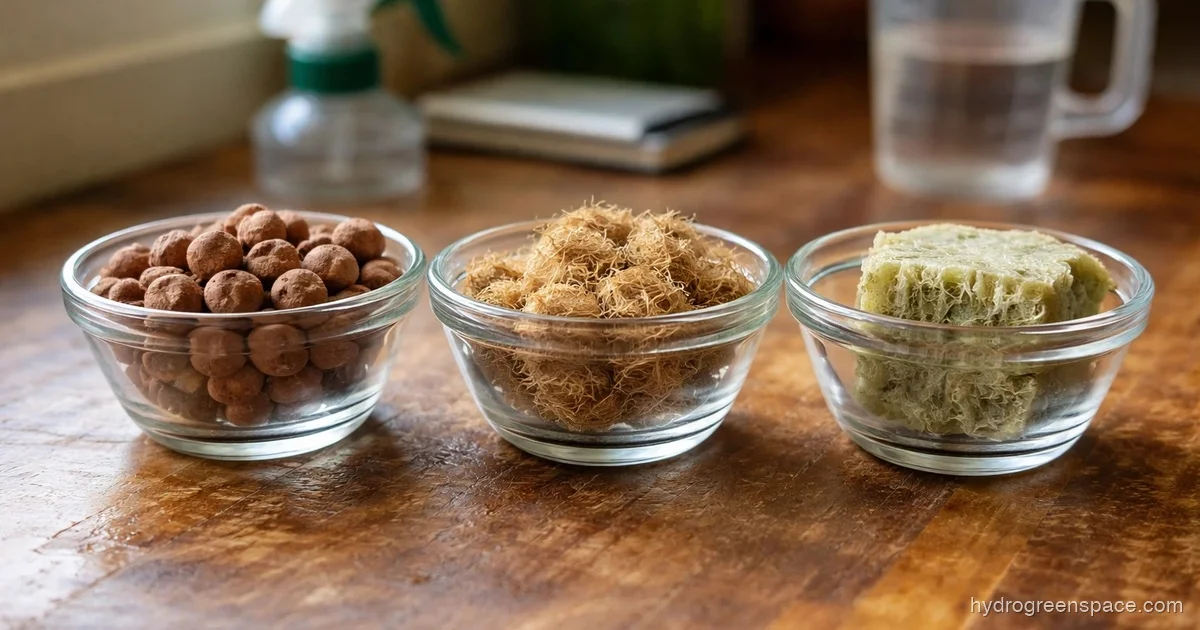
The growing medium you choose doesn’t just hold your plants in place. It determines how much oxygen gets to your roots, how fast your system dries out between cycles, whether you’re fighting pH swings constantly, and how much money you spend replacing media every season. Pick the wrong one for your system and you’ll spend weeks troubleshooting problems that were baked in from day one.
Different types of hydroponic systems are a good place to start if you’re still choosing a setup. If you already know your system, keep reading.
How Growing Media Actually Work in Hydroponics
Soil does three jobs: it anchors roots, holds moisture, and provides nutrients. Hydroponic growing media only needs to do the first two. Nutrients come from your solution, not the medium.
That shift in responsibility changes what you’re looking for. A good hydroponic growing medium is physically stable, chemically inert (pH neutral), and structured to balance water retention with root aeration. Those two properties, moisture and airflow, are almost always in tension. Media that holds a lot of water tends to restrict oxygen. Media that drains freely tends to dry out fast.
Getting that balance right matters more than which specific product you buy. Root rot almost always comes from too little oxygen, not too little water.
What Works Best for Each Hydroponic System
Deep Water Culture (DWC)
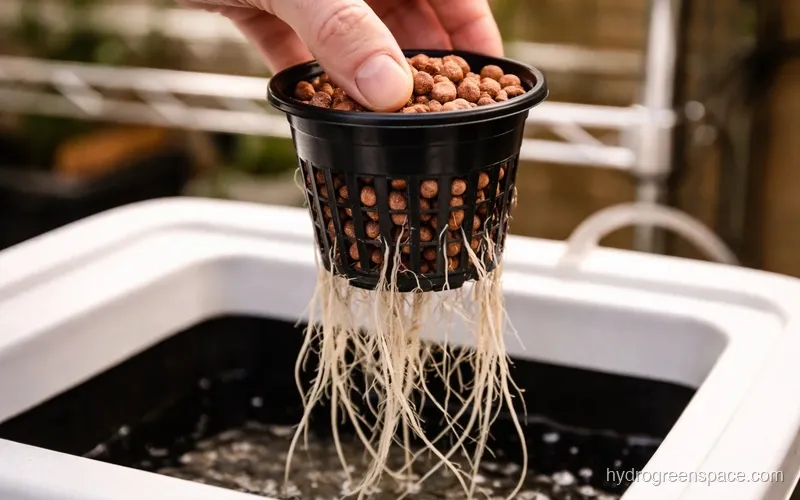
In a DIY DWC hydroponic system, your roots hang directly into an oxygenated nutrient solution. The growing medium only needs to hold the plant upright in the net pot long enough for roots to reach the water. After that, it’s basically structural.
Clay pebbles (also called LECA or hydroton) are the default choice here and for good reason. They’re heavy enough to anchor larger plants, pH neutral, and they leave plenty of air pockets around the roots at the crown. The medium never gets fully saturated because it drains freely back into the reservoir.
What I’d do: For a 5-gallon bucket hydroponic system, I use 3/4-inch clay pebbles. Start with a pound or two per net pot because that size anchors plants well and leaves plenty of airspace around the roots.
Rockwool starter cubes also work well in DWC, especially if you’re transplanting seedlings. You simply nestle the cube into clay pebbles and the roots take over from there. If you want to go deeper on that approach, how to use rockwool in hydroponics covers the full process.
Nutrient Film Technique (NFT)
NFT runs a thin film of nutrient solution along a sloped channel. Plants sit in net pots or small holes in the channel, and roots trail down into the flow. Most of the root mass hangs in air.
Because of that, you want a medium that holds just enough moisture to keep the crown zone from drying out between top-up cycles, without staying wet enough to cause crown rot.
Clay pebbles work here too. So does rockwool in cube form, placed directly in the channel holes. What you want to avoid is dense, moisture-retentive media like coco coir or perlite packed tightly around the stem. Those hold too much water against the plant in a system designed to aerate the roots.
Ebb and Flow (Flood and Drain)
Ebb and flow systems flood the grow tray periodically, then drain completely. The medium needs to absorb water during flooding and release it slowly, while keeping enough air pockets to prevent root suffocation between cycles.
This is where coco coir earns its place. Coco holds about 30% air even when saturated, which is significantly better than most soil. It also has a near-neutral pH and an excellent cation exchange capacity, meaning it buffers nutrient solution well. Coco coir for hydroponics is worth reading if you’re going this route.
Perlite mixed with coco (around 30% perlite by volume) improves drainage further and prevents compaction over time. Pure perlite is also an option for flood and drain, though it’s very light and can float during flooding if you’re not careful. The perlite vs vermiculite for hydroponics breakdown explains when perlite makes sense vs. when you’d want something denser.
Kratky Method
The Kratky hydroponic method is a passive, no-pump system where plants draw down a static reservoir as they grow. The air gap between the water surface and the net pot bottom is what provides oxygen to the roots.
Because there’s no active aeration, you need a medium that doesn’t block airflow or wick solution too aggressively up into the net pot. Clay pebbles are the natural fit again. They’re inert, they won’t pull moisture up through capillary action, and they’re easy to reuse.
Technically you don’t need a medium at all in Kratky. Some growers germinate seeds directly in the net pot with just a small piece of rockwool. But for stability and ease of transplanting, clay pebbles remain the go-to.
Drip Systems and Grow Bags
Drip systems deliver nutrient solution directly to the base of each plant on a timer. Grow bags work similarly: you pack them with medium, run drip lines to each, and let them drain.
Coco coir is the dominant choice for both, and for good reason. It handles repeated wetting and drying without compacting badly, it has good buffering properties, and it’s becoming easier to source in pre-buffered forms that are already pH adjusted and ready to use.
Rockwool slabs are also popular in commercial drip systems. They’re sterile, consistent, and have excellent air-to-water ratios. For home growers, rockwool cubes (50mm to 100mm) are a more practical size. If rockwool doesn’t appeal to you, rockwool alternatives for hydroponics covers what else holds up in drip applications.
Growing Media You Can Skip (for Most Home Systems)
Pea gravel and coarse sand work physically, but they’re heavy, hard to clean, and prone to pH issues if you grab the wrong source. Rocks for hydroponics covers this if you’re curious, but most home growers don’t need to go down that path.
Vermiculite is soft and compacts easily. It holds too much moisture for most hydroponic applications. It has a place in propagation trays, but not in a running system.
Soil is a hard no. Soil is not a soilless growing medium. It doesn’t drain predictably, it carries pathogens, and it will clog pumps and drip lines. If you want the feel of soil, use coco coir. It behaves similarly but without the problems.
Can You Reuse Hydroponic Growing Media?
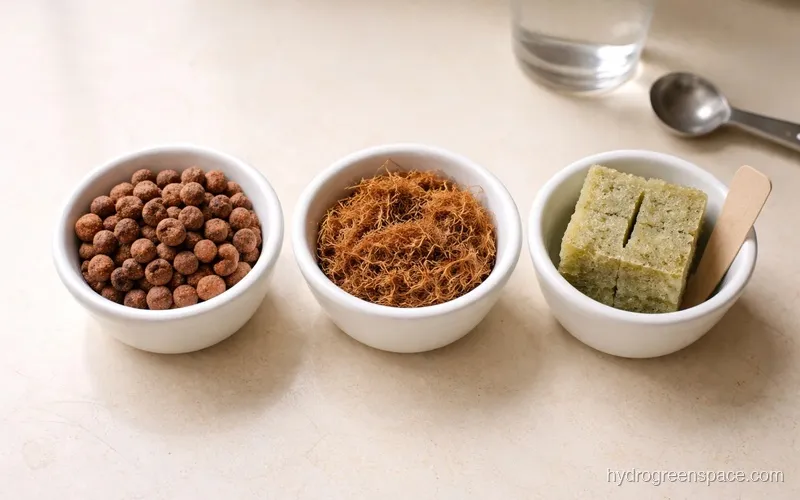
Clay pebbles: yes, easily. Rinse off debris, soak in a diluted hydrogen peroxide solution (3% at roughly 1:10 with water) for 30 minutes, rinse again, and they’re ready for the next round. I’ve used the same batch for five years.
Coco coir: technically yes, but it degrades over time and can harbor pathogens if not sterilized properly. Most home growers replace it after one or two grows. It’s cheap enough that the cleanup time rarely justifies reusing it.
Rockwool: you can reuse slabs and large cubes, but starter cubes are usually single-use since cleaning them thoroughly is harder than buying new ones.
Warning: Whatever medium you’re reusing, never skip the sterilization step. Root rot pathogens like Pythium survive in dried plant debris and can wipe out an entire new crop within a week if you transfer them.
Matching Medium to Your Skill Level
If you’re just starting out and choosing your first hydroponic system is still in front of you, the honest answer is: start with clay pebbles in a DWC or Kratky setup. They’re forgiving, widely available, easy to work with, and you won’t have to adjust your technique around the medium’s quirks.
Coco coir and rockwool are excellent choices once you understand your system’s watering frequency and pH behavior. They reward growers who are already comfortable dialing in their nutrient solution and monitoring runoff. If you’re not yet confident with that part, check the how to feed hydroponic plants guide before committing to a moisture-retentive medium.
Worth flagging here from common beginner mistakes in hydroponics: one of the most common errors is choosing a medium based on what a YouTube video used, without checking whether that medium actually makes sense for the system being built. A coco-heavy medium in a poorly timed ebb and flow setup will stay wet between floods and invite root problems fast.
A Few Numbers to Know
| Growing Medium | pH Range | Reusable | Best For |
|---|---|---|---|
| Clay pebbles (LECA) | 6.0–7.0 | Yes | DWC, Kratky, NFT |
| Coco coir | 5.8–6.5 | Sometimes | Ebb & flow, drip |
| Rockwool | 7.0–7.5 (pre-soak to adjust) | Sometimes | Propagation, drip, DWC |
| Perlite | 7.0–7.5 | Yes | Mixed medium, flood & drain |
| Hydroton (brand-name LECA) | 6.5–7.0 | Yes | Same as clay pebbles |
Note the rockwool row: it comes off the shelf alkaline. Always pre-soak it in pH-adjusted water (around 5.5 for 24 hours) before use. Skipping that step causes pH lockout in the first week of growth. Clay pebbles vs LECA is worth reading if you’re confused about the difference between generic clay pebbles and branded hydroton products (hint: there isn’t much of one).
Once you’ve chosen your medium and have your system running, the hydroponic equipment checklist will help you make sure you’re not missing anything else before your first grow. For a detailed head-to-head across all the options above, best growing medium comparison walks through performance data side by side.
For a full breakdown of substrate categories, system compatibility, and what to look for when choosing your first medium, the growing media for hydroponics guide covers everything in one place.
The medium is just the foundation. Once you have that sorted, the real variables, nutrients, pH, light, and airflow, are where most of the growth decisions get made.