
How Does a Hydroponic Tower Work? The Full Loop
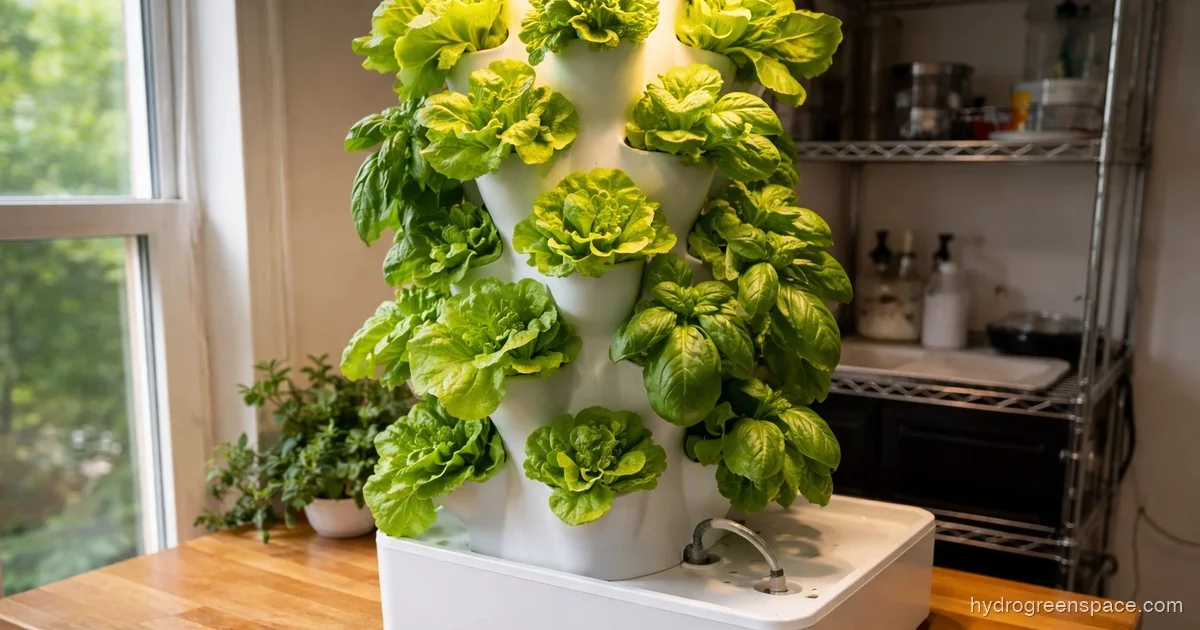
A hydroponic tower is one of the simplest systems to understand once someone explains the loop. Water goes up, water comes down, roots drink on the way. That’s the whole thing. The confusion usually comes from the two very different types of towers on the market that work quite differently from each other, and from specs sheets that never tell you how often to run your pump.
This article will walk you through exactly how the mechanism works, how to tell which type of tower you’re dealing with, and what running one actually looks like day to day.
The Core Loop: Pump, Top, Gravity, Reservoir
Every hydroponic tower runs on the same closed-loop recirculating system. A submersible pump sits in a reservoir at the base. When the pump turns on, it pushes nutrient solution up a central tube to the top of the tower. From there, gravity takes over.
The solution either trickles or drips down along the inside of the column, passing through the root zones of every plant on the way down. Roots hanging into the channel absorb water and nutrients as the flow moves past them. Whatever the roots don’t use drains back into the reservoir and gets pumped up again.
That’s the full loop: reservoir → pump → top of tower → gravity trickle → reservoir. The whole system recirculates on a timer, running in short cycles rather than continuously.
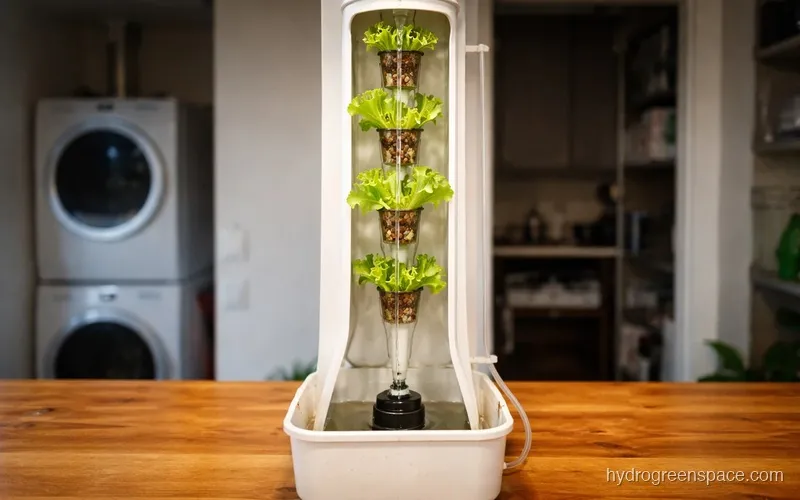
The net pots holding each plant are set into holes cut or molded into the column. Most towers use clay pebbles or rockwool as a growing medium inside those net pots. These materials don’t hold much water on their own, which matters: the roots aren’t sitting in standing water, they’re being wetted repeatedly by the passing flow, then exposed to air between cycles. That air exposure is what keeps roots healthy. If you’ve ever pulled a root-bound plant from a waterlogged container, you know how quickly roots suffocate without oxygen. The trickle motion in a tower gives you that oxygenation automatically.
If you’re new to how nutrient delivery works across different systems, the how hydroponics works overview covers the fundamentals before diving into tower-specific mechanics.
NFT-Style Towers vs. Aeroponic Towers: Not the Same Thing
The biggest source of confusion around hydroponic towers is that two very different mechanisms share the same name. Once you know the difference, you can make a much better buying or building decision.
NFT-Style Towers
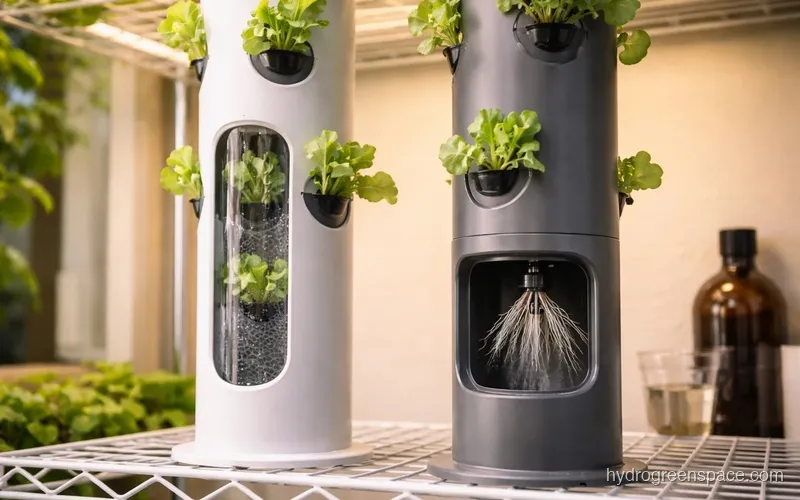
Most entry-level commercial towers, including many popular vertical garden kits, use a nutrient film technique approach adapted for vertical columns. The pump delivers solution to the top, and it runs in a thin film down the inner wall of the column. Roots grow into that film and absorb what they need.
These are forgiving, low-maintenance, and easy to troubleshoot. The flow rate is slow, the emitters are simple holes or splash plates, and there’s very little that can go wrong mechanically. If you’re looking at a tower with net pot openings arranged in a spiral around a hollow column, you’re most likely looking at an NFT-style system.
For a head-to-head look at how NFT compares to other hydroponic approaches, different types of hydroponic systems breaks down each method with real trade-offs.
Aeroponic Towers
Aeroponic towers work differently. Instead of a trickle film, they use spray nozzles or misting emitters inside the column to deliver nutrients directly to the root zone. Roots hang in air inside the column and get misted at intervals rather than bathed in a flowing film.
The benefit is aggressive oxygenation of the root zone: roots in air, with nutrients delivered as fine droplets, can grow dramatically faster than roots sitting in a film. The downside is that the emitters clog. Mineral deposits from your nutrient solution build up in those tiny nozzle openings, and if the misting cycle fails for even a few hours, your roots start to dry out.
Aeroponic towers produce impressive results when maintained properly. They’re not the best choice if you travel frequently or prefer a lower-touch system.
What I’d do: If you’re buying your first tower, go NFT-style. The aeroponic speed advantage is real, but not worth the maintenance complexity until you’ve grown a few successful crops and understand your water chemistry.
Pump Timer Schedules: The Numbers Nobody Gives You
Here are the actual numbers.
For NFT-style towers, a common starting schedule is 15 minutes on, 45 minutes off, repeated around the clock. Some growers run 30 minutes on, 30 minutes off with no issues. The goal is to keep the root zone moist without drowning it. If you notice roots starting to dry out between cycles (they’ll look lighter in color and less turgid), shorten the off-period. If you see roots starting to look slimy or brown, lengthen it.
For aeroponic towers, the cycles are shorter and more frequent. A typical schedule is 30 seconds on, 5 minutes off during lights-on hours, extending to 1 minute on, 10 minutes off during lights-off or cooler periods. The fine mist dissipates quickly, so roots dry faster than in an NFT film.
Temperature matters too. In a warm room (above 75°F), roots dry faster and benefit from more frequent cycles. In a cooler environment, you can extend the off period without stress.
How Many Plants, How Much Power
Tower size varies widely. A standard home tower typically holds 20 to 28 plants in a column 5 to 6 feet tall. Larger commercial towers go up to 44 or 52 plants. The spacing between net pots matters as much as the count: leafy greens like lettuce and spinach can handle tighter 5-inch spacing, while herbs like basil need 6 to 8 inches to spread without shading each other.
Electricity use is lower than most beginners expect. A small submersible pump running a home tower draws 10 to 25 watts. On a 15/45-minute timer cycle, it runs for 6 hours out of every 24, putting annual consumption at roughly 22 to 55 kWh. At average US electricity rates, that’s $3 to $8 per year just for the pump. Grow lights are a separate conversation and the dominant cost driver by far if you’re growing indoors. For a full breakdown of startup and running costs, how much does it cost to start hydroponics has the real numbers.
If you’re growing indoors under artificial light, towers work very well. A single 200 to 400 watt full-spectrum LED can cover most home tower footprints. The vertical stacking helps here: you’re growing more plants per square foot of floor space than almost any other indoor system.
What Grows Well in a Tower
Leafy crops dominate for good reason. Lettuce, spinach, kale, arugula, Swiss chard, and most herbs thrive in towers because their root systems are compact and they grow quickly enough to keep up with the constant moisture cycling.
Strawberries are the other great tower crop. They don’t need deep root space, they handle the wet/dry cycling well, and the cascading growth habit looks natural in a vertical column.
Heavy fruiting crops like tomatoes, cucumbers, and peppers are possible but genuinely difficult. Their root systems eventually outgrow net pots, they get top-heavy in a column, and they need more nutrient volume than most tower reservoirs are sized for. I’ve seen experienced growers pull it off with larger DIY towers, but for a first build or a commercial kit, stick to greens and herbs.
For a full breakdown of what grows in tower systems, what can I grow in a hydroponic tower covers this in detail, including what to avoid.
Maintenance Reality Check
Running a tower is straightforward if you stay on top of a few things.
Reservoir top-offs: In a warm room, a tower can lose 1 to 2 gallons of water per day to evaporation and plant uptake. Check the reservoir daily the first week until you know your system’s consumption rate. A reservoir that runs dry even briefly can fry your pump.
pH drift: Tower systems recirculate the same solution through the root zone repeatedly, which means pH can drift fast. Check pH every two to three days and target 5.8 to 6.2 for most crops. How to feed hydroponic plants covers nutrient solution management, including how to handle pH creep.
Full flush: Every two to three weeks, drain the reservoir completely, rinse it, and refill with fresh nutrient solution. Nutrient salts accumulate, ratios drift, and beneficial microbes can turn into problem pathogens if you never reset.
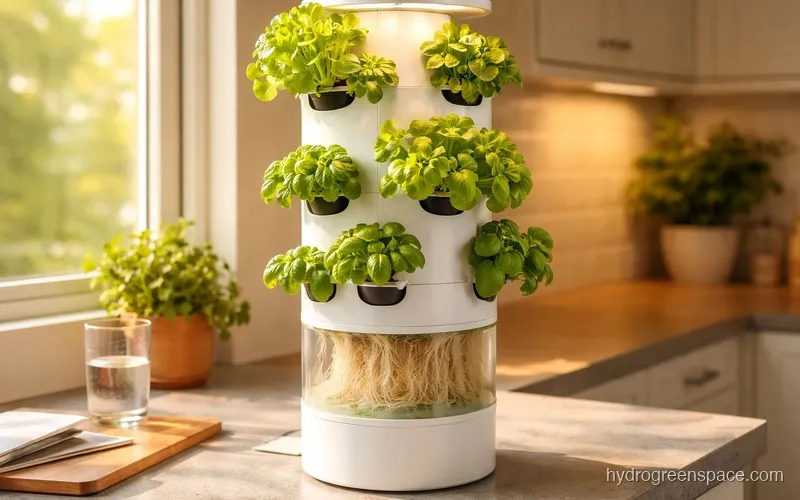
Emitter checks (aeroponic towers): Run your hand up the inside of the column with the pump running. Every spot should feel misted. Any dry section means a blocked emitter that needs to be cleared with a needle or soaked in citric acid.
If you want to build rather than buy, how to build a vertical hydroponic garden and the DIY hydroponic garden tower using PVC pipes guide walk through the build process from the ground up. And when you’re ready to compare the best commercial options, best vertical hydroponic system covers what’s actually worth buying.
Once you’ve run a tower for a few weeks and know your pump schedule, your pH rhythm, and your reservoir habits, it becomes one of the most low-effort high-yield systems you can run indoors. The mechanism is simple. The results, when you dial it in, are genuinely impressive.