2-Plant Hydroponic System: Two Buckets, One Simple Setup
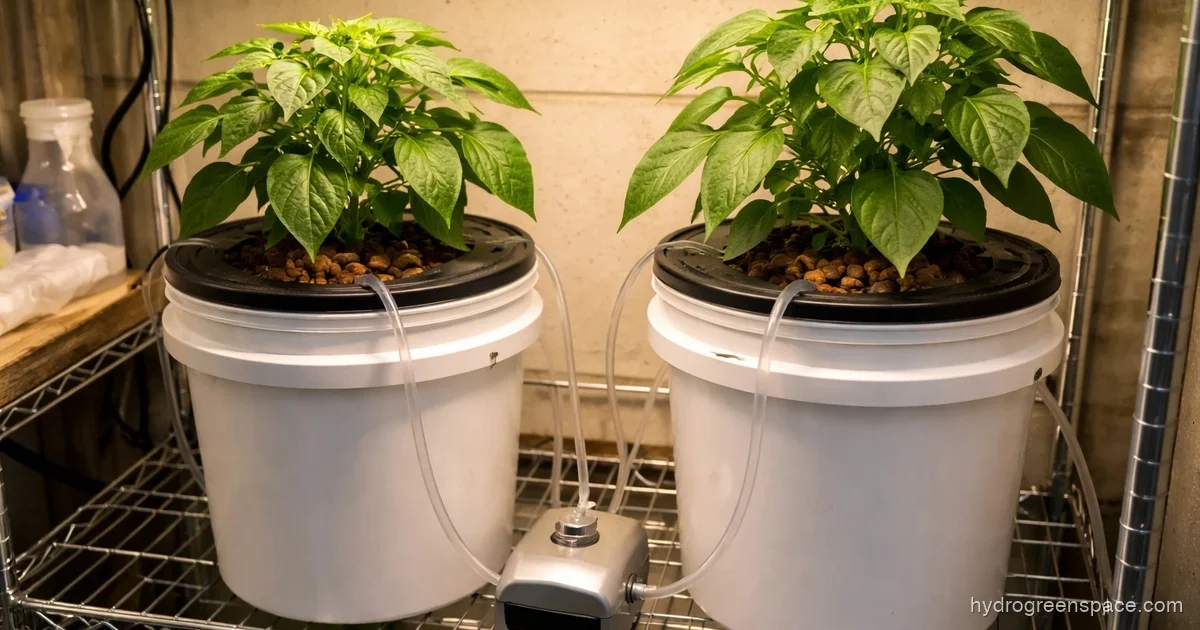
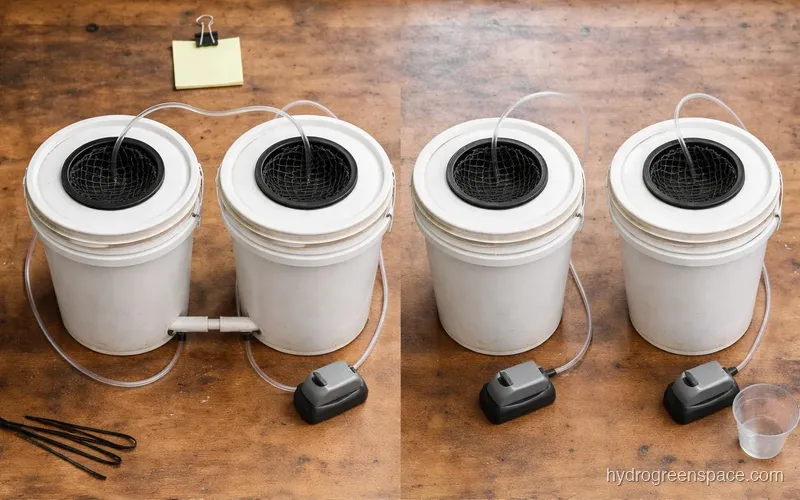
Once you’ve grown one plant hydroponically and seen it work, the next question is almost always the same: what changes if I add a second plant? The honest answer is: not much. A 2-plant hydroponic system uses the same logic as a single-plant setup, just doubled. Two buckets, two net pots, one shared air pump, and the same nutrient solution in both containers.
If you already have a single-plant hydroponic system running, you can expand it for about $20 in extra parts. If you’re starting fresh, this is a solid place to begin. Two plants give you twice the harvest without adding meaningful complexity.
Two Separate Buckets vs. One Shared Reservoir
Before anything else, you need to answer one question: do you want two independent buckets or one connected recirculating system?
Independent buckets (the simpler option): Each plant gets its own 5-gallon bucket with its own air stone. The buckets are not connected. You manage each one separately: check pH, top off water, and do water changes bucket by bucket.
RDWC (recirculating deep water culture): A 2 plant RDWC system links two buckets with a short piece of tubing so nutrient solution circulates between them. You manage one shared reservoir instead of two separate ones. pH and nutrient levels stay consistent across both plants automatically.
For beginners, independent buckets win. They’re simpler to build, cheaper to start, easier to troubleshoot, and the extra two minutes per water change is not a real burden at this scale. RDWC starts making sense when you’re managing five or more plants and want to avoid maintaining each bucket individually. At two plants, the overhead doesn’t justify the added plumbing.
Parts List for a 2-Bucket DWC System
Here’s everything you need for two independent 5-gallon bucket DWC setups. These numbers are for food crops: vegetables, herbs, and leafy greens.
| Item | Quantity | Cost |
|---|---|---|
| 5-gallon buckets with lids (opaque) | 2 | $10–16 |
| Net pots (3-inch for herbs/greens, 6-inch for fruiting plants) | 2 | $2–4 |
| Air pump with dual outlet | 1 | $12–18 |
| Air stones | 2 | $4–6 |
| Airline tubing | 1 pack | $3–5 |
| Clay pebbles or rockwool starter cubes | 1 bag | $8–12 |
| Hydroponic nutrient solution (3-part or pre-mixed) | 1 set | $15–25 |
| pH meter or test kit | 1 | $10–25 |
| Total | $64–111 |
You can cut costs significantly by reusing nutrients and the pH meter across multiple grows. The actual per-cycle consumable cost after the first setup is just the clay pebbles and a fraction of the nutrient solution.
If you’re starting from scratch and want to check what you already have on hand, the equipment checklist is worth running through before you order anything.
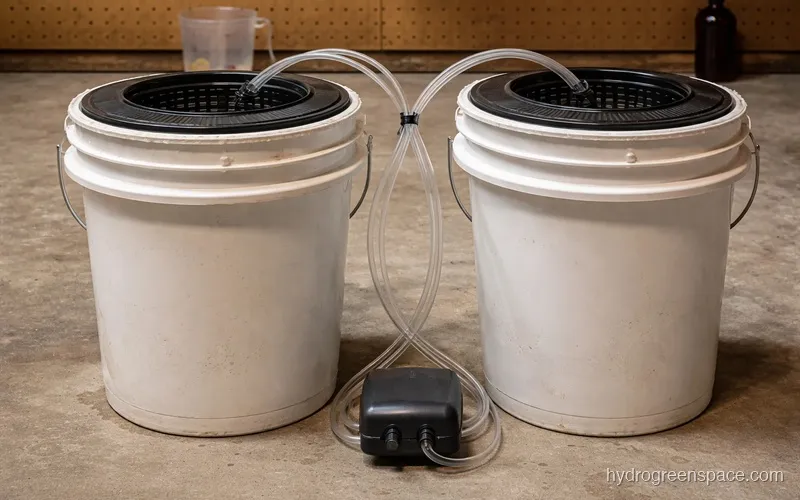
How to Build a Dual Bucket DWC System
This is a straightforward build. Plan for about 45 minutes the first time.
Step 1: Prep the Buckets
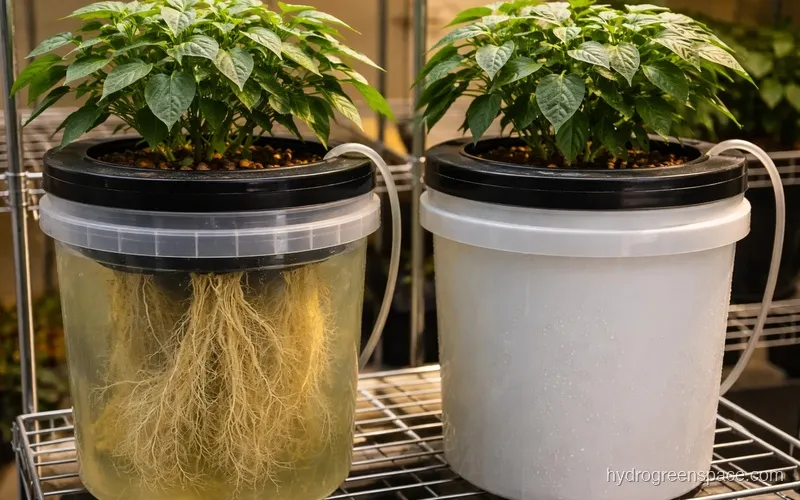
Standard 5-gallon buckets from a hardware store work fine, but they need to be opaque. Light reaching the nutrient solution causes algae growth, which competes with your roots and clogs the air stone. Black buckets are ideal. If you’re using white or translucent buckets, wrap them in black tape or sleeve them in a trash bag.
Drill or cut a hole in the center of each lid sized to fit your net pot snugly. A 3-inch net pot works for lettuce, basil, and most herbs. For tomatoes, peppers, or cucumbers, use a 6-inch net pot so there’s enough support for a heavier plant.
Step 2: Set Up the Air System
Place an air stone at the bottom of each bucket. Run a dedicated air line from each air stone up through a small notch in the bucket lid, or along the outside of the bucket, to a dual-outlet air pump placed above the water line.
The pump needs to sit above the water line. If power cuts out and the pump is below water level, the nutrient solution can siphon back into the pump and damage it.
A pump rated between 2–4 watts per gallon of total reservoir volume is adequate for most two-bucket setups. For two 5-gallon buckets at half-fill (about 3 gallons each), a 25–30 LPH pump handles both comfortably.
Warning: Never run a DWC setup without the air pump running. Roots sitting in still, unoxygenated water will begin to show stress within 24 hours and develop root rot within 48–72 hours. If you need to stop the pump for more than a few minutes, do it during a water change when the buckets are empty.
Step 3: Mix and Fill
Mix your nutrient solution in a separate bucket first, then pour into each grow container. This ensures both buckets start with identical pH and EC (electrical conductivity, a measure of nutrient concentration).
Target pH: 5.5–6.5 for most vegetables and herbs. If your pH is outside this range, nutrient lockout happens even when the nutrients are present in the water.
Target EC: depends on the plant and growth stage. For seedlings, 0.8–1.2 mS/cm. For established vegetative growth, 1.2–2.0 mS/cm. For flowering or fruiting stages, 2.0–2.8 mS/cm.
If you want to understand the underlying nutrient logic before you start mixing, how to feed hydroponic plants covers the full approach.
Fill each bucket to about 1–2 inches below the bottom of the net pot. You want the roots to reach down to the water without the net pot itself sitting in the solution.
Step 4: Plant Your Seedlings
Start your seedlings in rockwool starter cubes or small plugs before transferring to the net pots. Place the cube in the net pot and fill around it with clay pebbles for support. The clay pebbles hold the seedling upright and allow the roots to reach down into the nutrient solution as they develop.
Place one seedling per bucket. That’s it. One plant per container is the rule for healthy root development and stable nutrient uptake.
What to Grow in a 2-Plant DWC Setup
The best plant combinations share similar nutrient requirements and growth timelines. Two plants that want different EC levels, different pH ranges, or dramatically different water volumes will force you to compromise on one of them.
Pairs that work well:
- Two tomato plants (same variety): identical care, double the fruit
- Tomato and pepper: close enough in nutrient needs to manage in the same schedule
- Lettuce and basil: both prefer lower EC, fast turnover, good for cycling crops
- Two pepper plants: compact root systems, manageable nutrient demand
- Two cucumber plants: fast-growing, benefit from the dual reservoir volume
Pairs to avoid:
- Lettuce with tomatoes: lettuce needs lighter nutrient solutions than fruiting tomatoes; you’ll either overfeed the lettuce or underfeed the tomatoes
- Herbs with root vegetables: root vegetables need different pH ranges and don’t thrive in standard DWC setups
For your first run, two plants of the same variety eliminates one variable. You’re learning how the system behaves, not also learning how different plants respond to the same conditions.
Managing Two Buckets Day to Day
Running two independent buckets isn’t double the work. It’s more like 10 extra minutes per week compared to one bucket.
Daily: Check that both air pumps are running. A quick visual is enough: you should see bubbles in the nutrient solution.
Every 2–3 days: Check water levels and top off with plain pH-adjusted water (not nutrient solution). Plants drink water faster than they consume nutrients, so the nutrient concentration rises as the water level drops. Topping off with plain water keeps EC from climbing too high.
Weekly: Test pH in both buckets. Even if you started at the same pH, microbial activity and plant uptake can pull them in different directions. Adjust back to the target range with pH up or pH down solution.
Every 7–14 days: Full reservoir change in both buckets. Mix fresh solution, drain both buckets, refill. This prevents salt buildup and keeps the nutrient balance accurate.
The RDWC Question, Answered Plainly
There’s one meaningful downside to connecting two buckets in a recirculating setup that the scale argument doesn’t account for: if one plant develops root rot or a pathogen, the circulating water carries it to the second plant immediately. In a two-bucket independent setup, a problem in one bucket stays in one bucket.
For a small food garden with two plants, that cross-contamination risk outweighs the minor convenience of shared management. Save RDWC for when you’re running four or more plants and the separate-bucket maintenance becomes genuinely burdensome. When you get there, the RDWC equipment list lays out exactly what a proper recirculating system requires.
Upgrading From Your First Bucket
If you’re coming from a single-bucket setup and adding a second plant, the process is simple. Build a second bucket identical to your first. Use the same nutrient solution and the same pH target. Run both air stones from a dual-outlet pump, or keep a separate small pump for the new bucket.
That’s the whole upgrade. The DIY DWC system guide covers the base build if you want to reference the single-bucket version while you’re at it. For the full picture of every system you can build with buckets and totes at any plant count, the DIY hydroponic systems guide lays out every option.
The real value of running two plants instead of one shows up at harvest. You can stagger planting by two to three weeks so you’re not processing everything at once, which is particularly useful for lettuce and herbs that produce in a single flush. Plant one bucket, wait two weeks, plant the second. You’ll have a continuous harvest instead of a single large batch.
When you’re ready to go further, scaling up to three plants is the natural next step, and the same bucket logic extends cleanly.