What Is Hydroponics? The Complete Beginner's Guide
Hydroponics is one of those ideas that sounds more complicated than it is. Strip away the technical vocabulary and you’re left with a simple concept: instead of anchoring a plant in soil and hoping the soil delivers what it needs, you deliver everything directly to the roots in water. That’s it. No soil required, no complicated chemistry degree needed, and no, you don’t need a greenhouse or a warehouse to do it.
This guide covers everything a home grower needs to understand hydroponics from the ground up (forgive the pun). You’ll learn what the word actually means, how the mechanics work at the root level, which system types exist and how they differ, what you can grow, whether it’s worth the cost and effort, and links to every in-depth guide you’ll need as you go further.
If you’ve ever grown anything in soil and wondered whether hydroponics was worth exploring, or if you’re completely new and this is your starting point, you’re in the right place.
What Does Hydroponic Mean?
The word comes from the Greek roots “hydro” (water) and “ponos” (labor or work). Literally: water working. The term was formalized in the 1930s by William Gericke, a University of California researcher who grew 25-foot tomato vines in his backyard using a nutrient solution instead of soil, and needed a respectable name for what he was doing.
But the practice is far older than the name. The Aztec chinampas, floating garden islands built on lake beds, were a form of water-based growing. Ancient Egyptian murals show plants growing in water-filled bowls. What Gericke did was turn a scattered set of observations into a defined system with reproducible science behind it.
For a deeper look at where hydroponics came from and why that history still matters for your setup today, see History of Hydroponics: From Ancient Roots to Today.
How Does Hydroponics Work?
Soil isn’t magic. It’s a delivery system. It holds nutrients, provides physical support for roots, and retains moisture. When you understand that, the idea of replacing it stops feeling strange.
In a hydroponic system, plant roots grow directly in a nutrient solution (water mixed with the mineral nutrients a plant needs), or in a neutral growing medium like rockwool, perlite, or clay pebbles that holds roots in place while nutrient-rich water moves through or around them. The roots get oxygen, water, and nutrients all at once, without any of the competition or variability that comes with soil.
Because you control exactly what goes into the nutrient solution, and because roots can absorb nutrients directly without expending energy breaking down organic matter, hydroponic plants typically grow 20-50% faster than their soil-grown counterparts under the same light.
The question “does hydroponics require soil or just water and nutrients?” gets at this exactly. The answer is: just water and nutrients, supported by a growing medium that’s not soil. The plant doesn’t care about soil. It cares about the minerals, oxygen, and moisture that soil normally provides.
For a complete breakdown of what happens at the root zone and why direct nutrient delivery changes growth rates, see How Hydroponics Works: Nutrients, Roots & Systems.
Hydroponics vs Soil Growing
Most people who find their way to hydroponics aren’t starting from scratch. They’re already growing in soil and asking a real question: is this actually worth switching?
The honest answer is: it depends on what you’re growing and what frustrates you about soil right now. Hydroponics gives you faster growth, better water efficiency (up to 90% less water than conventional soil gardening), and much finer control over plant nutrition. Soil gives you a more forgiving margin for error, lower startup costs, and a more familiar workflow.
The comparison matters most for indoor growers. Soil indoors means more weight, more mess, more pest pressure from fungus gnats, and less precise control. Hydroponics indoors flips all of those.
For a side-by-side breakdown of growth rate, yield, cost, taste, and what actually wins in each category, see Hydroponics vs Soil: An Honest Comparison for Home Growers.
Different Types of Hydroponic Systems
There are six or seven main system types depending on how you count them, and they’re not interchangeable. The right system for growing lettuce in a small apartment is completely different from what you’d build to grow tomatoes in a garage.
Here’s a quick orientation:
- Deep Water Culture (DWC): Plants suspended in net pots with roots hanging directly into a reservoir of oxygenated nutrient solution. Simple, fast, and one of the best systems for beginners.
- Nutrient Film Technique (NFT): A thin film of nutrient solution flows continuously through angled channels past bare roots. Excellent for leafy greens and herbs, not suited for heavy fruiting crops.
- Kratky Method: A passive variant of DWC with no pump. Roots grow down as water level drops, and an air gap naturally forms above the solution. Almost zero maintenance.
- Ebb and Flow (Flood and Drain): A grow tray floods with nutrient solution on a timer, then drains back to the reservoir. Versatile and easy to scale.
- Drip Systems: Nutrient solution drips continuously or at intervals onto the base of each plant. Common in commercial operations and garage grow rooms.
- Aeroponics: Roots hang in air and are misted with nutrient solution at intervals. Fastest growth rates of any system, but also the most technically demanding.
- Wick Systems: Nutrient solution wicks up into the growing medium passively. Very low-tech, but limited to small plants with modest nutrient demands.
Which one should you start with? For most beginners, DWC or Kratky. For herbs and lettuce at any scale, NFT. For someone who wants to experiment with multiple crops without committing to one system, ebb and flow.
For a full explanation of how each system works, its pros and cons, and how to match a system to what you actually want to grow, see Different Types of Hydroponic Systems Explained.
What Can You Grow Hydroponically?
Most edible plants grow very well hydroponically. The fastest results and simplest systems come from leafy greens (lettuce, spinach, arugula, kale), herbs (basil, cilantro, mint, parsley), and small fruiting plants (cherry tomatoes, peppers, cucumbers, strawberries).
Larger fruiting crops like full-size tomatoes, squash, and melons are absolutely doable but need sturdier systems, more nutrients, and physical support structures for the vines. Root vegetables like carrots and potatoes are the one category where hydroponics gets awkward since the “root” you’re harvesting needs room to develop in a medium.
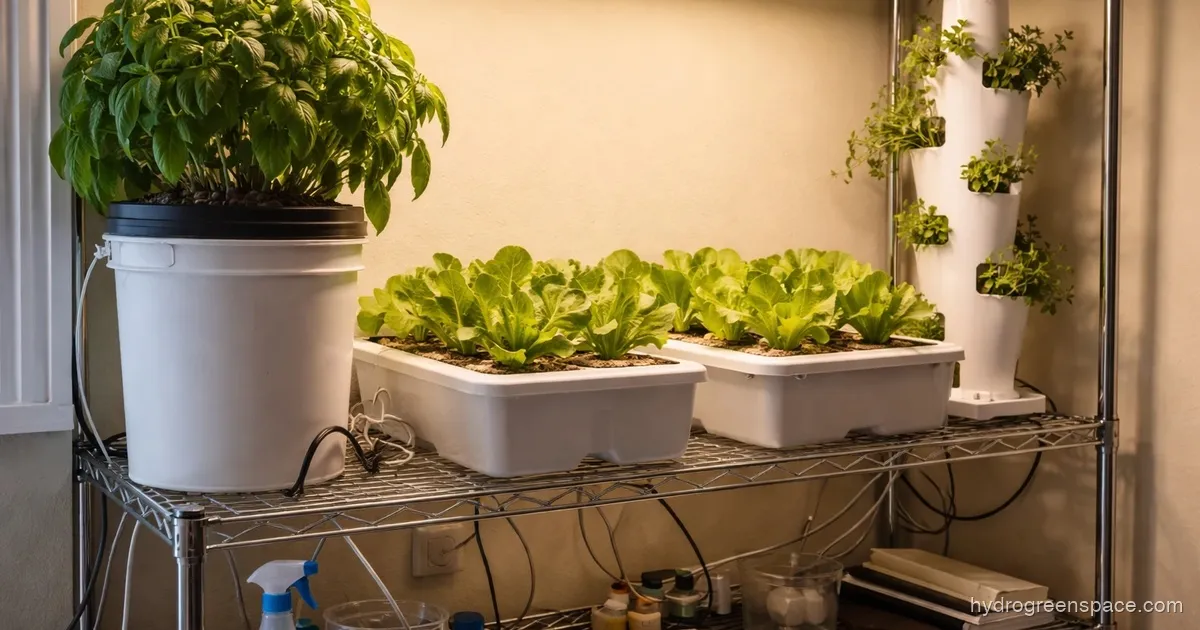
For a home grower, the sweet spot is herbs and salad greens. You can run a 12-site NFT channel or a row of Kratky jars, harvest continuously, and have fresh produce year-round in less than 10 square feet.
Why Hydroponics Matters Beyond Your Kitchen
The case for hydroponics isn’t just about faster basil. Conventional agriculture uses roughly 70% of the world’s freshwater, degrades topsoil at a rate faster than it regenerates, and ships food thousands of miles before it reaches a plate. Hydroponics sidesteps most of that.
A well-designed hydroponic system recirculates water, meaning runoff goes back into the reservoir rather than into the ground. It requires no pesticides when managed well (no soil means far fewer soil-borne pests and diseases). It can produce food year-round regardless of climate or season. And vertical hydroponic farming can grow the same volume of crops in a fraction of the land footprint.
The honest caveat, though: hydroponics uses electricity for pumps, lights, and climate control. That’s a real environmental cost that a backyard soil garden doesn’t have. Whether the trade-off makes sense depends on where your electricity comes from and what you’re replacing.
For the full breakdown of hydroponics’ environmental impact, including water use, pesticides, food miles, and the electricity problem, see Is Hydroponics Good for the Environment? The Full Answer.
Who Uses Hydroponics?
The short answer: a lot of different people with almost nothing else in common.
Retired teachers with a spare bedroom. Apartment dwellers who want fresh greens in a 4x4 space. Commercial farmers running 50,000-square-foot greenhouse operations. Researchers feeding astronauts. Urban farming collectives growing food in repurposed shipping containers. Schools using hydroponics as a hands-on science curriculum.
The reason such different people land on the same technique is that hydroponics solves different problems for each of them. For the apartment grower, it’s space and soil mess. For the commercial farmer, it’s yield and consistency. For NASA, it’s life support in a controlled environment.
To understand who’s actually doing this and why, see Who Uses Hydroponics? From Home Growers to NASA.
The Real Problems with Hydroponics (And What to Do About Them)
Every guide that only covers the upside is doing you a disservice. Hydroponics has real problems, and if you go in expecting it to be easy, you’ll quit after your first dead crop.
The startup cost is higher than soil. A decent beginner DWC setup runs $50-150. A serious grow room costs several hundred dollars before the first seed goes in. Power dependency is a real issue: if your pump fails and you don’t catch it within a few hours, you can lose an entire crop. And because all plants in a recirculating system share the same water, a root disease spreads fast.
The learning curve is steepest in the first 3-6 months. You’ll miscalibrate pH. You’ll overdose nutrients. You’ll have one failed crop and wonder if this was a mistake.
Most of these problems are solvable with good habits and the right starting point. But it’s worth understanding them honestly before you invest.
For a candid walkthrough of every major drawback, including who genuinely shouldn’t start right now versus who should push past these concerns, see Why Hydroponics Is Bad: Real Problems, Honest Fixes.
Is Hydroponic Food Healthy and Safe?
This question comes up constantly, and it’s a fair one. The short answer: yes, hydroponic food is safe and nutritionally comparable to conventionally grown produce. In some cases, it’s measurably better because you control the nutrient profile precisely.
The longer answer: the nutritional quality of any produce depends heavily on the growing conditions, the mineral content of the nutrient solution, and when the food is harvested. Hydroponic lettuce grown under proper light with a dialed-in nutrient solution and harvested fresh is going to outperform grocery store lettuce that spent a week in a cold chain.
Can Hydroponics Be Organic?
Whether hydroponic food can be called “organic” depends entirely on who you ask.
In the United States, the USDA has allowed hydroponic operations to receive organic certification since 2017, which means you can buy certified organic hydroponic produce at Whole Foods. In the European Union and Canada, organic certification requires soil as a growing medium, so hydroponics is explicitly excluded from organic labeling.
For a home grower, the label question is almost beside the point. You can grow with organic-approved liquid nutrients, skip synthetic pesticides entirely, and produce food that is cleaner than anything you can buy with a label. The certification debate is more relevant to commercial operations than to anyone growing herbs in their kitchen.
For the full breakdown of the certification debate, what “organic hydroponics” actually means in practice, and which nutrient sources work, see Can Hydroponics Be Organic? Certifications Explained.
Why Hydroponics Is Important Right Now
Soil has limits. It degrades. It gets depleted. It requires specific climates and consistent rainfall. It takes decades to regenerate once it’s gone. As the global population grows and freshwater becomes scarcer, the limitations of conventional soil farming become harder to ignore.
Hydroponics doesn’t fix those problems at a global scale on its own. But it contributes something meaningful: a way to produce food that is decoupled from soil quality, climate variability, and geographic constraints. Year-round growing. Smaller land footprint. Dramatically less water per pound of food produced.
For home growers, the importance is more immediate than global. Hydroponics means you can grow food anywhere, any time of year, in spaces where a garden is simply not possible.
For the full case, see Why Are Hydroponics Important? The Real Reasons.
If you’ve read this far, you have a solid picture of what hydroponics is, how it works, and what you’re getting into. The next move is to pick a starting point rather than keep researching.
If you’re brand new, read How Hydroponics Works next, then come back and choose a system from the types guide. If you’re already growing in soil and weighing a switch, go straight to the hydroponics vs soil comparison. Either way, the best thing you can do for your first crop is to start simple, start small, and let the system teach you.