
Brown Spots on Hydroponic Leaves: Causes & Fixes
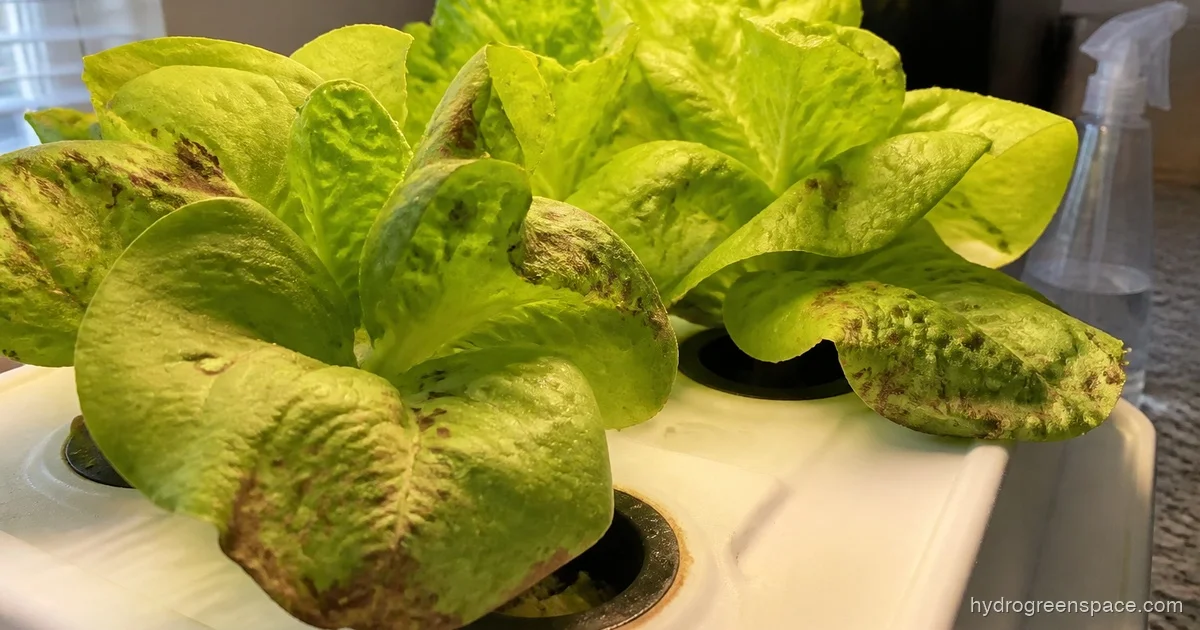
Brown spots on leaves in hydroponics are one of the most frustrating problems to diagnose because four completely different causes look almost identical at a glance. I’ve chased the wrong fix more than once, treating for nutrient burn when it was actually calcium deficiency, or dosing more nutrients when pH was the real culprit. The shortcut that actually works: look at where on the leaf the spot is before you touch anything.
Location tells you the cause almost every time. Once you know what you’re looking at, the fix is usually straightforward.
Where the Brown Spot Appears Is Your First Clue
Before you test your water, adjust your nutrients, or strip leaves, spend 60 seconds looking at your plants carefully.
Here’s what each location pattern usually means:
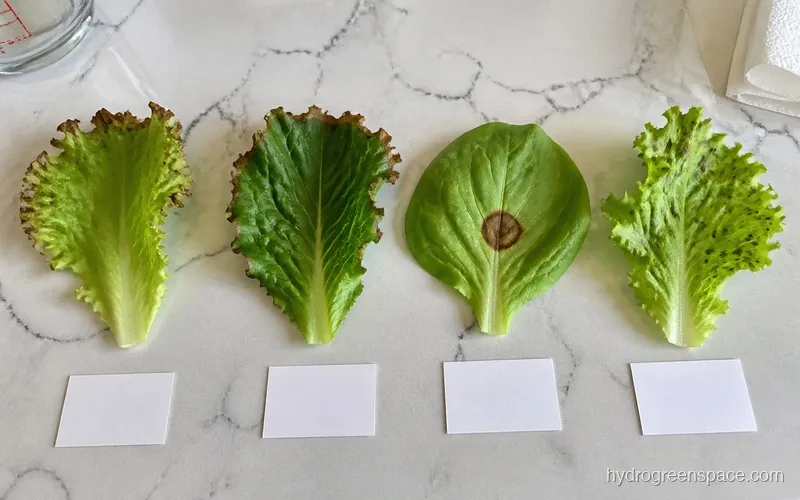
- Leaf tips only → Tip burn, usually from calcium deficiency or low transpiration
- Leaf edges (margins) → Nutrient burn from EC that’s too high
- Center or middle of the leaf → Fungal leaf spot or bacterial disease
- Random splotches across the whole leaf → pH lockout causing a secondary deficiency
These patterns overlap sometimes, especially in a system that has multiple problems at once. But start here. It eliminates at least two of the four causes immediately.
Leaf Tips Turning Brown: Tip Burn and Calcium Deficiency
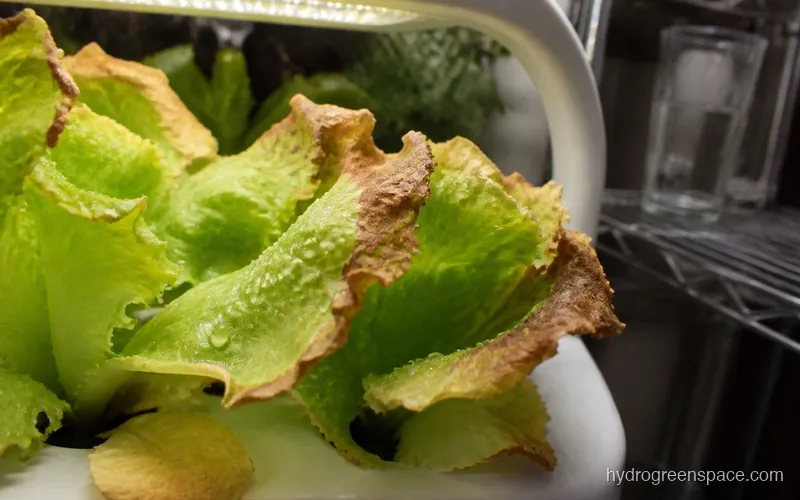
If you’re growing lettuce and the innermost, youngest leaves are showing brown crispy tips, that’s tip burn. It’s probably the most common brown spot problem for hydroponic lettuce growers and it’s not actually caused by a disease or a pest.
Tip burn happens when the plant can’t move calcium fast enough to the new growth. Calcium travels through the plant via transpiration (water moving up from roots through the leaves), and the innermost leaves on a head of lettuce don’t transpire much because they’re sheltered. Even when your calcium levels are fine in the reservoir, those leaves can still be calcium-starved.
The fix isn’t always adding more calcium. Often it’s improving airflow around the plant canopy so those inner leaves can actually transpire. A small fan pointed across the tops of your plants makes a bigger difference than adjusting your nutrient solution.
That said, if you’re seeing brown tips on outer leaves or across multiple plant types, calcium deficiency in the reservoir is more likely. Your EC might be fine but if you’re running a calcium-light nutrient formula, the ratio is off. Check your Part A/B ratios and make sure calcium is included.
For a closer look at how calcium fits into the broader picture, the nutrient lockout preventing absorption article covers how pH affects calcium uptake specifically.
Leaf Edge Browning: Nutrient Burn
Brown, crispy edges that work inward from the leaf margin, affecting older lower leaves first, is the classic sign of nutrient burn in hydroponics. Your EC is too high and the plant can’t handle the salt concentration in your reservoir.
This is a “too much of a good thing” problem. Either you mixed your solution too strong, your reservoir evaporated and concentrated the nutrients, or you’ve been top-feeding in a way that salts have built up around the root zone.
The fix is a reservoir flush and dilution. Drop your EC by 20-30% and see how the plants respond over the next week. The burned edges won’t recover, but new growth should come in clean. If your EC was within the recommended range, check whether your reservoir has been evaporating between top-offs without being diluted.
Warning: Don’t overreact to edge burn by flushing with plain water for days at a time. Plants still need nutrients. Dilute the solution, don’t eliminate it.
Center and Middle Spots: Fungal or Bacterial Disease
Brown spots that appear in the middle of a leaf, often with a yellow halo around them, are the one pattern that actually can spread to neighboring plants. This is fungal leaf spot or bacterial leaf spot, and it’s less common in properly managed hydroponic systems but not impossible.
Fungal issues thrive in high humidity, poor airflow, and warm reservoir temps. If you’ve had mold show up elsewhere in your system, including mold on your grow sponge, you already have a humidity or airflow problem that can lead to leaf spot.
The action steps here are different from nutrient problems:
- Remove affected leaves immediately and dispose of them away from your grow space
- Check your reservoir temperature (keep it under 68°F/20°C to slow pathogen growth)
- Improve airflow in the grow area
- If the problem is spreading despite those steps, a diluted hydrogen peroxide solution (3% H2O2, 1 part to 3 parts water) sprayed on leaves can help knock back fungal growth
One thing worth noting: not every center spot is fungal. Physical damage from water droplets sitting on leaves under strong grow lights can also create necrotic spots in the center of the leaf. If you’re misting your plants or have condensation dripping onto leaves, that’s worth ruling out first.
Random Splotches Across the Whole Leaf: pH Lockout
If the brown spots don’t fit any of the three patterns above and they’re appearing unpredictably across different parts of the leaf and on plants of different ages, pH lockout is the most likely culprit. Your nutrient solution pH might be drifting outside the absorption window, which means the plant literally cannot take up certain nutrients even when they’re present in the water.
In hydroponics, most nutrients are best absorbed between pH 5.5 and 6.5. Go above 6.8 and iron, manganese, and zinc start locking out. Go below 5.5 and calcium and magnesium become less available. The plant shows this as brown discoloration that looks almost like multiple deficiencies happening at once, because it is.
Check your pH first. Test at the reservoir and also at the root zone if you can. pH fluctuations in your system are more common than most beginners expect, especially if your water has high alkalinity or you’re not buffering properly.
If your pH has drifted, correct it gradually. A swing of more than 0.5 pH units in a few hours can stress the plant more than the lockout was. Aim for 5.8-6.2 as your target range and keep a log of your readings so you can spot drift patterns before they damage plants.
When It’s Not Just One Problem
Real systems don’t always give you clean, textbook symptoms. A plant stressed by pH lockout becomes more vulnerable to fungal infection. Tip burn on lettuce can happen alongside early nutrient burn if you’re running a rich solution in a poorly ventilated space. When multiple symptoms appear together, fix the pH first, then reassess everything else. pH is the foundation that everything else depends on.
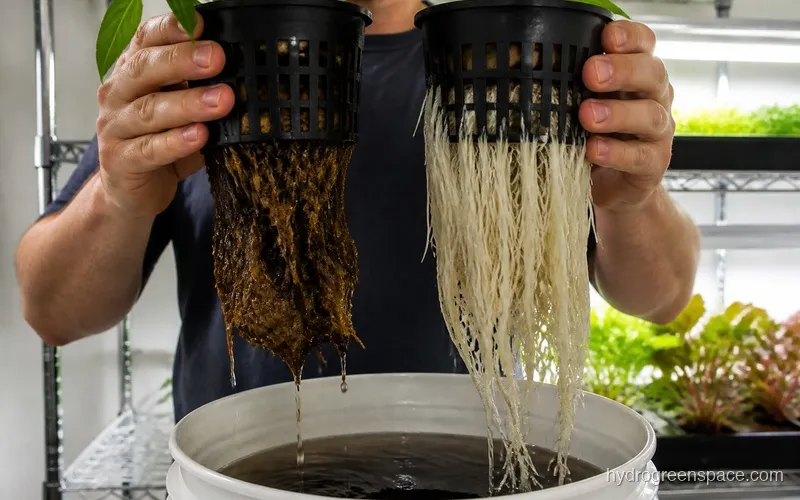
It’s also worth checking your roots if you’re unsure whether the problem is nutrient-related or disease-related. Healthy roots are white and firm. Brown, slimy roots point to root rot in hydroponics, which causes nutrient uptake failure that can look exactly like a deficiency on the leaves. The leaves might show yellowing leaves in your hydroponic system alongside the brown spots when root health is poor enough.
Ruling Out Leaf Damage That Isn’t Disease or Deficiency
Before spending time adjusting nutrients, rule out physical causes:
- Water droplets under intense grow lights can act as a magnifying glass and create burn spots in the center of leaves
- Leaves touching reservoir walls or air lines can get mechanical damage that looks like spots
- Cold drafts directly on leaves can cause localized discoloration
- Leaves curling in hydroponics are sometimes the first sign of environmental stress before brown spots appear
If your spots are perfectly round, appear only on leaves directly under your light, and your EC and pH are both in range, physical damage is a serious candidate.
A Quick Triage Checklist
When you spot brown spots, work through this order before changing anything:
- Where on the leaf? (Tips, edges, center, random)
- Which leaves are affected? (New growth, old growth, or both)
- What’s your current pH? (Test it now)
- What’s your EC? (Compare to recommended range for your crop)
- What does the root zone look like?
- Is airflow adequate around the canopy?
If you’re still stuck after working through this, the hydroponic troubleshooting guide covers the full diagnostic process from reservoir to canopy in one place.