
Hydroponic Strawberry Yield Per Plant: What to Expect
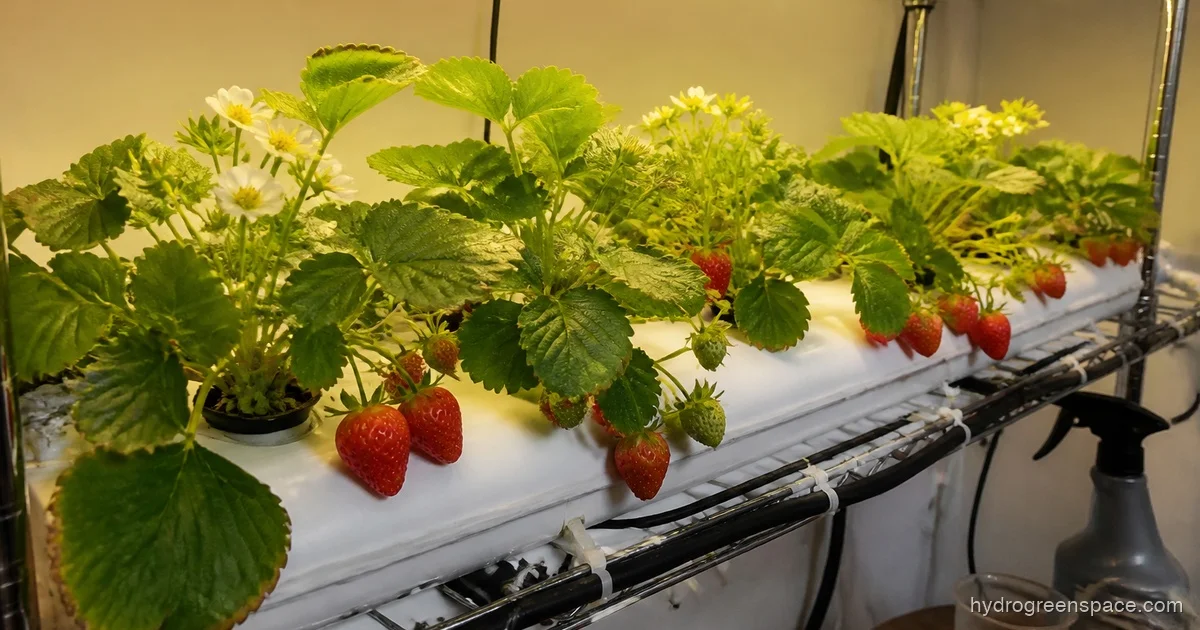
Most people start with the wrong question. They ask “how many strawberries will I get?” when they should be asking “what am I doing to either maximize or kill my yield?” Because the range is enormous: a neglected strawberry plant in an NFT channel might give you 80 grams of fruit over an entire season, while an optimized day-neutral plant in the same system can hit 400 to 500 grams. Same variety, same system, dramatically different results.
Here’s what the research and real grower data actually show, and more importantly, what moves the needle.
What the Numbers Actually Look Like
A reasonable baseline for hydroponic strawberry yield per plant in a home setup is 0.5 to 1 pound (roughly 225 to 450 grams) over a full growing season. That’s for a well-managed day-neutral or everbearing variety with decent light and a dialed-in nutrient solution. Under optimized conditions with a high-performing variety like Albion or Monterey, some growers push past 1.8 pounds (800 grams) per plant.
Before those numbers mean anything, you need the context they come with.
By system type:
| System | Typical Yield Per Plant | Notes |
|---|---|---|
| NFT (Nutrient Film Technique) | 0.5 – 1.0 lb | Reliable, good oxygen exposure |
| DWC (Deep Water Culture) | 0.4 – 0.9 lb | Works well, watch root temps |
| Tower / Vertical PVC | 0.3 – 0.7 lb | Lower per-plant, but high density |
| Ebb and Flow | 0.5 – 1.0 lb | Consistent if timed right |
Tower setups like a DIY PVC garden tower yield less per plant but let you fit far more plants in the same footprint. If you’re calculating total harvest rather than per-plant output, towers can win on square footage.
By variety:
Day-neutral varieties (Albion, Monterey, Seascape) are the clear choice for hydroponic production. They fruit continuously regardless of day length, which matters enormously when you’re growing indoors under artificial light. June-bearing varieties are bred around outdoor photoperiod triggers and tend to underperform in controlled environments. Choosing the right variety before you plant is the decision that sets your ceiling.
Runner Management Is the Biggest Yield Lever You Have
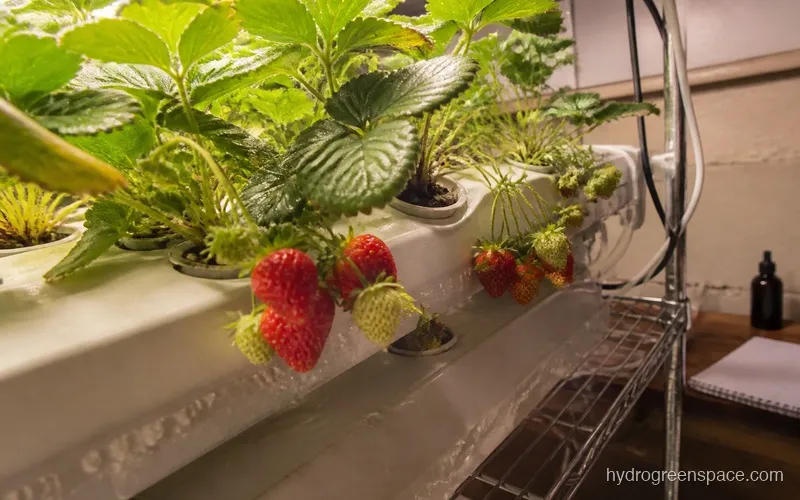
This is where most home growers leave fruit on the table, literally. A strawberry plant will send out runners (horizontal stems that want to root and become new plants) as fast as it can. The plant sees runners as reproductive success. But for you, every runner is a direct tax on fruit production.
Research on runner removal shows the impact clearly: plants allowed to run freely produce roughly 80 to 120 grams of marketable fruit. The same plants with runners consistently removed produce 400 to 500 grams. That’s not a marginal improvement, it’s a 4x difference.
The practical rule: check your plants twice a week and snip any runner the moment you see it. Don’t let them get established, don’t let them root into neighboring pots. Just remove them. The plant will try again, and you’ll remove those too. Over time it redirects that energy into flowers and fruit.
Managing strawberry runners in hydroponics covers the mechanics in detail, including what runners look like at different stages and the best tool to use without damaging the crown.
What I’d do: Set a phone reminder for Monday and Thursday to do a runner sweep. It takes 5 minutes but it’s the single highest-ROI task in strawberry growing.
Light Hours and What Happens When You Get It Wrong
Day-neutral varieties are more forgiving of photoperiod variation, but light duration still affects yield. The sweet spot for continuous fruiting is 14 to 16 hours of light per day. Drop below 12 hours and you’ll see slower flowering and fewer fruit set events per week.
More importantly, strawberries need a dark period. Running lights 24 hours doesn’t increase yield, it stresses the plant and often causes more runners and fewer flowers. Think of it like sleep deprivation for your crop.
If you’re not hitting the right light duration, it’s not just about intensity, it’s about schedule. A cheap outlet timer on your grow light fixes this for under $10.
Dialing In Your Nutrient Solution
Strawberries are moderate feeders compared to tomatoes or peppers, but they’re not as forgiving as lettuce. The nutrient EC (electrical conductivity) range that works best for fruiting is 1.4 to 2.0 mS/cm, with PPM roughly in the 700 to 1,000 range.
Go too low and you get weak plants that struggle to set fruit. Go too high and you’ll see tip burn and salt stress, which directly cuts marketable fruit weight. The key is that “marketable fruit weight” matters more than raw fruit count. Ten small, misshapen berries aren’t the same as five firm, full-sized ones.
During peak flowering and fruiting, bump toward the higher end of that range. When plants are young or you’re in a vegetative push, stay lower. For the full feeding picture, the guide on feeding hydroponic plants applies the same tiered approach that works for fruiting crops. A nutrient formula specifically tuned for strawberry fruiting phases is covered in detail at hydroponic strawberry nutrient solution.
Potassium is the one nutrient worth watching separately. It drives fruit quality and sugar content. If you’re using a general-purpose vegetable formula, you may need to supplement with potassium during fruiting. The difference in berry flavor is noticeable.

The Timing Curve: Don’t Expect Week-One Harvests
Hydroponic strawberries don’t fruit on a linear schedule. Most growers expect a ramp-up of 6 to 10 weeks from transplant to first harvest. After that first flush, a well-managed day-neutral plant in good conditions will flower and fruit in repeating waves rather than all at once.
What this means practically: don’t judge your system at week 3. The plant is establishing roots, adapting to the solution, and building the crown mass it needs to support heavy fruiting. Patience in the first two months pays off in the next six.
Once you hit peak production, a healthy day-neutral plant will produce for 12 to 18 months before performance drops enough to warrant replacement. Watch for reduced flower count and more runners appearing even after you remove them. That’s the signal the plant is winding down.
For a full breakdown of the timeline from transplant to first harvest, how long hydroponic strawberries take maps it out week by week.
Harvest Planning: If You Have X Plants, Expect Y
Here’s the math for planning your setup:
Assume 0.6 pounds per plant as a realistic mid-range for a well-managed home setup. That’s the number after accounting for imperfect pollination, occasional runner escapes, and normal variation.
- 4 plants: roughly 2.4 lbs per season (a good amount for fresh eating)
- 8 plants: roughly 5 lbs per season (enough to share and occasionally make jam)
- 16 plants: roughly 10 lbs per season (meaningful weekly harvest at peak)
These numbers assume you’re pulling runners, maintaining your nutrient solution, and getting solid pollination. If you’re skipping any of those, scale down. And pollinating your hydroponic strawberries matters more than most growers realize, especially indoors where there’s no wind or insects to do the work.
If you want to run the numbers for your specific setup before committing to plants and hardware, the hydroponic yield estimator lets you model expected harvest based on your system, plant count, and variety.
Are Hydroponic Strawberries Worth It Compared to Lettuce?
This is the honest question every strawberry grower asks at some point. The answer is: it depends what you’re optimizing for.
Lettuce is faster, simpler, and produces more frequently. Strawberries require more management, take longer to establish, and are more sensitive to nutrient imbalances. They’re also far more rewarding when you get it right. A hydroponic strawberry picked at full ripeness is a different fruit from what you buy at the store. There’s a reason growers stick with them even after the frustrating first season.
If you’re new to hydroponics, consider starting with an NFT or DWC system and getting comfortable with nutrient management before adding strawberries. The skills transfer directly. If you’re already growing leafy greens well, strawberries are the natural next challenge.
When you’re ready to expand beyond strawberries, the nutrient discipline and plant management habits you build here transfer directly to tomatoes, peppers, and other fruiting crops. The fundamentals are the same, just with higher stakes. If you’re still planning your first grow, the complete hydroponic strawberries guide covers system selection, variety choice, and nutrition in one place before you commit to hardware.