
Strawberry Runners in Hydroponics: Root or Remove?
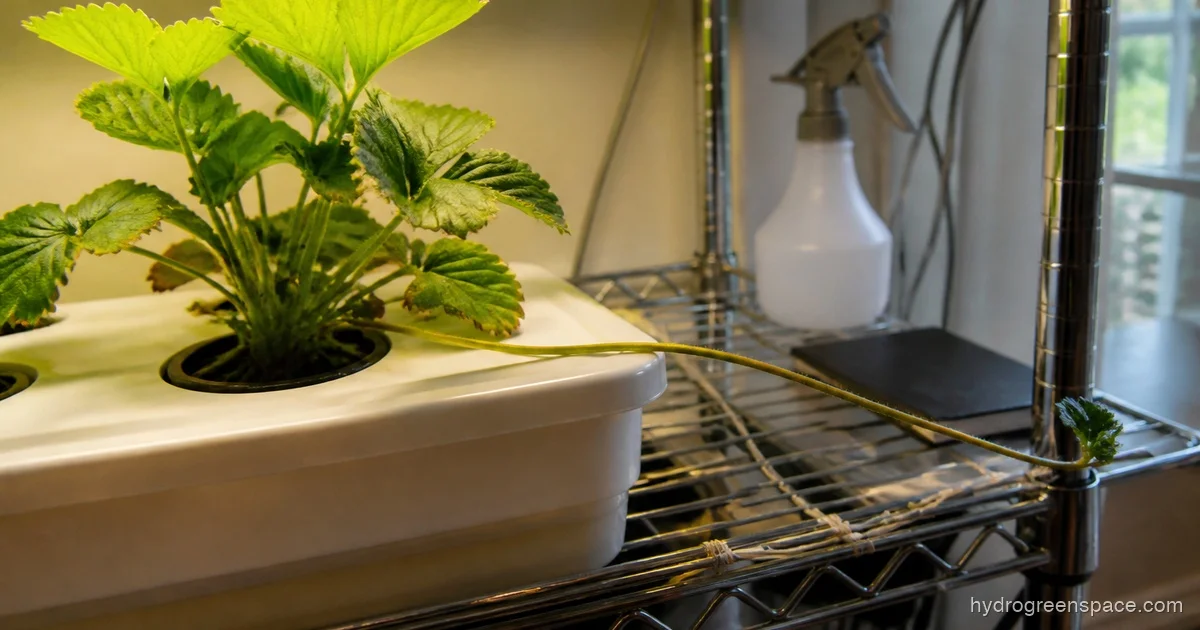
Every strawberry plant you grow hydroponically will eventually throw runners. These long, horizontal stems (called stolons) creep outward from the base and develop small plantlets at their nodes. What you do with them is one of those decisions that shapes your whole season.
The right answer depends on what you actually want from your system. This article covers how to make that call, how to root runners if you decide to keep them, and when to separate a rooted plantlet and transition it into its own space.
The Decision: Fruit Production vs. Free Plants
Before anything else, you need to decide what mode your system is in.
If you want maximum fruit output right now, cut every runner as soon as you see it. Strawberry plants have a fixed energy budget. Every stolon that develops draws from the same resources the plant would otherwise put into flowers and fruit. A plant with no runners running consistently puts noticeably more energy into berry production. During the peak fruiting window, a runner-free plant can produce 30 to 50 percent more fruit than one left to send out stolons unchecked.
If you want to expand your system without spending money on new stock, let a few runners develop and root them. This is vegetative propagation at its simplest. A rooted runner is genetically identical to the mother plant, skips the seedling stage entirely, and can move into its own net pot and begin fruiting in a fraction of the time a new crown would take.
The practical compromise that works well for most home systems: run your plants in full fruit-production mode for the first 12 months by removing all runners. Then, around months 12 to 14, allow two or three runners per plant to root so you are generating replacements before the original plants start declining. Day-neutral varieties, the ones worth growing hydroponically (Albion, Seascape, and Tristar being the standouts), typically start losing vigor after 18 to 24 months, so having rooted replacements ready matters.
For variety-specific notes on runner frequency and production cycles, the breakdown of best strawberry varieties for hydroponics covers what to expect from each cultivar.
What I’d do: Keep a running tally of how many runners you trim per week. If a plant that was producing heavily starts throwing three or four runners in a single week with fewer flowers, that is often a sign it is shifting energy toward vegetative growth. Cut the runners, check your EC, and make sure the plant is getting adequate light.
How Hydroponic Strawberries Produce Runners
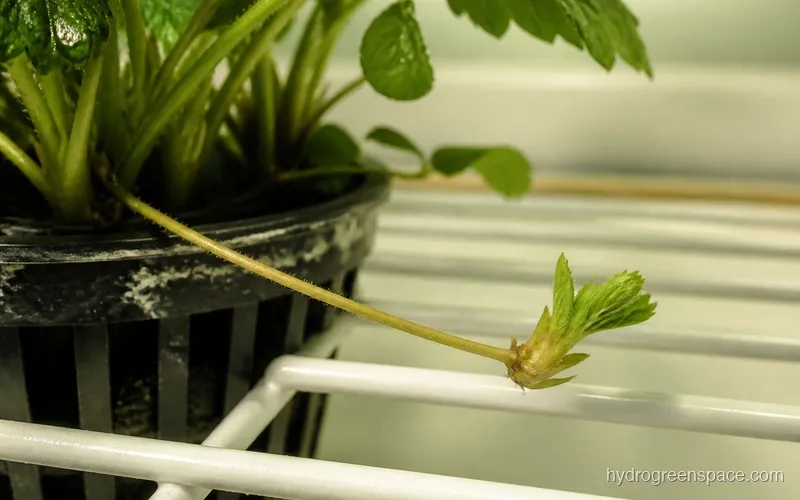
Understanding how runners work makes managing them easier. A runner is not a root, despite sometimes being called one. It is a modified stem (a stolon) that grows horizontally from the crown, usually at a leaf axil. At intervals along that stem, the plant produces nodes, and at each node sits a plantlet: a miniature version of the mother plant with a small leaf cluster and the beginning of a root structure.
In soil, those plantlet nodes touch the ground, roots push out, and in a few weeks you have a new plant. In hydroponics, the node is hanging in the air next to your system, and nothing happens unless you intervene.
A healthy, well-fed plant in a productive hydroponic system can generate three to five runners per month once it is fully established. Plants in a more stressed state, whether from low nutrients, suboptimal pH, or inadequate light, tend to produce fewer runners, but the ones they do produce still draw energy from the system.
If you are learning how to set up a hydroponic strawberry system at home, getting comfortable with runner management is one of the maintenance habits worth building early.
Rooting Runners Hydroponically: Step by Step
If you decide to propagate, here is how to do it correctly. The goal is to root the plantlet node while it is still attached to the mother plant. Cutting it free first and hoping it roots on its own is not a reliable approach.
What You Need
- Rapid Rooter plugs (primary recommendation), rockwool cubes, or coco coir plugs
- A shallow propagation tray or small net pots
- A dilute nutrient solution (EC 0.4 to 0.6, pH 5.8 to 6.0)
- Hairpins, toothpicks, or small wire clips to anchor the node
The Process
Step 1: Identify a mature plantlet node. Look for a node that has at least three small leaves developed and shows a small nub of pre-root tissue at the base. A node that is just a tiny bud is not ready.
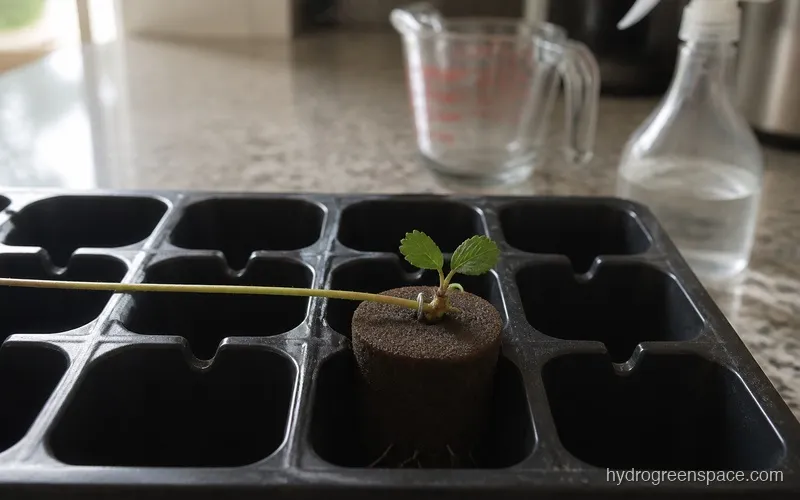
Step 2: Prepare your propagation medium. Soak Rapid Rooter plugs in plain pH-adjusted water (pH 5.8) for 10 to 15 minutes, then squeeze gently until they stop dripping. Do not oversaturate. For rockwool cubes, soak in pH 5.5 water for at least an hour before use. For coco coir plugs, moisten to the consistency of a wrung-out sponge.
Step 3: Position the node on the medium. Rest the plantlet base directly onto the center of the plug or cube. Pin it in place using a hairpin or bent piece of wire so the base has firm contact with the medium. You do not need to bury it; firm surface contact is enough.
Step 4: Keep it humid and do not overwater. Set the tray somewhere it gets ambient light or very low-intensity grow light. Direct, full-intensity light stresses unrooted plantlets. Keep humidity around 65 to 75 percent if possible. Mist the medium if it starts to dry out, but avoid saturating it. Soggy Rapid Rooter plugs will rot the base of the plantlet before it roots.
Step 5: Wait. Roots typically emerge in 10 to 21 days. Rapid Rooter plugs tend to be the fastest in my experience because they drain well and resist the waterlogging that slows rockwool. For a detailed comparison of the two, Rapid Rooter plugs vs rockwool for propagation is worth reading before you choose.
Warning: Do not cut the runner from the mother plant until you can clearly see root tips emerging from the bottom of the plug or cube. Cutting early is the most common reason propagated plantlets fail. If in doubt, wait another week.
Alternative Rooting Media
Rockwool: Works well, but needs to be pre-soaked thoroughly and the pH must be corrected before use (rockwool is naturally alkaline). For a full overview of rooting runners in rockwool, the technique is the same as above with the additional pH prep step.
Coco coir: A forgiving medium for propagation because it retains just enough moisture without becoming waterlogged. The buffering capacity also reduces the margin for error on pH. More detail on using coco coir as a rooting medium covers the prep process.
Water: Rooting strawberry runners in water is possible but produces fragile, hair-like roots that struggle when transitioned to a nutrient solution environment. It is slower than plug-based methods and the transition shock is higher. I would reach for Rapid Rooter plugs over a cup of water every time.
For a broader overview of options, choosing a growing medium for rooting compares the full range.
When to Separate and Transition Into the Main System
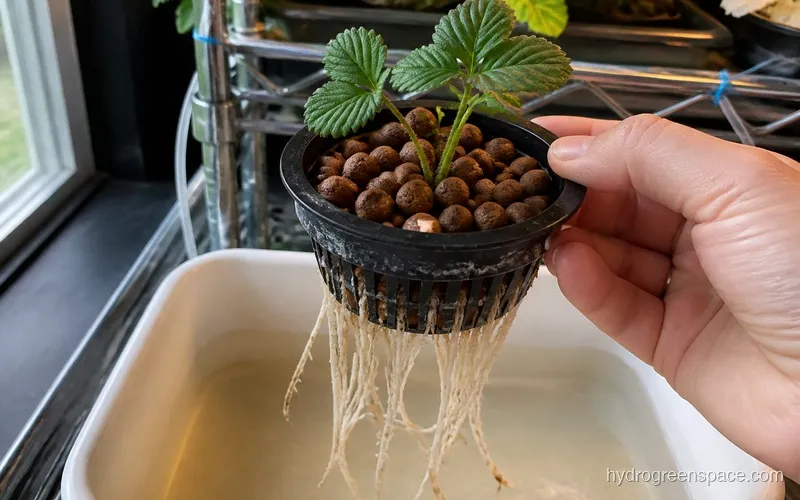
The plantlet is ready to separate from the mother plant when it has a visible root system emerging from the propagation medium (usually a few roots at least an inch long visible from the bottom of the plug) and is showing active new leaf growth on its own.
At that point, cut the runner cleanly between the plantlet and the mother plant. Leave a short stub of runner attached to the plantlet; cutting flush with the base can damage the crown.
Now you have a rooted plug ready for the main system. This transition is similar to transplanting your rooted runner into the system: set the plug or cube into a net pot, backfill lightly with clay pebbles, and drop it into a system running a low nutrient concentration (EC 0.8 to 1.0) for the first week. The root system from a rooted runner is more established than a bare root crown, so the transition is usually smoother and faster.
Once the plant is established and actively growing, dial in your nutrient approach. For the specifics of feeding runner plants once established, that guide covers the schedule and ratios from establishment through fruiting.
Runner vs. Crown Propagation: Which Gives Better Plants?
Runner propagation (rooting stolons) is not the only way to expand a hydroponic strawberry system. Crown division, where you split a mature plant’s crown into multiple sections, each with its own root mass, is another option. Starting with bare-root strawberry plants is essentially a version of this, using commercially produced crowns rather than divisions from your own plants.
For most home growers, runners win on simplicity. The plantlet is already partially formed; you are just encouraging it to root rather than building a root system from scratch. Crown division takes more skill and has a higher failure rate if you are not experienced with it.
The downside of runner propagation is time. Each plantlet takes two to three weeks to root and another two to four weeks to establish in the system. If you need plants quickly, buying bare-root crowns is faster. If you are planning ahead and want to maintain your system at no additional cost, runners are the smarter long-term play.
For those interested in going further than runners, propagation techniques beyond runners covers crown division and tissue culture methods in more depth.
A Few Final Notes on Runner Management
One thing that trips up new growers: runners will often appear and develop quickly when you are focused on other parts of your system. Getting into a weekly habit of checking for new stolons and making a deliberate decision about each one (root it or cut it) keeps things from getting away from you.
If you are running a multi-plant system and want consistent production, designate one or two plants specifically for propagation at any given time. Let those plants run runners while the rest stay in full fruit-production mode. It is a cleaner way to manage the two goals without everything getting messy.
Once your rooted runners are established and producing, keep an eye out for crown rot and other diseases to watch for in young plants, since new additions to a system are the most vulnerable in their first few weeks. And if you are curious about what kind of output to expect from your growing population of plants, the guide on how many berries to expect per plant gives realistic numbers based on variety and conditions.
Getting runner management right means you can run the same system for years on free propagations from your own stock. That is when hydroponic strawberries stop feeling like a project and start feeling like a real operation. If you are still setting up your initial system or choosing varieties, the complete guide to hydroponic strawberries is worth working through before your first runners appear.