12 Common Beginner Mistakes in Hydroponics to Avoid
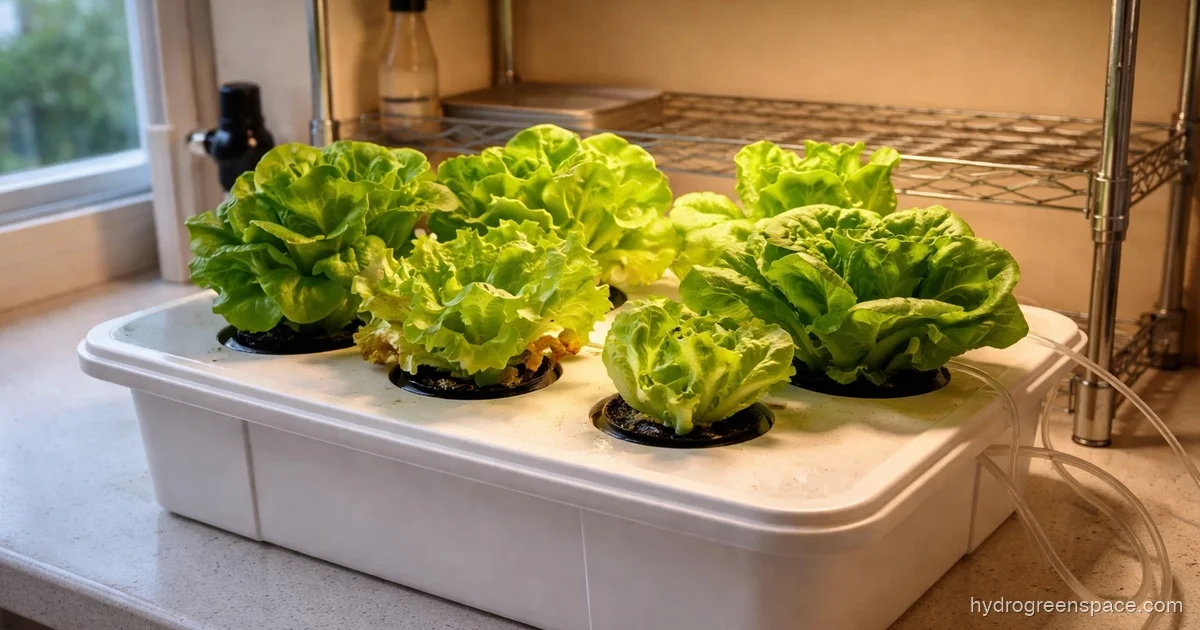
Most people who quit hydroponics in the first month didn’t fail because hydroponics is hard. They failed because nobody warned them about a handful of specific problems that hit beginners almost every time. This article covers 12 of the most common beginner mistakes in hydroponics, and more importantly, what to do instead.
If your plants are struggling, yellowing, or just not growing the way you expected, you’ll probably find the answer somewhere in this list.
Mistake 1: Ignoring pH Until Something Goes Wrong
This is the single biggest reason beginners lose crops. pH management in hydroponics isn’t optional background maintenance. It’s the job. When your reservoir pH drifts outside the 5.5–6.5 range, nutrients lock out even when they’re present in the water. Your plants show deficiency symptoms. You add more nutrients. The problem gets worse.
The ideal pH for hydroponics is 5.8–6.2 for most vegetables and herbs. Check it daily for the first two weeks. Once you understand how your system behaves, every other day is usually fine.
What to do instead: Buy a digital pH meter (not drops or strips), calibrate it with pH 4.0 and 7.0 calibration solution once a week, and check your reservoir before any other task. If you want to understand why pH keeps swinging even after you correct it, ph-fluctuation-problems covers the common causes in detail.
Tip: pH moves up when plants consume nutrients and down when CO2 dissolves into the water. A small daily drift is normal. A swing of more than 0.5 in 24 hours points to a root or microbial problem.
Mistake 2: Using Tap Water Without Testing It First
Tap water seems convenient, but it can work against you in two ways. First, most municipal water contains chlorine or chloramine. Chlorine off-gasses overnight if you let your water sit, but chloramine does not. It can inhibit beneficial root zone activity and affect nutrient availability. Second, tap water in many areas has a high TDS (total dissolved solids) reading, sometimes 300–500 ppm before you add any nutrients. That’s already eating into your headroom.
What to do instead: Test your tap water TDS before your first mix. If it reads above 200 ppm, you’re working with a compromised starting point. For high-TDS tap water, an RO (reverse osmosis) filter is worth the investment. If your TDS is under 150 ppm and you’re on a city chlorine supply (not chloramine), letting water sit overnight in an uncovered bucket will usually clear it. For more on this, water-quality-for-hydroponics walks through exactly what to test for.
Mistake 3: Picking a Complex System Before You’ve Grown Anything
Beginners often land on a drip system, NFT (nutrient film technique), or aeroponics because those setups look impressive online. They’re not wrong to want them eventually. The problem is that these systems require you to understand how your plants respond before you can dial them in. If something goes wrong, there are five possible failure points instead of two.
Starting with a Kratky or deep water culture setup gives you the fundamentals: you learn how roots look when healthy, how fast your plants drink, and how nutrients behave, all with minimal moving parts. Once you’ve run one crop successfully, different types of hydroponic systems will make a lot more sense because you’ll know which variables actually matter to you.
What to do instead: Start with a Kratky method setup or a 5-gallon bucket DWC system. Grow one full crop. Then upgrade.
Mistake 4: Overfeeding Nutrients
The label on your nutrient bottle is a starting point, not a target. Beginner hydroponic problems cluster heavily around overfeeding because it feels counterintuitive to feed less when plants look slow. But hydroponic plants grown indoors under modest LED lighting don’t have the metabolic demand to process high-concentration nutrient solutions.
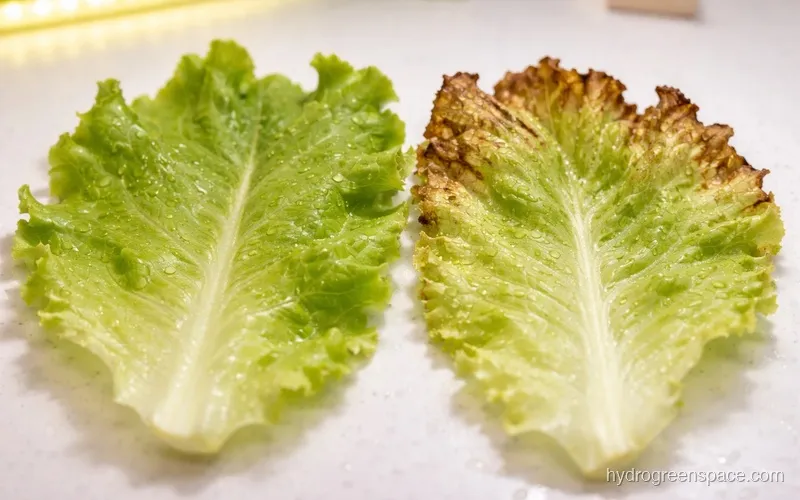
Nutrient burn shows up first on leaf tips, which turn brown and crispy. By the time you see it, the damage is done for those leaves. You can’t reverse burn, only correct the conditions so new growth comes in clean.
What to do instead: Start every nutrient mix at 50–75% of the recommended dose. Dial up only if you see deficiency signs after a week. For a full walkthrough on mixing properly, how to feed hydroponic plants covers the process step by step.
Mistake 5: Confusing Light Duration with Light Intensity
These are two completely separate variables. Duration is how many hours per day your lights run. Intensity is how much light actually reaches the plant canopy (measured in PPFD or roughly in lux).
Beginners often compensate for weak, cheap lighting by running lights for 20 or even 24 hours. That doesn’t work. A plant that needs 400 µmol/m²/s of PPFD doesn’t get that by running a weaker light longer. It just stays light-stressed and energy-depleted.
What to do instead: For most leafy greens, 16 hours on / 8 hours off with adequate intensity works well. For fruiting plants, 18 hours is common. Measure or look up the PPFD output of your specific light at the distance you’re hanging it. If you’re unsure what distance to use, grow-light-distance-from-plants covers this specifically.
Mistake 6: Letting Reservoir Temperature Get Too High
Warm water holds less dissolved oxygen. When reservoir temperature climbs above 72°F (22°C), dissolved oxygen levels drop and pathogens like Pythium (the most common cause of root rot) thrive.
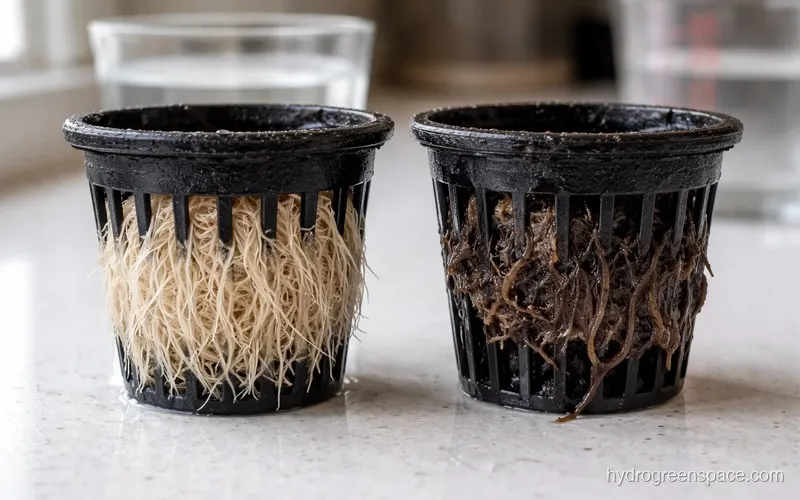
Most beginners don’t think about reservoir temperature because their setup looks fine. Then the roots go brown over a week or two, and by the time the smell hits, the crop is gone.
What to do instead: Keep reservoir temperature between 65–72°F (18–22°C). In a warm room, this sometimes means a small aquarium chiller or insulating your reservoir with foam wrap. A $15 aquarium thermometer tells you where you stand. For a complete guide on managing this, ideal-hydroponic-reservoir-temperature is worth reading before your first summer grow.
Warning: Drop the reservoir temp immediately, add H2O2 (3 ml of 3% per gallon as an emergency measure), and remove any dead root material. root-rot-hydroponics covers the recovery process in detail.
Mistake 7: Not Changing the Nutrient Solution on Schedule
Tap water chemistry and nutrient solutions both shift over time. Plants selectively uptake certain minerals, leaving others to build up and create imbalances. After 7–14 days, your solution is no longer what you mixed. The remaining ratios are off, and you’re essentially guessing at what your plants are getting.
What to do instead: Change your full reservoir every 7–10 days for active systems, or every 10–14 days for passive Kratky grows (just top off between full changes). When you do change, rinse the reservoir and any accessible root chamber. when-to-change-hydroponic-nutrients explains how to read the signs that a change is overdue.
Mistake 8: Skipping Aeration in Reservoir-Based Systems
Dissolved oxygen in the root zone is not a luxury. It’s required for nutrient uptake. Without adequate aeration, roots switch to anaerobic respiration, which is inefficient and creates conditions where root rot pathogens multiply.
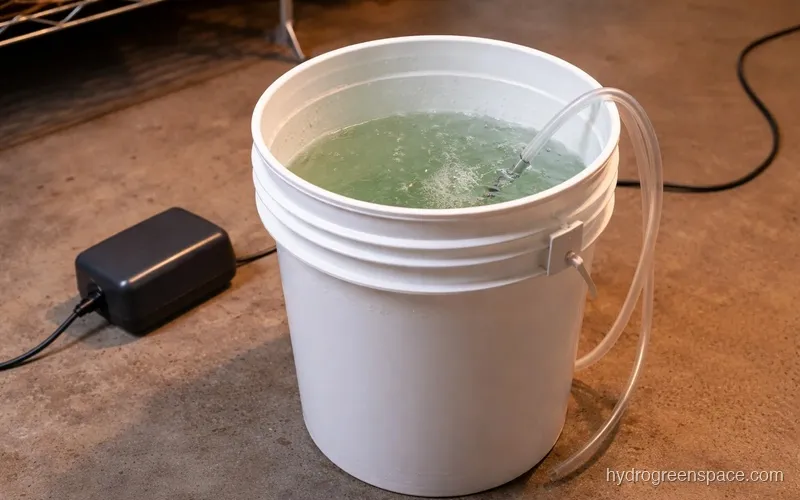
A lot of beginner setups use a simple tote or bucket without any air pump. This works for short periods in small Kratky grows with an air gap above the waterline. But in DWC or reservoir-based systems where roots are submerged, an air stone and pump are essential.
What to do instead: Use an air pump rated at roughly 1 liter per minute per gallon of reservoir volume. Run it 24/7. Replace air stones every 4–6 weeks as they clog and lose output efficiency.
Mistake 9: Planting the Wrong Crops First
Cherry tomatoes, peppers, and cucumbers are all great crops, but all wrong for a first hydroponic grow. These are long-cycle, high-demand plants that require months of stable nutrient management, pruning, support structures, and pollination. If anything goes wrong (and something always does when you’re new), you’ve lost weeks of investment.
What to do instead: Start with fast-growing leafy greens. Lettuce, spinach, and basil give you feedback in days, not months. You can see what grows well as a beginner and plan your crop rotation from there. Lettuce in a Kratky setup is ready in 4–5 weeks. You get a full feedback loop before the season changes.
Mistake 10: Letting Light Reach the Reservoir
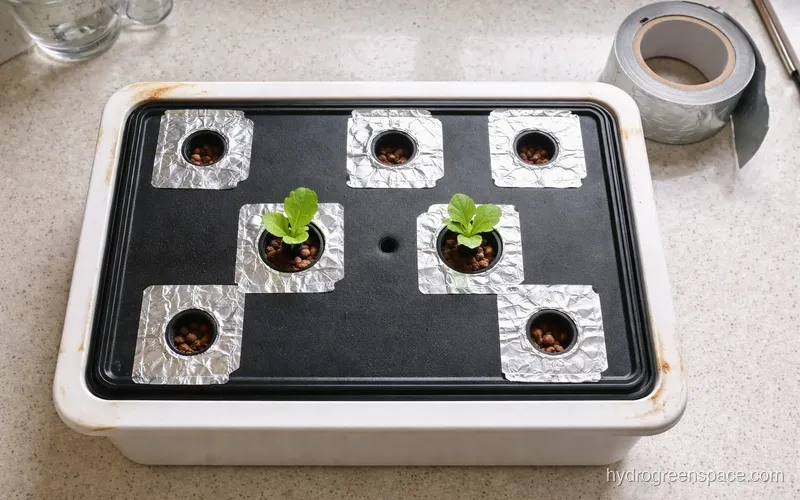
Algae growth is one of the first visual problems beginners notice, often green slime on the reservoir walls or around net pot collars. Algae competes for nutrients, consumes dissolved oxygen, and creates a breeding ground for fungus gnats and root pathogens.
The cause is almost always light penetrating the reservoir.
What to do instead: Cover every reservoir opening. Use opaque lids, black poly film, or aluminum foil tape around net pot holes. If your system is a clear or translucent container, wrap the outside in black material. Algae can’t grow where there’s no light.
Mistake 11: Skipping Sanitation Between Grows
Between crops is the best time to deal with problems you can’t see. Biofilm, root debris, and mineral deposits left in the reservoir and tubing carry pathogens into your next grow before the new plants have any chance to establish.
What to do instead: After each crop, clean everything with a diluted bleach solution (1 tablespoon per gallon of water) or food-grade hydrogen peroxide. Rinse thoroughly and let dry before refilling. This single habit eliminates most persistent root disease problems.
Mistake 12: Not Reading the Signs Early Enough
Yellowing leaves, slow growth, and wilting all have specific causes in hydroponics, and each one points to something different. Yellowing from the bottom up usually means nitrogen deficiency. Yellowing between veins on new leaves often points to iron deficiency caused by pH being too high. Wilting with healthy roots points to heat stress or light burn. Wilting with brown roots is root rot.
The earlier you learn to read these signals, the faster you can correct them. yellowing-leaves-hydroponics has a full diagnosis chart by symptom location and pattern.
What to do instead: Take photos every 3–4 days and compare. Changes that seem subtle in the moment are obvious when you look at a photo from four days ago. This is also how you catch nutrient lockout before it becomes a full deficiency.
If you’ve made several of these mistakes already, that’s normal. Every experienced grower has killed a crop to root rot, burned a plant with nutrients, or struggled with pH at some point. The difference between someone who quits and someone who gets good is just persistence through those first few grows.
The best next step depends on where you are. If you haven’t started yet, the beginner guide to hydroponics covers system selection, costs, and equipment before you spend a dollar. If you’re ready to build, how to build an indoor hydroponic garden walks through a full first setup. If you’re already a few weeks in and wondering what to expect, first 30 days of hydroponics covers the timeline and what’s normal vs. what needs fixing.